Have you thought about why some companies can seamlessly scale their technology while others have outages, delays, and an increase in operating costs? As the complexity of digital products and services increases, organizations will continue to experience a challenge—to stay competitive, they cannot rely on legacy manual infrastructure management. Organizations can move from slow provisioning to overcoming configuration errors, then to react quickly to changes in demand. Infrastructure automation is paving the way.
In the rapidly evolving technological environment today, organizations are constantly searching for means to become more efficient, provide enhanced reliability and scalability without the necessity of increasing engineering teams. The problem is clear: manual/wooden processes can no longer successfully handle the requisite pace of contemporary software engineering. This post will discuss exploring how infrastructure automation can solve the above problems, while exploring why it is essential for scaling technology efforts, and how Keploy fits into the larger context of automation. By the end, you will have an understanding not only of the critical reasons automation is important but also how it also changes the operational bedrock of budding businesses.
The Increased Complexity of Modern Infrastructure
With organizations adopting cloud-native architectures, microservices, hybrid-cloud deployment, and distributed systems, the operational environment is more complex than ever. To manage such systems via manual operations creates substantial risk:
-
Human errors in configuration
-
Long lead times for provisioning resources
-
Varying environments in development, testing, and production
-
Challenges scaling to meet traffic spikes
As user growth occurs and as product complexity grows, commonly the infrastructure and environments that supported a small product or user authenticating experience becomes cumbersome. This complexity leads to inefficiencies that directly affect, speed of innovation, customer experience, and cost controls.
In essence, infrastructure automation offers a way to work through that complexity. It establishes a series of mechanisms that allow systems to configure, scale, and manage themselves effectively, without requiring significant input from humans.
The Issues with Manual Processes
Manual processes for managing infrastructure could work perfectly fine for small teams or non-complex architectures, but they ultimately break down due to their inherent constraints and limitations once teams scale quickly. Some of the most notable limitations are:
1. Difficulties with Quickly Netscalable
When demand spikes, such as during product launches or sudden increases in traffic, provisioning resources manually becomes a bottleneck.
2. High rates of errors
Even highly experienced engineers can make mistakes, and in infrastructure, a simple misconfiguration can cause downtime or introduce security holes.
3. Engineers effectively not deployed efficiently
Highly compensated engineers are often assigned to low-value, menial maintenance tasks instead of spending time on innovation.
4. Critical reduction in visibility and control
When everything else is being done manually, it can become harder to tracking configuration changes and/or notice when an issue occurs.
These issues delay development cycles, worsen reliability, and increase operating costs. As organizations scale, the gap between what is needed and what manual operations can handle increases dramatically. This is exactly why infrastructure automation is no longer an option but instead is a foundational requirement for accelerating the development of technology-focused businesses.
How Infrastructure Automation Enables Scalable Growth
Infrastructure automation refers to managing IT environments with as little manual intervention as possible through tools, scripts, and automated workflows. The change that comes with this transition is transformational.
1. High Speed capability for Provisioning and Deployment
With infrastructure setup becoming automated, the time to provision new environments plummets. What could take days – or even weeks – can now be done in minutes.
2. Consistency in Environments
Through the automation of configuration management, teams establish a standard set of configurations across all three stages of the software development lifecycle development, testing, and production as well as improve overall reliability of software deployments. In an automated world, "it worked on my machine" is no longer a concern, poorly impacting software development’s reliability; using uniform environments reduces the potential for exposure to unanticipated problems arising during testing in production and increases smooth rollout and consistent behavior of systems in production.
3. Lower labor Operational Costs
Replacing manual processes of work cycles with automated work flow in these cases reduces labor costs and mitigates the risk of human error, all contributing to long term cost savings.
4. Improved Reliability of Systems
Automated infrastructure responds to changes in system health in real-time and therefore can have self-healing capabilities, such as auto-scaling, failovers, and automated rollbacks.
5. Improved Security and Compliance
Automation can consistently enforce security compliance thus providing compliance without encumbering engineering teams.
Essentially, infrastructure automation enables organizations to manage growth confidently—scaling, not stressing, or disrupting development workflows or wasting unnecessary finances.
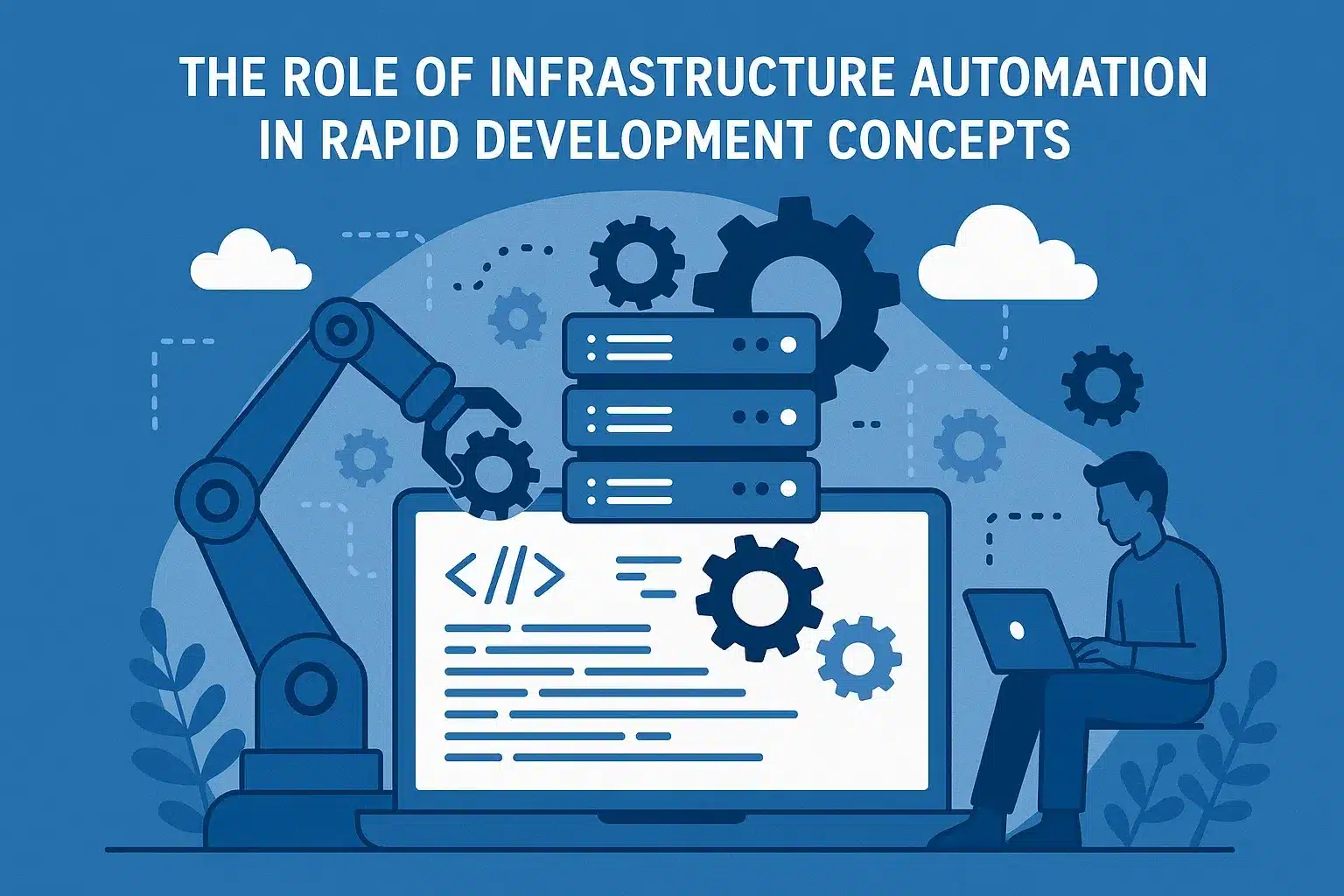
The Role of Infrastructure Automation in Rapid Development Concepts
For organizations following DevOps, or developing in a cloud-native environment, or under a microservices architecture here, infrastructure automation is not just beneficial; it is critical.
Supports Continuous Integration and Continuous Delivery (CI/CD)
Modern release cycles depend on predictable infrastructure. Automated environments reduce deployment friction and accelerate the delivery pipeline.
Eliminates Environment Drift
With manual processes, environments can gradually diverge, causing unexpected behavior. Automation keeps everything synchronized.
Enables Rapid Experimentation
Teams can spin up test environments quickly, run experiments, and make data-driven decisions without operational overhead.
Improves Collaboration Across Teams
Infrastructure automation provides shared visibility and reduces dependency on specialized operators, empowering cross-functional teams.
In a world where speed determines competitiveness, automation is a cornerstone of high-velocity engineering culture.
How Keploy Bolsters Infrastructure Automation
Infrastructure automation improves the provisioning and management of environments, but tools like Keploy provide automation in another key area: testing and reliability. Keploy automatically creates test cases and test data based on what it sees happening in a real-time application traffic environment, aiding teams in managing robust systems as they scale.
Here’s how Keploy fits into an automation-first strategy:
Automated test generation reduces the manual burden on developers.
Consistent test environments complement the consistency provided by infrastructure automation.
High test accuracy helps identify issues early, reducing risk in large, automated deployments.
Seamless integration with CI/CD pipelines is a way to guard quality without impacting teams performance.
Infrastructure automation looks after the “where” and “how” systems run, while Keploy strengthens the “what” by making sure applications behave as expected in automated environments. It’s the basis for building a strong ecosystem for efficient technology expansion.
Future Trends: Why Automation Will Increase
Some of the industry trends leading to the increasing use of automation are:
– AI-based resource management
– Autonomous operations (AIOps)
– Increased adoption of multi-cloud environments
– Increased need for reliability in distributed systems
– Shift from reactive to predictive
Organizations that start automating now will be in a better position to embrace these advancements and remain competitive in the future.
Conclusion: Scaling Technology Requires Smarter Infrastructure
As the digital world rapidly evolves, there’s now found time for manual infrastructure management. Infrastructure automation allows enterprise operations to grow their capacity, eliminate errors, increase reliability, and make development happen much faster and more efficiently. For that reason it is an essential enabler of growth by breaking down barriers and rebuilding an efficient operational machine status.
As products like Keploy continue to automate the testing of reliability of your applications and subsequently integrations to that application. Technology teams will be more focused on innovating, than performing repetitive tasks. Whilst scaling will always remain paramount, the future lies in doing things smarter -not harder- with automation being the key to that future.
FAQs
What is the significance of automation with infrastructure for scaling technology?
As systems grow in complexity, manual processes will become more time consuming and error-prone. Automating infrastructure allows for faster delivery of infrastructure as a service, less downtime, more consistency, and the ability to address greater workloads.
What difficulties do companies experience without automation for its infrastructure?
Organizations that depend on manual processes repeatedly get challenged by slow deployments, configuration drift, inconsistent environments, expensive outages, and can’t respond quickly to changes in demand.
What tools are commonly used for infrastructure automation?
Popular tools include Terraform, Ansible, Puppet, Chef, and Kubernetes. Additionally, platforms like Keploy complement automation by generating automated tests to ensure application reliability in changing environments.
Is infrastructure automation exclusive to large enterprises?
No. Startups, small, medium, and large enterprises can all utilize automation. In fact, smaller teams can benefit more than larger engineering organizations do when they implement automation and are able to scale without significantly increasing their engineering head count.
Does infrastructure automation improve security?
Yes. Automation limits the number of places where a security configuration can be misconfigured, it helps ensure compliance, improves visibility into changes to your systems, and helps enforce consistency; all of which have a positive effect on security.

Leave a Reply