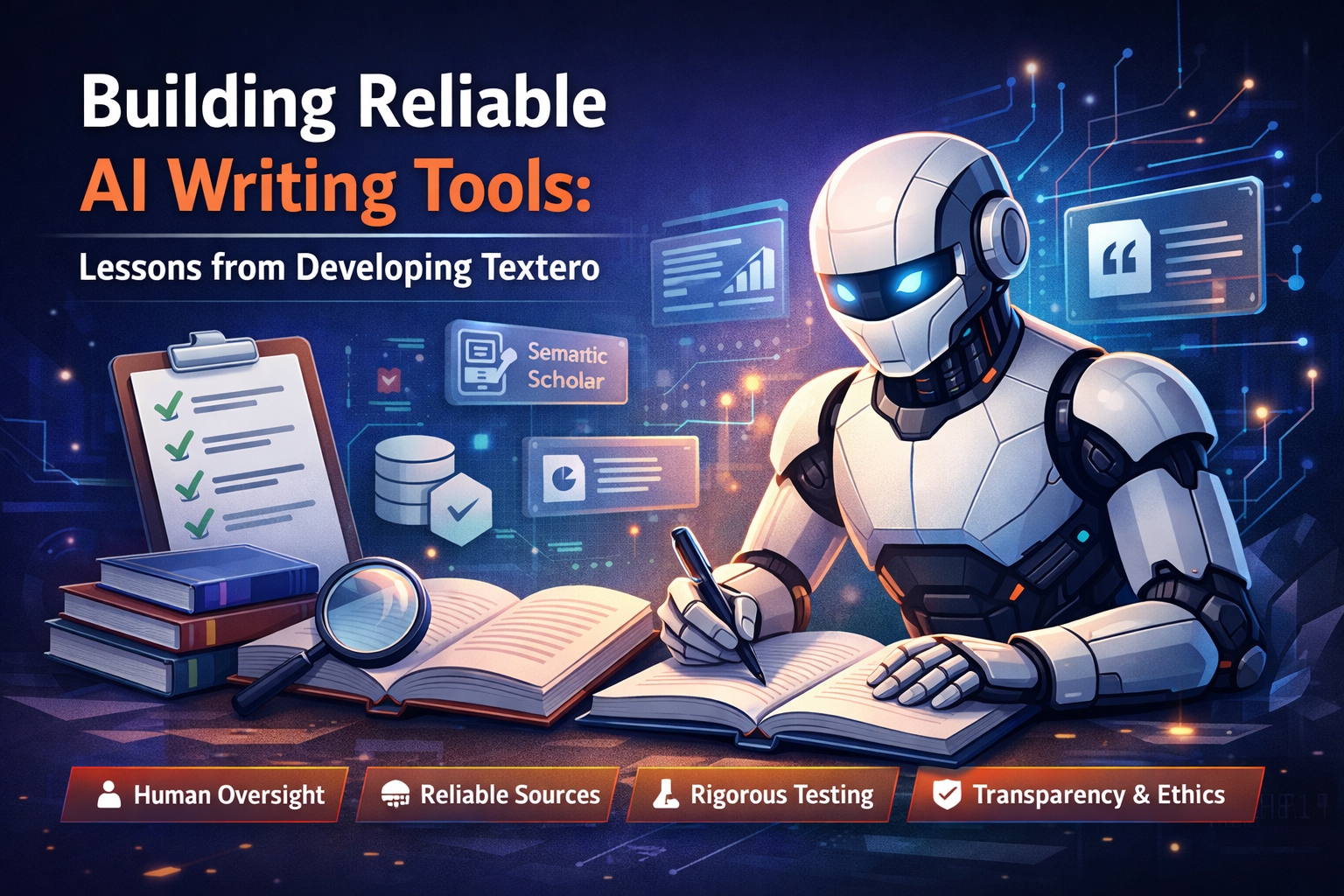
Creating AI writing tools is messier than you’d think. You start with this grand vision of an assistant that actually helps people write better, not just spits out generic text. Then reality hits. Models hallucinate. Users have wildly different needs. And suddenly you’re facing questions about responsibility, accuracy, and whether you’re building something genuinely useful or just another gimmick.
Textero’s development offers a fascinating case study. Unlike many AI writing tools that simply generate and walk away, this platform was built around a specific philosophy: keep humans in control, support the learning process, and don’t promise magic. That approach meant making some hard choices about what the tool should and shouldn’t do. Let’s break down what actually goes into building something reliable.
What “Reliable” Actually Means
- Keep humans in charge
AI reliability means being honest about what the tool can’t do. Textero’s whole setup focuses on helping you learn, not doing the work for you, which changes how everything functions. As an AI Essay Editor, it gives you feedback and suggestions without steamrolling your actual writing process. The interface lets you upload your own research and has citation tools that make it easier to keep your academic work honest. This matters because tools you can really trust don’t pretend they’re perfect, they build in spots where you can catch mistakes before they become problems.
- Make it make sense
A good AI content generator needs to create text that’s accurate, makes sense for what you’re doing, and actually helps. Textero handles this by connecting to academic databases like Semantic Scholar, so it pulls from real verified sources instead of just grabbing whatever pops up first online. What’s more, since it works with uploaded PDFs and URLs, it can focus on very specific topics. These features fix one of the biggest problems with AI writing: when it sounds very confident while saying complete nonsense.
- Focus on your purpose
Before writing any code, you must figure out exactly what problems your tool should solve and, just as important, what it shouldn’t try to do. Textero’s focus on academic writing for students and researchers gives clear limits that guide what features to build and help avoid trying to do too much. This focus makes it easier to pick the right training data, design useful features, and test whether the tool actually does what it promises. Generic writing tools that try to do everything end up not doing anything particularly well.
The Testing Challenge
- Why normal testing doesn’t work
Testing AI systems isn’t like testing a calculator. Large language model applications act differently each time: ask the same question twice and you might get two different answers. This makes life hard for people building these tools with hopes for consistent quality. Regular tests that check for exact outputs don’t work when the system is supposed to make unique content every time. So AI model testing needs to check if outputs are good enough and keep watching for problems over time.
- Testing for weird situations and tricky inputs
Real users don’t type perfect questions. They make typos, ask vague stuff, or try to trick the system. Good testing means throwing hard scenarios at the AI on purpose to see what happens. For academic writing tools, this means testing how it handles weird topics, sources that disagree with each other, or requests that might encourage cheating. The hard part is making test scenarios that cover all the ways students and researchers might actually use the tool, not just the perfect cases you imagine when building it.
- Your data decides your output
Your writing tool is only as good as what it learned from. Testing must include checking the training data hard for bias, gaps, and quality problems. Textero learned from millions of real essays and academic sources, which gives it a base in how scholarly writing works, but testing needs to keep checking that this training works across different school subjects and writing styles. This means keeping different versions of datasets and adding more data to test scenarios that might not show up much in training.
What It Can Do vs What Users Control
- The urge to overhype
AI companies face huge pressure to hype what they can do. The market rewards big claims about AI, but building tools you can trust means fighting this urge. Textero clearly says it won’t guarantee good grades or make perfect content. This honest approach isn’t just the right thing to do, it’s actually smart. Tools that promise too much create expectations that can’t be met, which leads to misuse and disappointed users. Better to promise less and let the actual usefulness speak for itself.
- Making it easy to use responsibly
Features shape how people act. If your interface makes it super easy to create a whole essay with one click, users will do exactly that. Textero’s design pushes responsible use by organizing the workflow around developing ideas, working with sources, and improving drafts bit by bit instead of one-click essay creation. The tool has grammar checking, summarizing, and paraphrasing as separate functions that help different parts of the writing process. This split-up approach gives students useful help without taking away the learning that happens through actual writing.
- Being clear about AI’s role
Users should know when they’re working with AI systems, but just telling them doesn’t build trust by itself. Textero’s approach of putting AI detection tools right in the platform shows they get a key reality: students need to understand which parts of their work might trigger detectors so they can make smart choices about using the tool. This transparency extends to citation features that show clearly where information came from, helping users keep their academic work honest while getting AI help.
Quality Check List
Before launching any AI writing tool, make sure you can say “yes” to these:
-
Have we tested the system with different, realistic data that covers real use?
-
Do we have ways to spot and warn users about potentially fake content?
-
Are all claims and stats sourced to real references?
-
Have we set up ongoing watching to catch when performance gets worse?
-
Does the interface push human oversight rather than blind automation?
-
Are we clear about AI’s role in making content?
-
Have we tested weird cases, tricky inputs, and unusual scenarios?
-
Do we have ways to learn from real-world use?
-
Have we stress-tested the system under heavy use and unexpected inputs?
-
Is there a clear way for users to report problems and ask for fixes?
-
Have we checked citation accuracy across different academic styles and subjects?

Leave a Reply