Have you ever stared at a section of code and felt lost, even though it seemed straightforward at first glance? Many developers have faced this challenge – where understanding, testing, or modifying code feels harder than it should. This difficulty is what we refer to as code complexity, a factor that directly affects software quality, maintainability, and performance.
In this blog, we’ll explore the concept of code complexity, its causes, learn how to measure it effectively, and examine practical ways to manage it. We’ll also discuss modern tools and practices that simplify complexity management.
What is Code Complexity?
Code complexity is a measure of how hard a piece of software is to read, maintain, and modify. It is too simplistic to say that complexity is simply the length of the code or the line count — a tool with only a few lines of code could be very complex if the logic is convoluted or the code is poorly structured.
High complexity in code increases the difficulty of debugging or testing and expanding features. The opposite holds true for lower complexity – Low- and moderate-complexity code generally corresponds to more clearly defined, modular, and maintainable code. The importance of knowing about code complexity comes when we apply it to software testing as well, as more complex code often means more work must go into designing meaningful tests and maintaining quality.
In short, code complexity directly relates to whether you can build software efficiently, reduce bugs, and remain confident while scaling your features.
What Causes Code Complexity?
There are many reasons we see the complexity of code increase in ongoing software projects. Code complexity can build up slowly over time as a project matures.
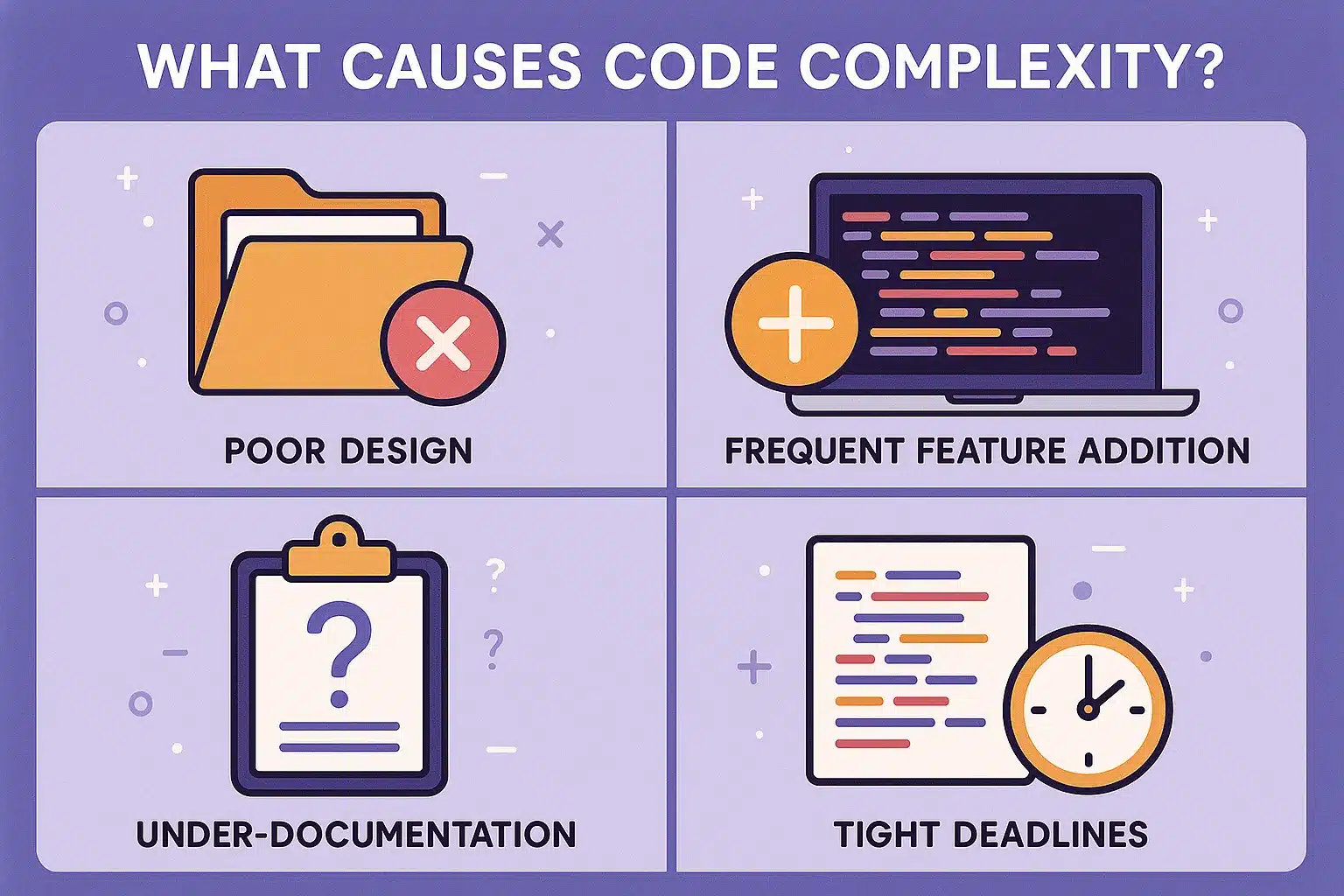
Common reasons for complexity include:
-
Poor Design or Architecture: With no thought or planning, code dependencies and code logic can become tangled.
-
Frequent Feature Additions: Too many features added without modifying the existing code can create complicated logic.
-
Undocumented: If the code was written with no review and has repeated redundant code or multiple or different codes that do the same thing, it may become more complex over time.
-
Under-documented: Difficulties maintaining code happen if developers do not know why code was written a certain way.
-
Tight Deadlines and Fixes: Patches or fixes made in a timely manner may fix issues now, but it can become even more complex in the long run.
By knowing these reasons early, the team will be able to put practices in place that will lessen the complexity of code and avoid spiraling out of control and deteriorating code complexity.
Types of Code Complexity
Code complexity may come in many forms, with each highlighting a different challenge in how software is designed, written, and maintained. Understanding these types helps teams identify where complexity exists and how it affects long-term maintainability.
-
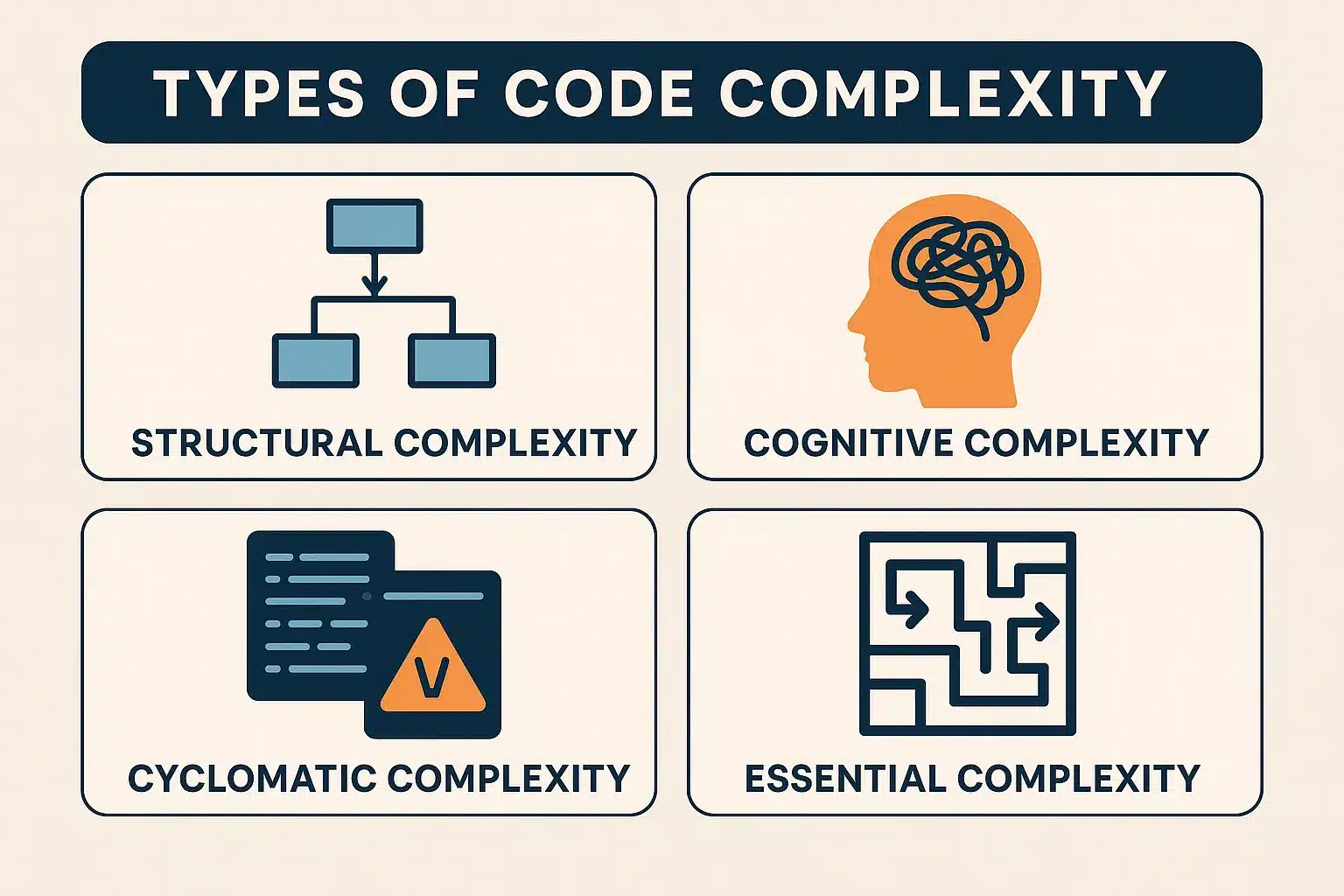
Structural Complexity: Refers to how classes, methods, and modules are interconnected within a system. High structural complexity often results from tightly coupled components, making the code harder to modify or scale without introducing regressions.
-
Cognitive Complexity: Measures the mental effort required for a developer to understand the code. Deep nesting, unclear naming, and overly complex logic increase cognitive complexity, slowing down code reviews and onboarding.
-
Cyclomatic Complexity: Quantifies the number of independent execution paths through a program’s control flow. Higher cyclomatic complexity increases testing effort, as more test cases are required to cover all possible paths.
-
Essential Complexity: Represents complexity that is inherent to the problem being solved rather than the implementation itself. While it cannot be eliminated entirely, good design choices can prevent essential complexity from spreading unnecessarily across the codebase.
Once the type of complexity is identified, teams can take targeted action. Structural complexity often calls for refactoring, while cognitive and cyclomatic complexity can be reduced through clearer logic, better documentation, and automated testing.
How to Measure Code Complexity?
Measuring code complexity helps teams identify parts of the codebase that are difficult to understand, test, or maintain. Instead of relying on intuition, software teams use a combination of metrics, tools, and human review to quantify complexity accurately.
Common ways to measure code complexity include:
-
Static Code Analysis Tools: Tools like SonarQube and ESLint analyze source code without executing it and highlight areas with high code complexity, such as deeply nested logic, long methods, or tightly coupled components.
-
Automated Metrics: Several quantitative metrics are used to measure code complexity in practice. Cyclomatic complexity evaluates the number of independent execution paths, while cognitive complexity focuses on how difficult the code is to understand. Other metrics, such as Halstead complexity, assess operators and operands to estimate overall code effort.
-
Peer Review: Manual code reviews provide a qualitative view of code complexity. Experienced engineers can often spot unclear logic, over-engineering, or design issues that automated tools may overlook.
-
Unit Test Coverage: High code complexity often leads to lower testability. Tools like Keploy, which automatically generate test cases and detect regressions, help teams safely refactor complex code by ensuring that behavior remains consistent as complexity is reduced.
By continuously monitoring code complexity throughout the development lifecycle, teams can reduce long-term maintenance risks, improve code quality, and prevent defects from being introduced as the system evolves.
Common Code Complexity Metrics
Many metrics to measure code complexity exist in software testing. When referring to these metrics, we typically meet the following definitions:
-
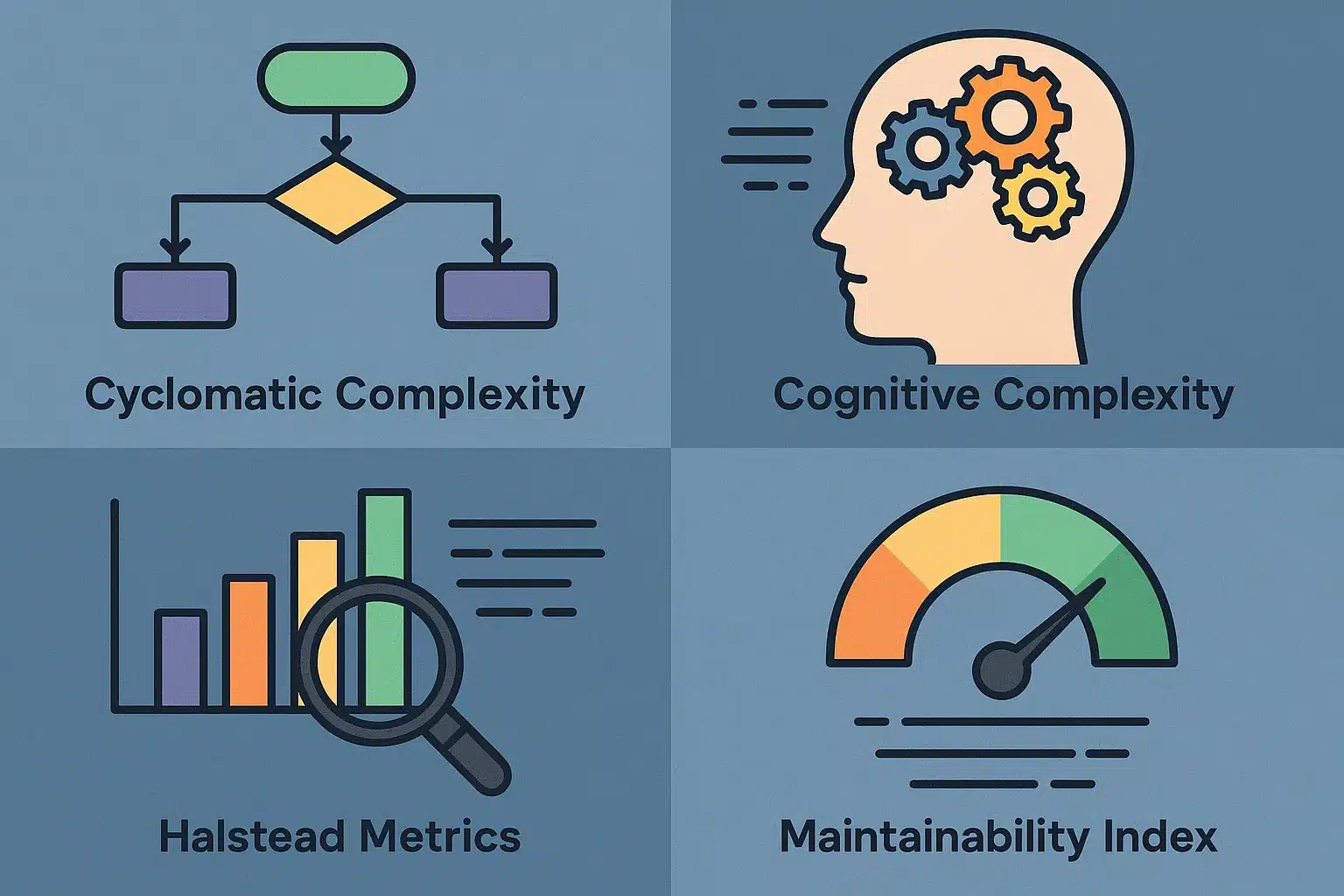
Cyclomatic Complexity: The number of independent paths in a given code base.
-
Cognitive Complexity: How much mental effort does it take to understand a given code base.
-
Halstead Metrics: Measures the number of operators and operands in code to measure program difficulty.
-
Maintainability Index: A Measure of how easy a developer can maintain a given code base.
Applying these metrics will help you and the QA team to make better data-informed decision-making for testing, refactoring, and QA. Additionally, it can assist with making determinations of high-risk areas of code that require immediate attention.
Challenges of High Code Complexity
High complexity introduces multiple challenges for software development teams:
-
Longer debugging cycles and harder maintenance: More complex code is difficult to read and comprehend, which takes longer to find and fix bugs. You can spend a lot of time finding and fixing even a simple bug that requires checking a bunch of modules that are dependent on each other.
-
Greater risk of regression bugs: Complex logic and dependencies mean that modifying code can break another part of the code and create a new bug if you modify one part of the code.
-
Reduced scalability from tightly coupled code: Very complex code typically has tightly coupled code, which makes it hard to add to, or scale with new features to the system without adding additional bugs in existing functionality, or needing a lot of refactoring to separate code into new files.
-
Greater cognitive load on developers: More complex code takes more mental effort to comprehend, test, and modify, which results in either slower development cycles, more mistakes, or onboard additional programmers to a team and so on.
-
Difficult to achieve full test coverage: Complex code paths, conditional statements, and deeply nested logic make it difficult to write all the test case scenarios and achieve comprehensive full coverage.
These issues ultimately slow down the rate of development, increase cost, and reduce quality; however, it is possible to overcome these obstacles and challenges by doing regular refactoring, coding modularly, consistently testing code, and using automated code analysis tools to give feedback.
When Should You Worry?
There is no universal “bad” code complexity number. Instead, teams should watch for rising trends, frequent regressions, slowing test cycles, and increased onboarding time – all strong indicators that code complexity is becoming a risk.
How to Reduce Code Complexity?
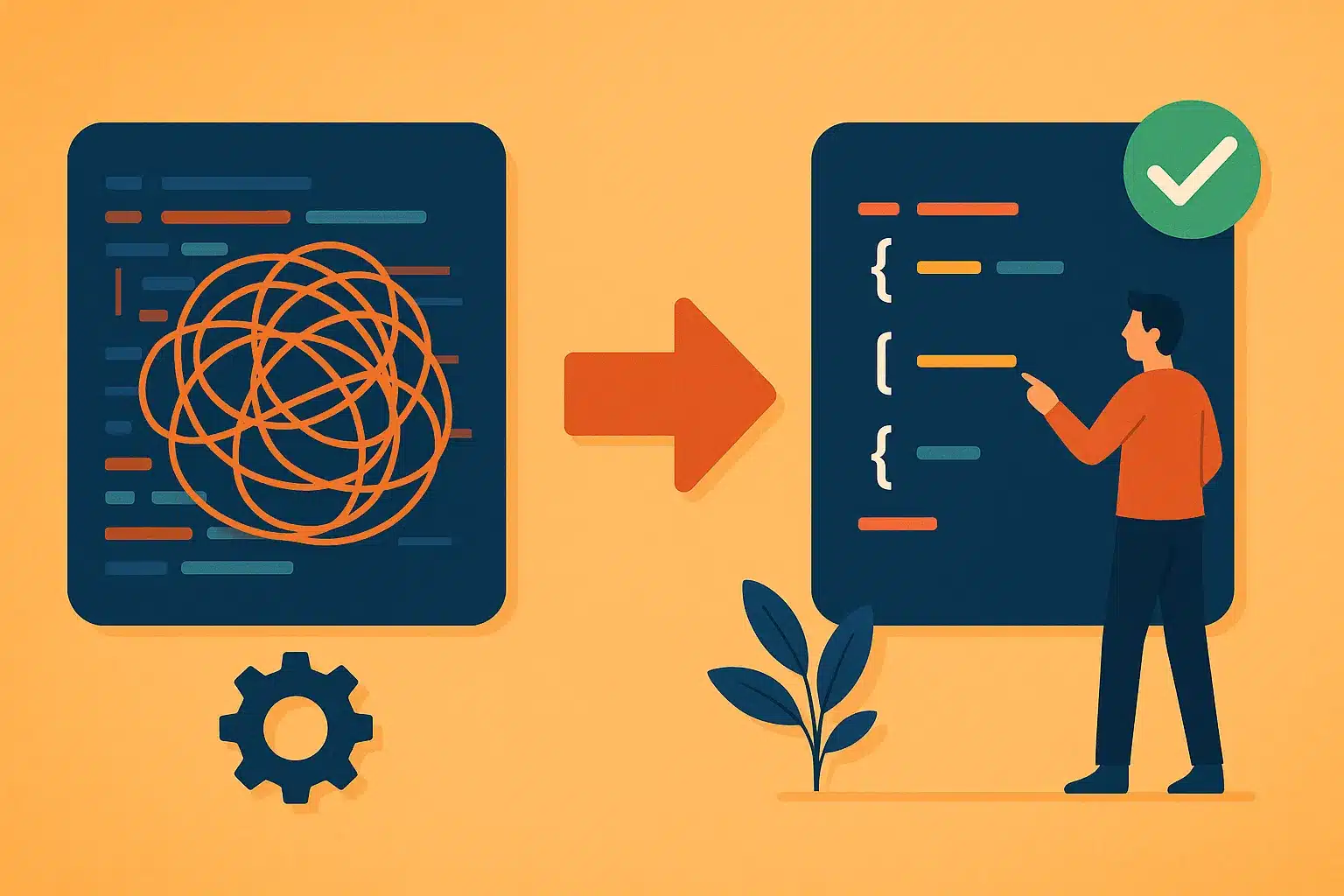
Reducing complexity improves maintainability, readability, and testability; among the more pragmatic ways to do so are:
-
Refactor regularly: simplify nested logic, avoid duplication, and improve naming.
-
Design modularly: break up existing large functions or classes into smaller, more self-contained modules.
-
Review code, and practice pair programming: these processes will help to build shared understanding and surface potentially overly complex logic early on in the process.
-
Automate testing: automate the maintainability of your test coverage with tools; otherwise, assessing coverage manually adds time and overhead to manual testing methods.
The take-home here is that teams can and must systematically implement the less complex strategies for a simpler, more reliable, and more scalable codebase.
Why Code Complexity Metrics Are Crucial for Software Development?
Code complexity metrics provide concrete and actionable information related to the state of a software project. By measuring complexity, teams can identify areas that warrant greater testing effort, need to be refactored, or need design improvement.
Metrics also help project managers with key decisions around timelines, testing efforts, and resource allocation. They establish an environment of accountability and quality by empowering developers to emphasize not just writing code, but also sustainment and quality coding.
Why Does Ongoing Maintenance Matter?
Code does not stay complex – it becomes complex as features are added and existing modules are modified. Ongoing maintenance will mean that complexity is regularly monitored, and refactorings are accomplished when necessary.

Without ongoing maintenance, even code that is cleverly structured will warp over time and create increased opportunities for bugs and test development slows. By continuously revisiting the codebase, and just enjoying the process of improving it, you can maintain complexity, as well as performance, readability, and testability over the development of the software in terms of quality over time.
Using Keploy for Smarter Complexity Management
As codebases grow, refactoring to reduce code complexity becomes risky without strong regression protection. Keploy helps teams manage this risk by:
-
Automatically generating test cases from real applications and API traffic
-
Replaying captured tests after code changes to detect regressions early
-
Allowing developers to refactor complex logic with confidence in CI/CD pipelines
-
Reducing the manual effort required to maintain test coverage as the system evolves
By safeguarding existing behavior during refactoring, Keploy supports ongoing complexity reduction while keeping software stable and release cycles fast.
Conclusion
In today’s world of software development, code complexity is an inevitable challenge, but shouldn’t be considered a roadblock. Understanding the types of code complexity, causative factors, and correct measures can help development teams gain visibility and control of their codebase. Dealing with high complexity in a manageable way through refactoring, managing continuous improvements, and product testing not only produces better software quality and better scalability but also lowers the chance of defects being introduced. This ensures that teams can deliver safe, maintainable, and high-performance software that matches the pace of contemporary application development.
FAQs
1. How Is Time Complexity Different from Code Complexity?
Time complexity measures how a program’s execution time grows with input size, usually expressed using Big O notation. Code complexity focuses on how difficult the code is to read, understand, test, and maintain, based on factors like logic, structure, and dependencies.
Both matter: time complexity affects performance, while code complexity impacts maintainability and testing.
2. What Does Cognitive Complexity of Code Mean?
Cognitive complexity is how difficult it is for a person to understand the underlying code. It considers readability, nested structures, and the mental capacity to retrace logic. If logic is optimized or large functions are categorized into smaller sub-units, cognitive complexity can be lowered.
3. How Do I Eliminate Cyclomatic Complexity in Coding?
Cyclomatic complexity increases when you have many logical paths (loops, conditionals, branches). Keeping functions small, limiting nesting, and avoiding large functions with many paths are all ways to limit cyclomatic complexity. There are tools that continuously check code complexity (even if those tools use cyclomatic complexity for prediction).
4. How Does Code Complexity Affect Software Testing?
Code that is more complex will be much harder to test due to the sheer number of likely testing scenarios and paths that need to be entered by the developer to conduct the testing. So, simplifying complexity and using code complexity checker will help to ensure that the most thorough and efficient testing can occur.
5. Are There Tools That Can Automatically Measure Code Complexity?
Yes, tools are available that can automatically measure code complexity (cyclomatic, cognitive, etc.) with reports that can provide a checklist for the developers to use to improve code or maintain cleaner, easier-to-navigate code.

Leave a Reply