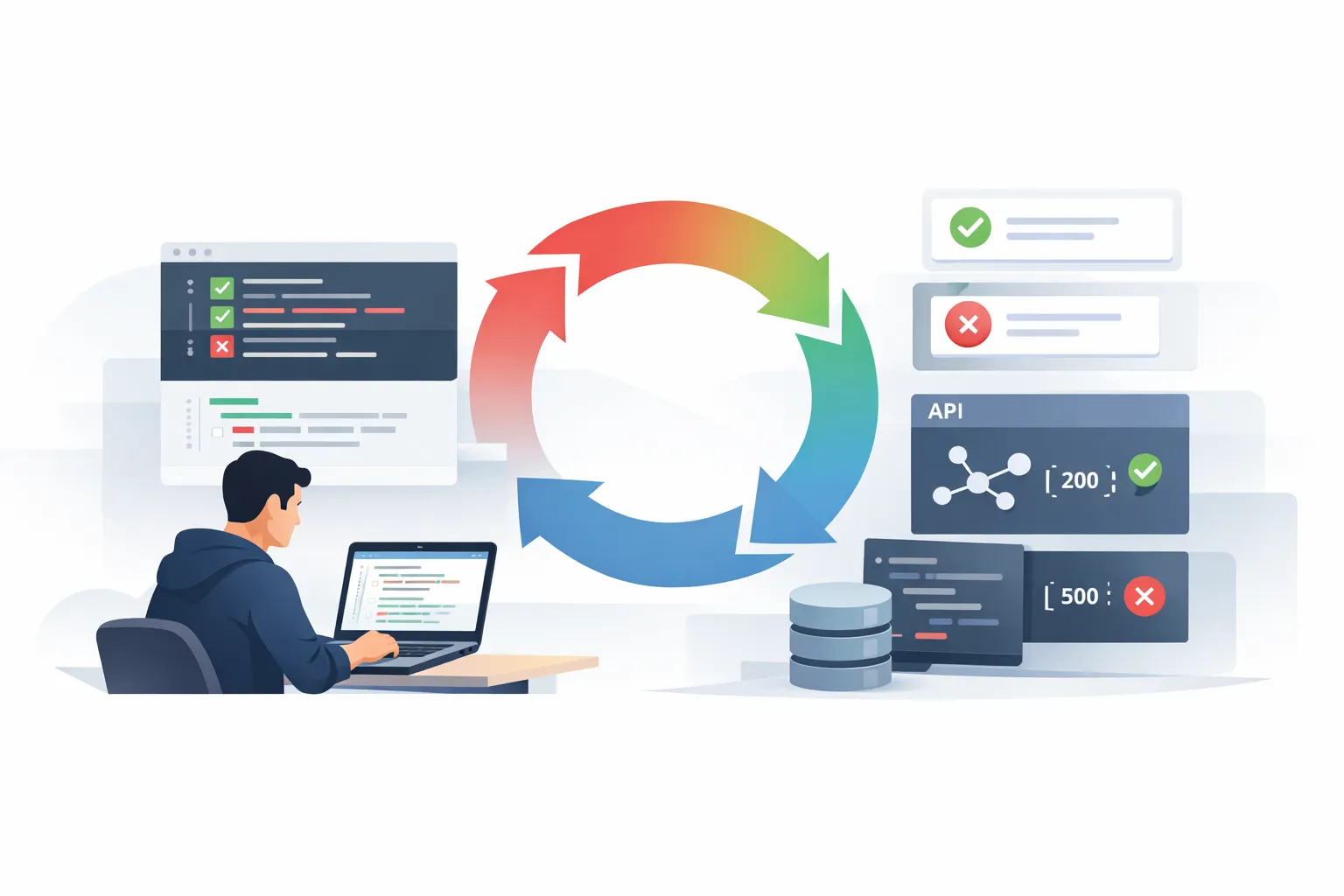
Modern software development moves fast. Delivering bug free code is no longer just a goal. It is a requirement. But how do you ensure your code works before you even finish writing it? The answer is TDD, or Test Driven Development.
In this guide, we will answer what is TDD, explore how it transforms the development lifecycle, and share practical examples you can apply immediately. This article explains what is TDD test driven development, why it matters in modern systems, and how teams use it to ship reliable software in 2026.
What Is TDD?
Test Driven Development (TDD) is a software development approach where you write automated tests before writing the production code.
Instead of:
Write code → then test it
TDD flips the workflow:
Write a test → write code to pass the test → improve the code
So if you’re asking what does TDD mean, it literally means that tests drive how your code is designed and implemented.
This approach is especially useful in systems where changes are frequent, APIs evolve fast, and regressions are costly.
What Is TDD in Software Testing
Many developers confuse TDD in software testing with simply writing more tests. In reality, TDD is not only a testing practice. It is a development mindset.
In TDD testing:
-
Tests define expected behaviour upfront
-
Code exists only to satisfy those tests
-
Every change is validated immediately
Unlike traditional testing, where tests are added after implementation, TDD in testing integrates validation directly into the development loop. This is often referred to as a shift left testing approach.
What Is TDD Development
TDD development means building software incrementally, one test at a time.
You do not:
-
Write extra code just in case
-
Build large features without validation
-
Introduce complex logic without coverage
Instead, each test answers one simple question:
What should this piece of code do?
This makes TDD development especially effective for:
-
Backend services
-
APIs
-
Business logic heavy systems
-
Microservices where regressions are hard to trace
How Test Driven Development Works
TDD follows a short feedback loop commonly known as the Red Green Refactor cycle.
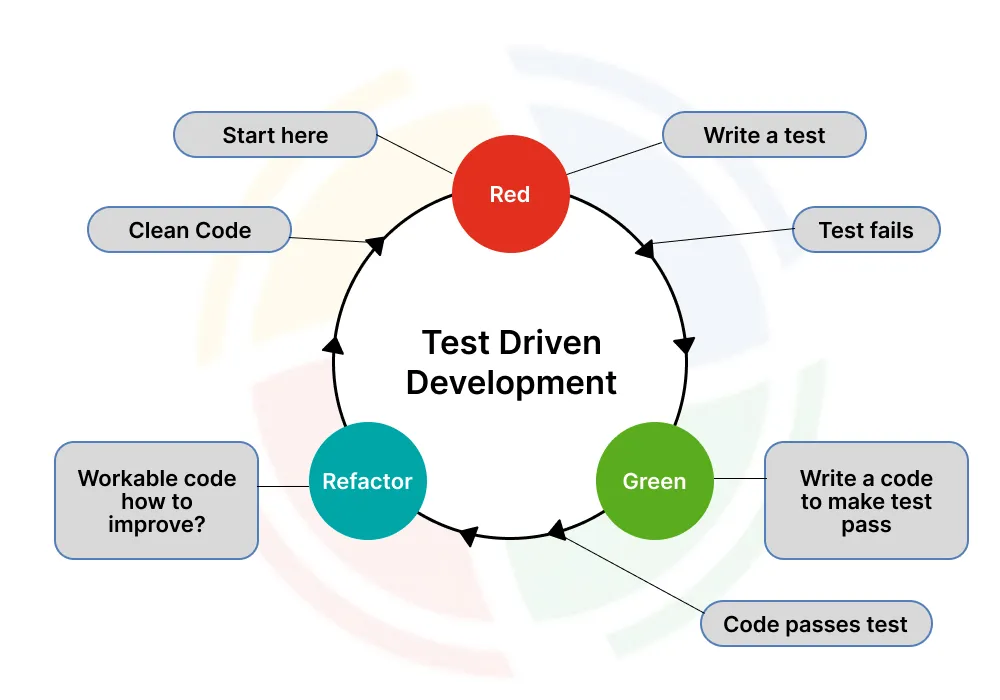
Step 1 Write a Test (Red)
You write a test for a small piece of behaviour.
The test fails because the feature does not exist yet.
Step 2 Write Minimal Code (Green)
You write the simplest code required to make the test pass.
Step 3 Refactor
You clean up the implementation without changing behaviour.
Existing tests ensure nothing breaks.
Step 4 Repeat
You move to the next test and continue the cycle.
This tight loop is what makes TDD testing effective in real world development.
Why Teams Use TDD
Understanding what is TDD test driven development becomes clearer when you see the benefits in practice.
Benefits of TDD
Reduced Regressions
Every Change is Verified through testing.
Increased Confidence during refactoring
Developers feel comfortable optimizing or restructuring their code.
Clearer Architecture
Tests will force TDD to create modular and testable structures.
Quicker Feedback
Bug found when code was originally written instead of waiting till QA for days.
Greater Collaboration
Tests provide ongoing documentation of how the system works.
Why TDD Is Important for Business Teams and Product Teams
TDD affects more than just how productive developers are at creating products. It has an impact on how businesses do business too.
-
Bugs caught early are less expensive to repair
-
Stability leads to fewer problems for customers
-
Software can be delivered more quickly with fewer rollbacks
-
Users will develop a relationship of trust with the company as they see the same consistent behaviour from an API.
TDD helps keep APIs compatible with old versions of them, and prevents new versions of an API from introducing ‘breaking changes’ into production.
A Simple TDD Example
To help you visualize what TDD looks like in regards to testing, think about a simple function that adds two values together.
Step 1 Write a Failing Test
python
def test_add_numbers():
    assert add(2, 3) == 5
The test fails because the function does not exist yet.
Step 2 Write Minimal Code
python
def add(a, b):
    return a + b
The test now passes.
Step 3 Refactor
In this simple case, no refactoring is required. In real applications, this step improves structure while keeping all tests green.
This example shows how TDD development works in practice.
Benefits Of TDD To Backend/API Development
When using TDD to build an API or backend services, it can be very beneficial for a backend engineer.
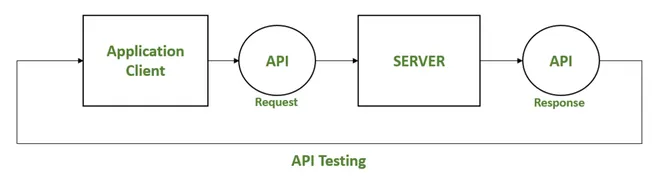
In an API driven architecture, regressions can be caused by various reasons such as:
-
Changes to request/response contracts
-
Changes to validation rules
-
Edge cases are missed with refactors.
With Test Driven Development, we create tests that define all behaviours expected when interacting with APIs. Each API will return:
-
Correct response status
-
Handle invalid requests appropriately
-
Maintain backward compatibility
In real-world API systems, unit-level TDD alone is often not enough. While TDD ensures correctness of individual functions, APIs also depend on integrations, request-response contracts, and real traffic patterns. Tools like Keploy extend TDD by automatically capturing real API interactions and generating regression tests, helping teams validate behaviour beyond unit tests without additional manual effort.
Many groups combine TDD with executing automated API tests to verify the request-response flows that the API will experience in the actual production environment. This helps ensure that any unforeseen issues will not go unnoticed during production.
TDD vs Unit Testing vs BDD
TDD, unit testing, and BDD are often confused, but they serve different purposes.
| Approach | Focus | Purpose |
|---|---|---|
| TDD | Development workflow | Guides how code is written |
| Unit Testing | Code validation | Tests existing logic |
| BDD | Business behaviour | Aligns tests with requirements |
TDD focuses on how code is built, unit testing verifies correctness, and BDD ensures alignment with business expectations.
Common Misunderstandings About TDD
TDD makes development slower
TDD may seem to be a slower development method initially; however, TDD will help to reduce the number of bugs and the amount of rework you will have to do later during development.
TDD eliminates the need for QA (Quality Assurance)
TDD does not replace quality assurance – TDD and quality assurance work together (e.g., exploratory testing, integration testing).
TDD provides bug-free code
While TDD will not guarantee 100% bug-free code, TDD will help reduce the amount of logical and regression bugs.
Situations Where TDD May Not be the Best Approach
While TDD is an effective software testing technique, TDD does not fit every situation. TDD may not fit the following situations:
It may not be ideal when:
-
Building on an existing codebase that has no tests associated with it
-
Developing a "proof-of-concept (POC)" rapidly
-
Having daily requirements changes without clearly defined behaviour
Furthermore, understanding what TDD is in software testing also means understanding when to use TDD.
TDD Best Practices for Real Projects
To make TDD testing sustainable:
-
Write small, focused tests
-
Test the behaviour, NOT the implementation
-
Use descriptive test names
-
Refactor regularly
-
Always run tests Automatically using CI pipelines
Implementing these best practices, TDD will not be slow and painful.
Popular Tools for TDD
Depending on the type of Tech Stack you are Using, some common TDD Development Tools Include:
-
JUnit & TestNG (Java)
-
pytest (Python)
-
Jest (JavaScript)
-
Go Built-In Testing Package
-
NUnit for C#
Most CI/CD Platforms are built to seamlessly integrate with These Tools.
FAQs About TDD
What is test-driven development?
Test-driven development (TDD) is an approach to software development that emphasizes writing tests before developing any production code.
How does test-driven development fit into software testing?
Test-driven development is an approach to software development where test code is integrated with source code.
What type of development is used in test-driven development?
Test-driven development uses a combination of incremental development and unit tests as developmental goals.
Does test-driven development focus primarily on unit tests?
While the focus of test-driven development is on unit testing, there are many additional benefits to the software architecture and design of the code being created using test-driven development.
Is it possible to use test-driven development when developing APIs?
Yes! TDD works great to ensure the correct functionality of APIs and to eliminate any regressions in API functionality.
Final Thoughts
Software development based on Test Driven Development (TDD) is an organized and methodical way to develop, and helps teams to increase their quality of code, minimize their defects, and build confidence that they are shipping the highest quality code with each change made. There are some challenges when using TDD, such as the time required to set up the project and to work with external dependencies; however, the long-term benefits of using TDD are much greater than any of the costs associated with it. This is especially true for Agile and other rapid development environments.
However, simply having a high confidence level at the unit level is not enough. Many modern applications utilize APIs and integration points, and as such, when the application is actually used in the real world, the application’s performance may not meet user expectations. Combining TDD with automated testing for both APIs and integration points provides greater confidence that your application will perform the way it should when it is under actual use. A multi-layered testing approach will allow teams to ensure that their applications are reliable, and provide faster feedback, and that the quality of their software will continue to increase as the complexity of their products increases.

Leave a Reply