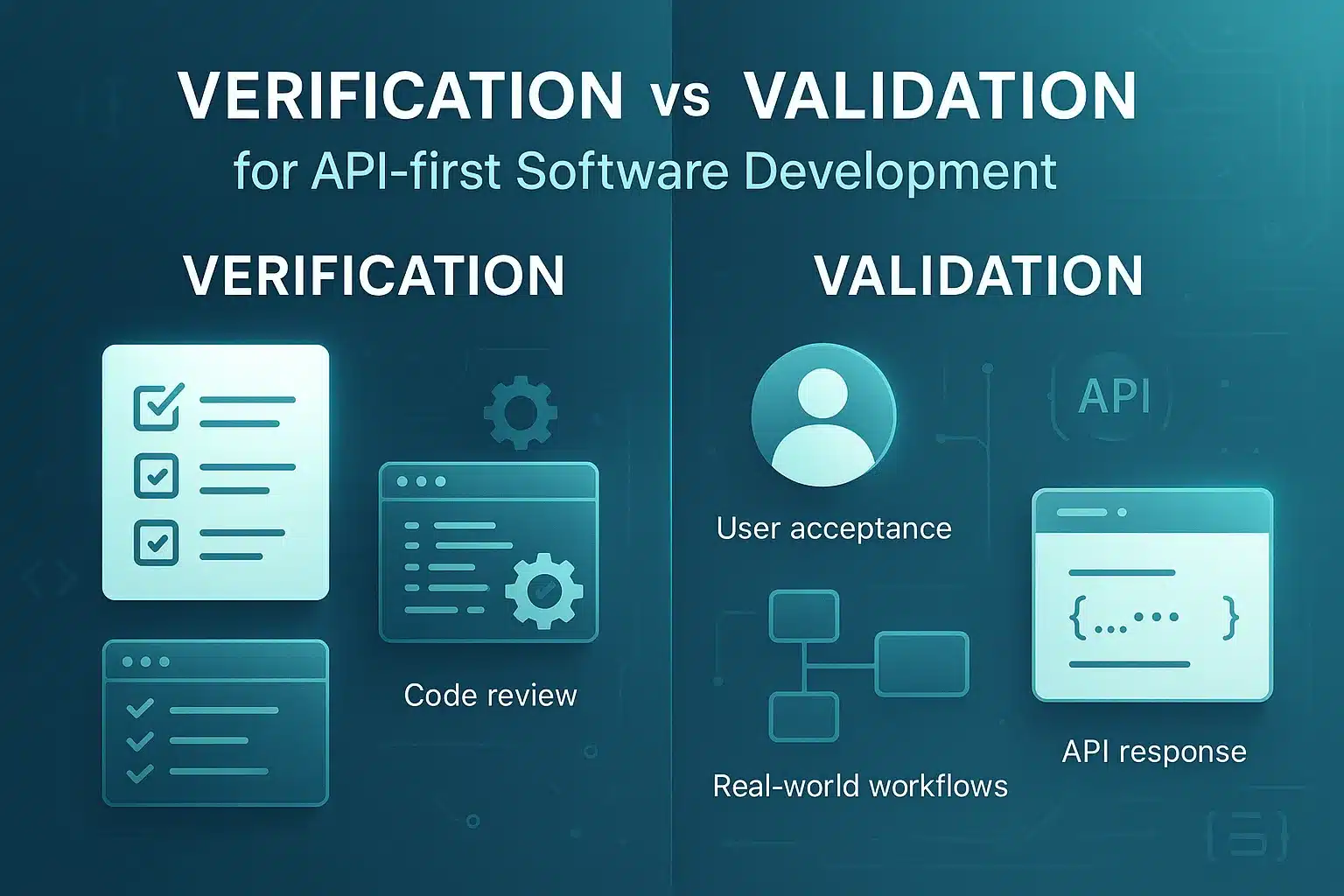
It’s easy to create APIs very quickly. However, creating APIs that are reliable when used in challenging distributed systems is much harder. Many development teams are moving quickly to ship features to the market, which has led to the verification vs validation distinction becoming the middle ground between a successful launch and an incident that could occur from a production system.
In an API-first environment, where microservices are entangled with the many APIs they rely on, both verification and validation are responsible for the reliability, user confidence, and long-term health of an API.
What Is Verification in Software Testing?
Verification is the term used to describe how to ensure a software product has been created exactly the way it was designed. Verification involves confirmatory checks on artifacts created and produced as a result of the software development life cycle before the software is put into operation.
Key Aspects:
-
Through early detection of product problems, verification reduces the amount of effort required to correct the errors at a later date.
-
Verification incorporates both static and pre-execution activities.
-
It confirms that an API is operationally correct in all implementations.
Examples in API-first teams:
-
Reviewing OpenAPI/Swagger specifications.
-
Contract checking
-
Unit-testing of API handlers
-
Checking dependencies
-
Validating API specifications
When to Use Verification?
Verification is most effective when applied early and systematically to prevent defects and ensure your APIs are built correctly:
-
During requirements and design reviews – to catch errors before development begins.
-
Before development starts – to confirm API contracts, schemas, and specifications are accurate.
-
When introducing new features or architectural changes – to ensure all components adhere to system standards.
-
During unit or component testing – to verify each API handler or service behaves as intended
Tip: Use verification whenever you want to build APIs the right way from the start and prevent issues before they propagate downstream.
What Is Validation in Software Testing?
Validation is the process of determining if you are building the correct product. It confirms that the software functions accurately for users in a realistic environment.
Key Aspects:
-
Focuses on user expectations and business outcomes
-
Uses dynamic execution of the software
-
Happens after integration or deployment
-
Ensures correct external behavior of APIs
Examples in API environments:
-
End-to-end API testing
-
System testing in a staging environment
-
Performance/load testing
-
Production synthetic checks
When to Use Validation?
Validation should be applied after implementation to ensure your APIs work as expected in real-world conditions:
-
After integration or deployment – to check that APIs behave correctly across services.
-
During end-to-end workflows – to ensure multiple APIs interact as intended.
-
Before production releases – to confirm business rules and user scenarios are implemented correctly.
-
During performance or load testing – to assess reliability, scalability, and resilience under realistic conditions.
Tip: Use validation whenever you want to ensure APIs deliver the right functionality and meet user expectations.
Quick Comparison: Verification vs Validation at a Glance
The table below summarizes the differences in verification vs validation clearly for faster decision-making:
| Aspect | Verification | Validation |
|---|---|---|
| Purpose | Build the product right | Build the right product |
| Focus | Design, documentation, specifications | Actual execution and behavior |
| Stage | Early in SDLC | After development or in staging/pre-prod |
| Techniques | Reviews, static checks, unit tests | E2E tests, UAT, performance tests |
| Output | Detects logical or design errors | Detects functional or user-experience issues |
Verification vs Validation Across the SDLC
Both methodologies are implemented in various stages of the Software Development Life Cycle (SDLC) to assist API-focused teams with their planning.
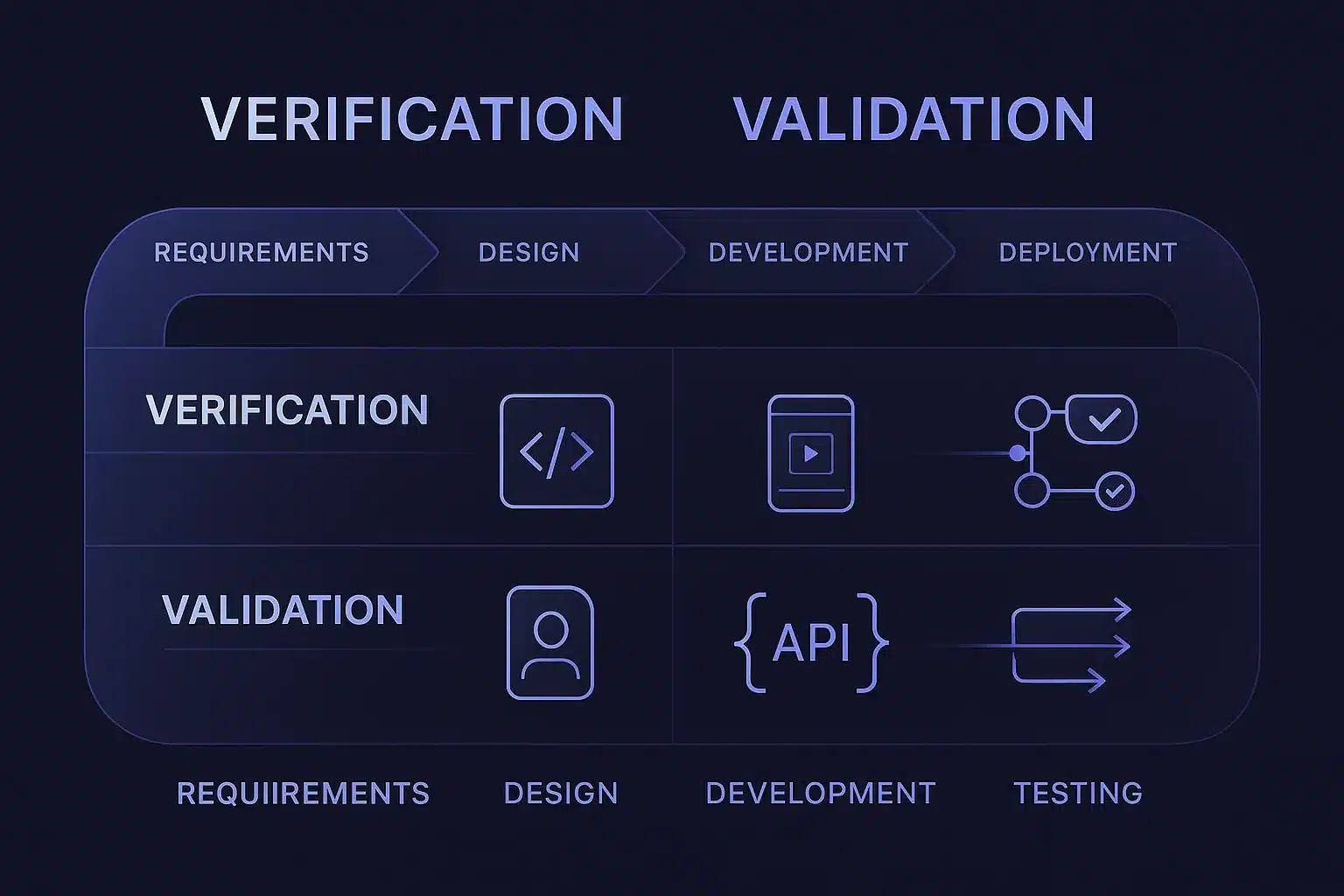
Verification and Validation of the Software Life Cycle have the following relationships:
Requirements
-
Verification – Reviewing the Requirements
-
Validation – Clarifying User Expectations
Design
-
Verification – Reviewing the API Design and Validating the Schema
-
Validation – Prototype or Mock Validation
Development
-
Verification – Running Unit and Integration Tests
-
Validation – Running Workflow Tests
Testing
-
Verification – Contract Verification and Linting
-
Validation – Running Functional, Regression, and Load Tests
Deployment
-
Verification – Performing Pre-deployment Checks
-
Validation – Traffic Replay and Shadow Testing
Verification Techniques and Tools for API-first Development
The API-first (also referred to as ‘contract-first’) development approach assumes that contracts and communication constitute a lot of the interactions and dependencies anticipated when developing software, and therefore, an API contract must be verified prior to moving any code into the staging environment.
Common verification techniques used by API-first development teams are as follows:
-
API Contract Verification – To ensure that the response data returned by an API matches the schema and structure defined by its API Contract
-
Static Analysis/Code Quality Verification – To ensure that code is compliant with code quality guidelines and is functionally correct
-
Unit/Component Testing – To verify that each function/handler/controller behaves as expected
-
Interface/Dependency Verification – To verify that all microservices are correctly integrated at the API Contract level.
-
Design Review/Requirements Review- To determine whether the API design supports the goals and objectives of the Business.
Validation Techniques and Tools for API-first Development
Validation ensures that the API works as intended under realistic conditions. Teams can use the following validation techniques to test user-facing behaviors:
-
End-to-End Testing: Testing an end-to-end workflow with multiple API calls from several services.
-
Functional and Regression Testing: Tests to make sure newly created functionality does not break existing APIs.
-
Performance and Load Testing: Tests the reliability of the API under duress.
-
User Acceptance Testing (UAT): Validates that business and customer requirements are being met.
-
Tools for Replay of Production Traffic: Provides a way to use real user interactions to validate API behavior.
CI/CD Playbook: Where Verification and Validation Fit in API Pipelines?
Validation and Verification both apply to your API Pipeline in a CI/CD workflow; they both occur in the same way, but at different points in the pipeline.
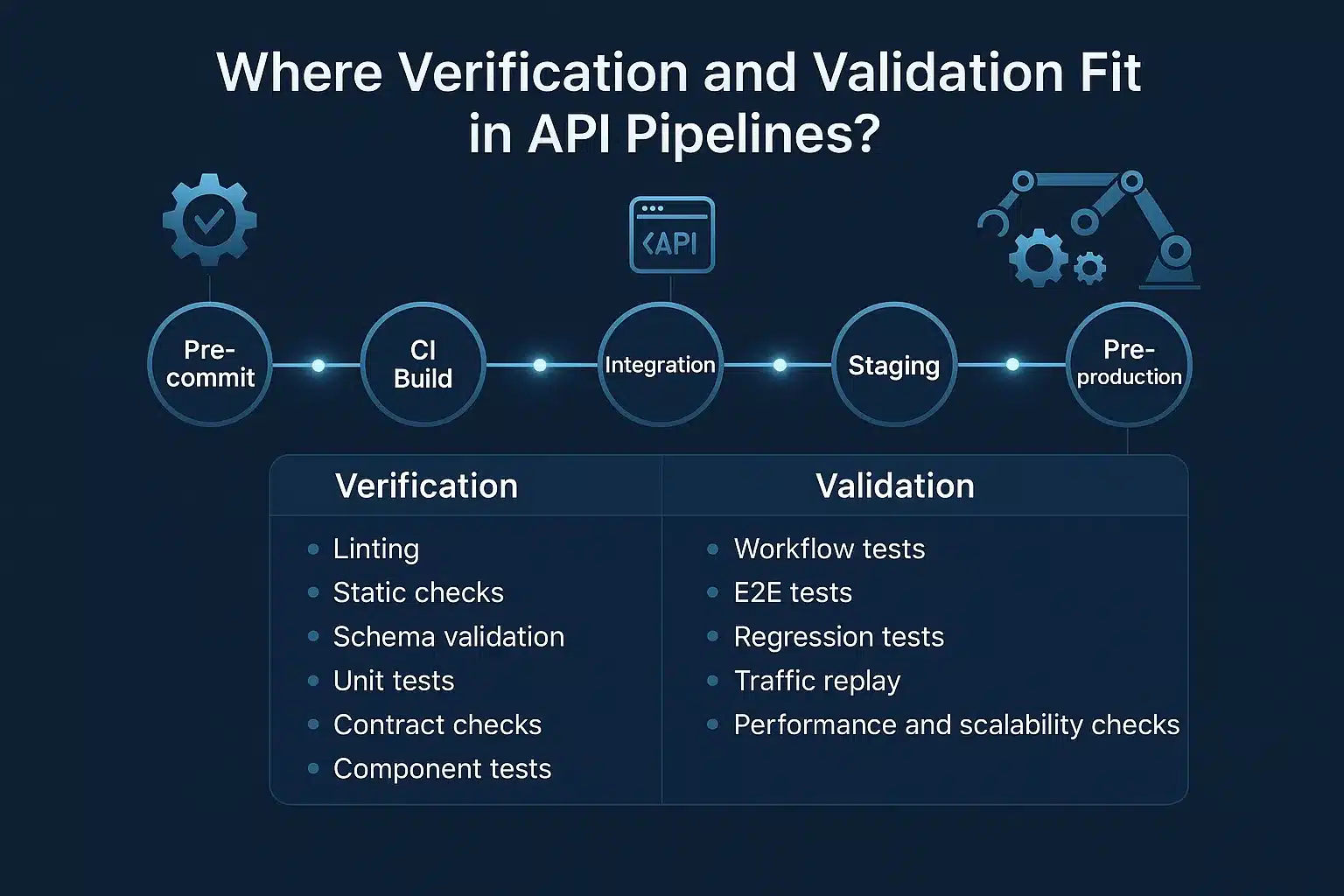
For example, the following is the location of Validation and Verification Activities in your API Pipeline Workflows:
-
Pre-commit / Pre-push
- Verification: linting, static checks, schema validation
-
CI Build Stage
- Verification: unit tests, contract checks
-
Integration Stage
-
Verification: component-level tests
-
Validation: basic workflow tests
-
-
Staging Stage
- Validation: E2E tests, regression tests, traffic replay
-
Pre-production
- Validation: performance tests, scalability checks
In the above structure, an organization has the opportunity to catch any issues early in the pipeline; however, there must also be full validation of any issues before the code is deployed to production.
Example Walkthrough: An API Microservice from Verification to Validation
Let’s see how an API-based order service moves through verification and validation.
- Verification Phase
-
Review API spec (OpenAPI)
-
Validate request/response formats
-
Run unit tests for order creation logic
-
Verify interaction contracts with the payment service
- Validation Phase
-
Validate entire order workflow via E2E tests
-
Run regression tests after feature updates
-
Perform load testing on peak traffic scenarios
-
Replay real production traffic patterns to ensure correctness
This flow demonstrates how modern API First Teams mitigate risk and reduce late-cycle surprises.
How Keploy Supports Verification and Validation?
Keploy provides an inclusive developer-centric solution for both verification and validation for API-centric teams looking for accuracy, speed, and ease. Rather than splitting the verification and validation processes into two distinct phases, Keploy streamlines both processes within the current development workflow.
Verification with Keploy
-
Keploy supports verification by making certain that the correct item is built at the time of development.
-
Generates API test cases automatically based on actual traffic patterns to prevent contract drift.
-
Provides deterministic mocks/stubs representing the dependent service using the real service contract.
-
Gives assurance that the schema of the test case and its contract agreement align.
-
Provides a mechanism by which to repeat test executions among multiple environments.
Validation with Keploy
-
Keploy performs a validation check to determine if the developed product performs as expected by users.
-
Provides repeat tests using actual production traffic as a means of confirming consistency in performance.
-
Separates ‘noise’ related to function discrepancies (i.e., issues unrelated to product performance) from legitimate functional differences.
-
Provides the capability of repeating a test in multiple environments.
-
Supports the validation of complex multi-state workflows.
Unified Approach: Keploy takes a single test format for both verification and validation, thus providing a seamless process and eliminating the need for multiple tests. This not only reduces the maintenance of your tests, but also provides a significant speed to your release processes.
Common Pitfalls and How To Avoid Them
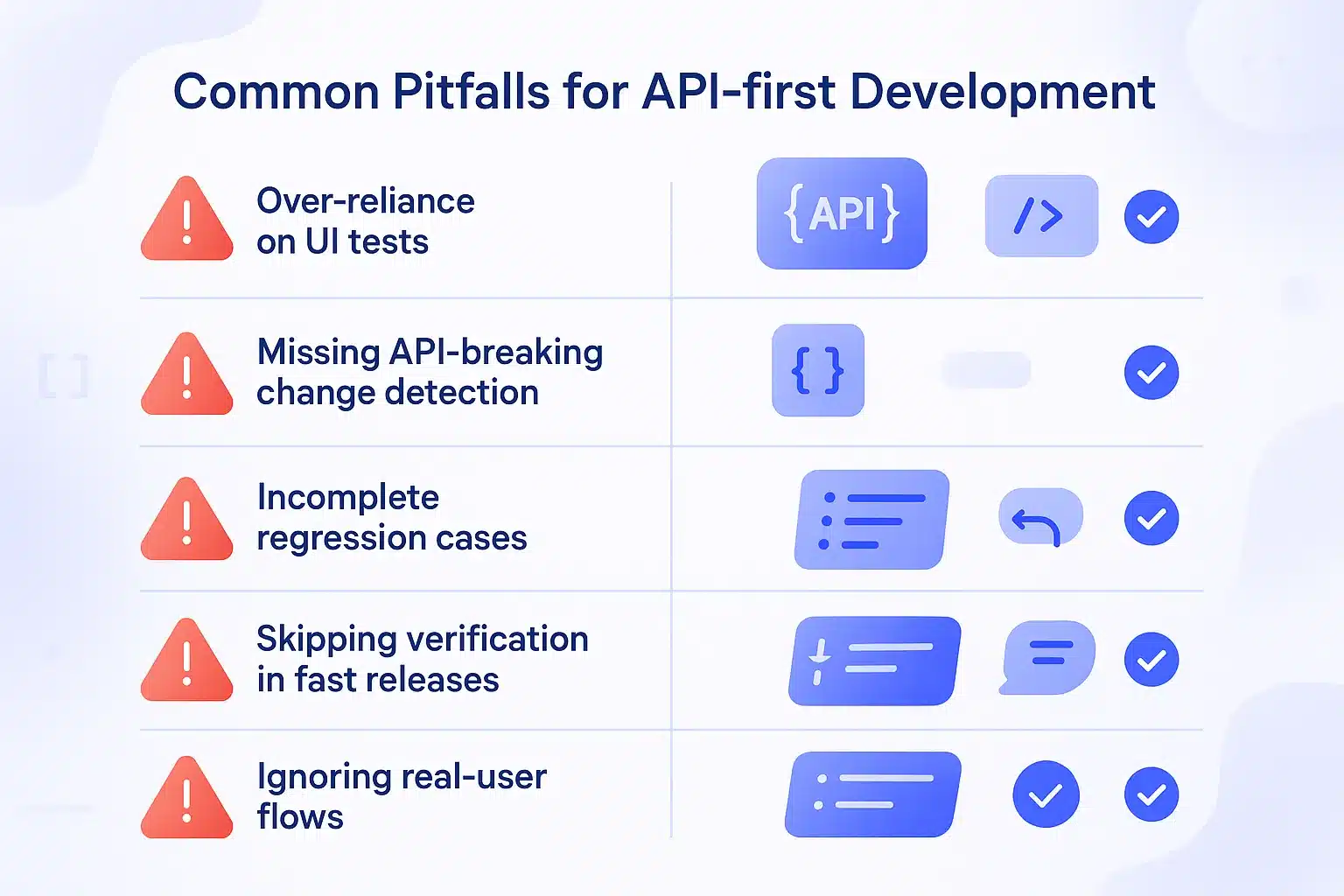
Teams sometimes make the mistake of mixing verification and validation. This leads to coverage gaps. By recognizing the mistakes that lead to silent failures, you can avoid these failures. There are many common mistakes that occur repeatedly on teams, such as:
-
Reliance on UI testing the majority of the time, when instead they should be relying on contract testing
-
The failure to identify breaking API changes early in the process
-
Manual test generation leads to incomplete regression coverage
-
Treating verification (in fast-moving release cycles) as an optional task
-
Lack of consideration for real-world usage paths when validating functionality
-
Inability to test anything other than the “happy path” when testing your application
Verification vs Validation Checklist for API-first Teams
API-first teams can use this checklist to ensure that each area is thoroughly covered by their team as part of their verification and validation process.
Verification Checklist
-
Validating and Reviewing all API Contracts
-
Ensuring all schema changes have been validated prior to release
-
Having reliable unit (and integration) tests in place
-
Using Static Code Analysis Tool to identify problems before they happen
-
Service-to-Service Validation
Validation Checklist
-
Having completed tests against all end-to-end workflows
-
Updating the regression suite to include newly-approved tests
-
Executing Performance Tests
-
Executing a Real-Traffic Re-Play for Performance Testing
-
Validating Business Rules Against the Business Process Model
Advanced Considerations for Modern Distributed Systems
When systems become larger or more complicated, the way we validate and verify that they work must also evolve with the increased complexity of the system.
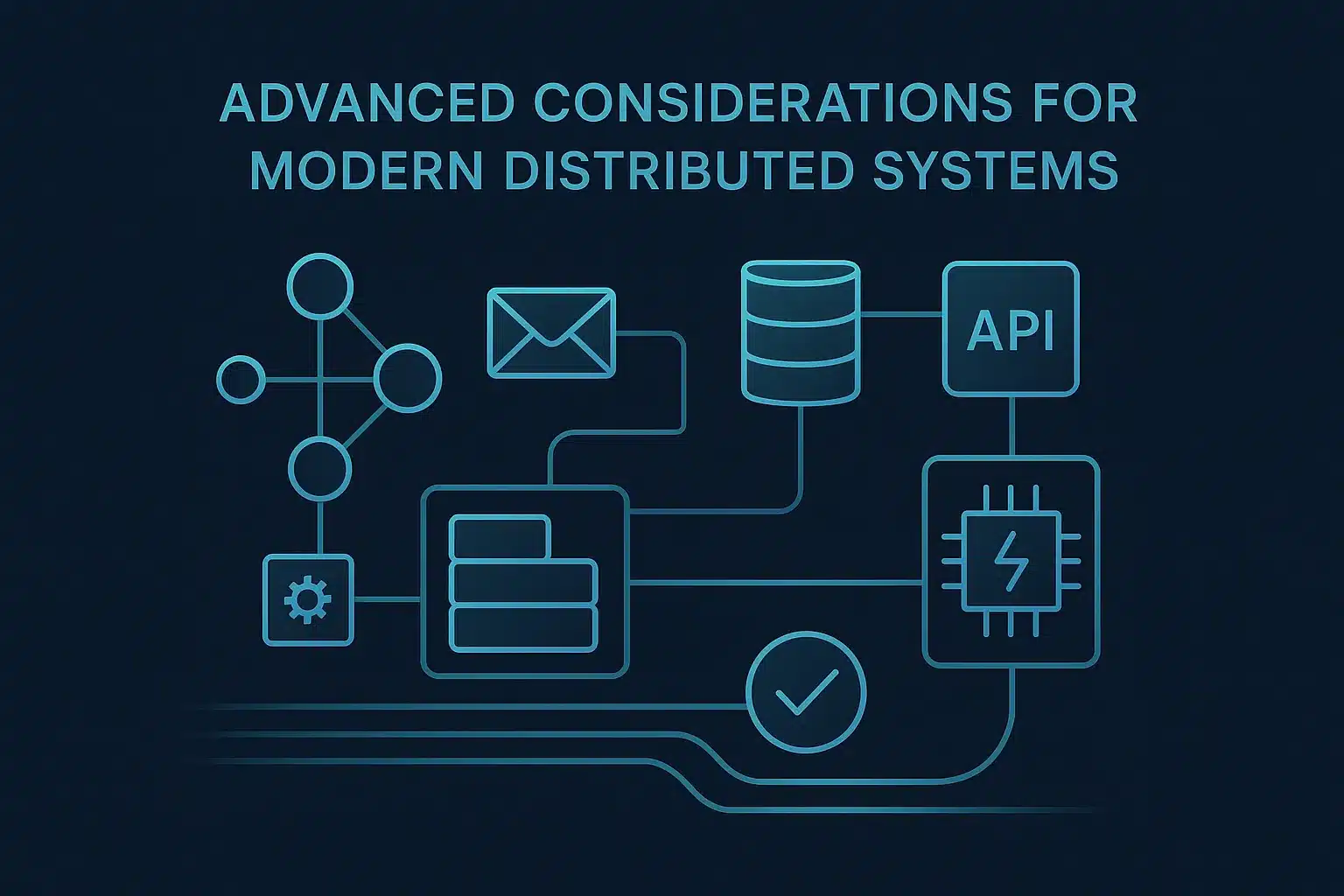
Many factors contribute to how we will do this; here are some examples of these considerations:
-
Developing a means of processing events asynchronously in event-driven systems
-
Establishing Means Of Validating Distributed Transactions
-
Ensuring the stability of contracts through multiple versions
-
Establishing a means of testing backward compatibility with Client APIs
-
Using Shadow Deployment/Traffic Mirroring
-
Verifying Resilience and Fault Tolerance behavior of the System
Conclusion
Verifying your APIs ensures they are developed to meet specifications, while validating your APIs ensures they conform to your users’ actual experiences. When verification and validation are used together, regressions are reduced, API reliability increases, and trust in the API-first system improves. Systematically applying both methodologies helps validate functionality, as well as resilience, scalability, and dependability across environments, especially when leveraging tools such as Keploy.
FAQs
1. Which comes first: verification or validation?
Verification occurs earlier in the SDLC than validation, which occurs either after development has been completed or formally exhibited within a staging environment.
2. Can the same test cases be used for both?
Definitely; Keploy and other tools enable users to generate automated test case results so that they can serve both V&V roles.
3. Are verification and validation needed in agile?
Yes, the increased speed of iterative development that is required by Agile Methodologies makes it imperative for companies to conduct both verification and validation in order to prevent potential regression issues from occurring.
4. Is traffic replay part of verification or validation?
More specifically, traffic replay primarily represents validation, as it validates that the expected behaviour of the developed software is occurring in the production environment.

Leave a Reply