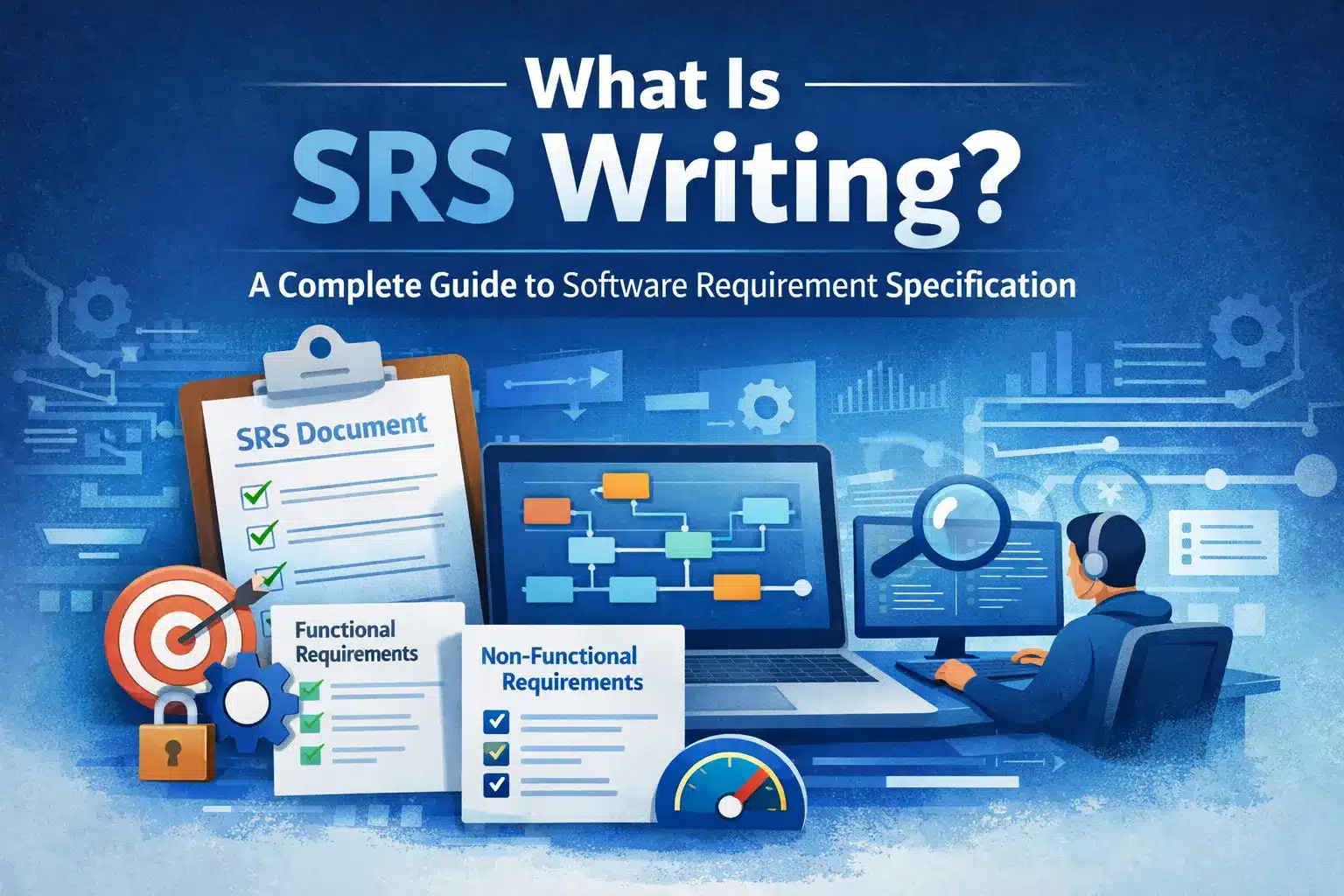
A Software Requirements Specification (SRS) is a detailed document that defines how a software system should behave, what features it must include, and the constraints under which it operates, before development begins. In simple terms, an SRS acts as a single source of truth for everyone involved in building the software.
SRS is a documented process that contains all of the software-system requirements in a clear and consistently formatted manner so that developers and testers, product management teams, and other stakeholders can clearly understand the software that will be built.
SRS writing is a foundational step in the software development lifecycle. When done well, it prevents miscommunication, reduces rework, aligns stakeholders early, and provides a blueprint that guides development and testing. When done poorly, or skipped entirely—it often leads to scope creep, mismatched expectations, and costly fixes late in the project.
What Is an SRS Document?
An SRS document is a written description of how a software application is expected to work by explaining what it will do and what it won’t. This means that all the requirements of the system should be collected in one location.
An SRS will often include:
-
Functional requirements: The functions that the system should be able to perform.
-
Non-functional requirements: The level of performance that the system should provide.
By clearly separating out these two types of requirements, the team can have a clearer idea of what users will expect.
Purpose of SRS
The SRS has four main purposes:
-
Establish a formal agreement between parties involved in the development process.
-
Minimise uncertainty by providing clear definitions of expectations.
-
Provide a common reference point throughout the development process and test.
-
Act as a reference point for managing both scope and changes As such, when creating a high-quality SRS.
It provides a clear understanding of how the final system will function – long before any code is ever written.
What Makes SRS Writing Effective
Helps Everyone Expect the Same Thing
A well-written SRS document allows all parties (e.g., Product Owners, Developers, Designers, and Quality Assurance Teams) to interpret the requirements the same way. This helps minimize the risk of misunderstanding the requirements and reduces the likelihood of a situation where one team believes they have completed a feature and another team does not.
Lowers Risk
Having clear requirements will allow you to identify potential issues with the requirements as early in the project as possible and rectify any issues before they become very costly or time-consuming to fix. You will save significantly on your overall development efforts if you can identify and resolve issues at the requirements level versus at the time of coding.
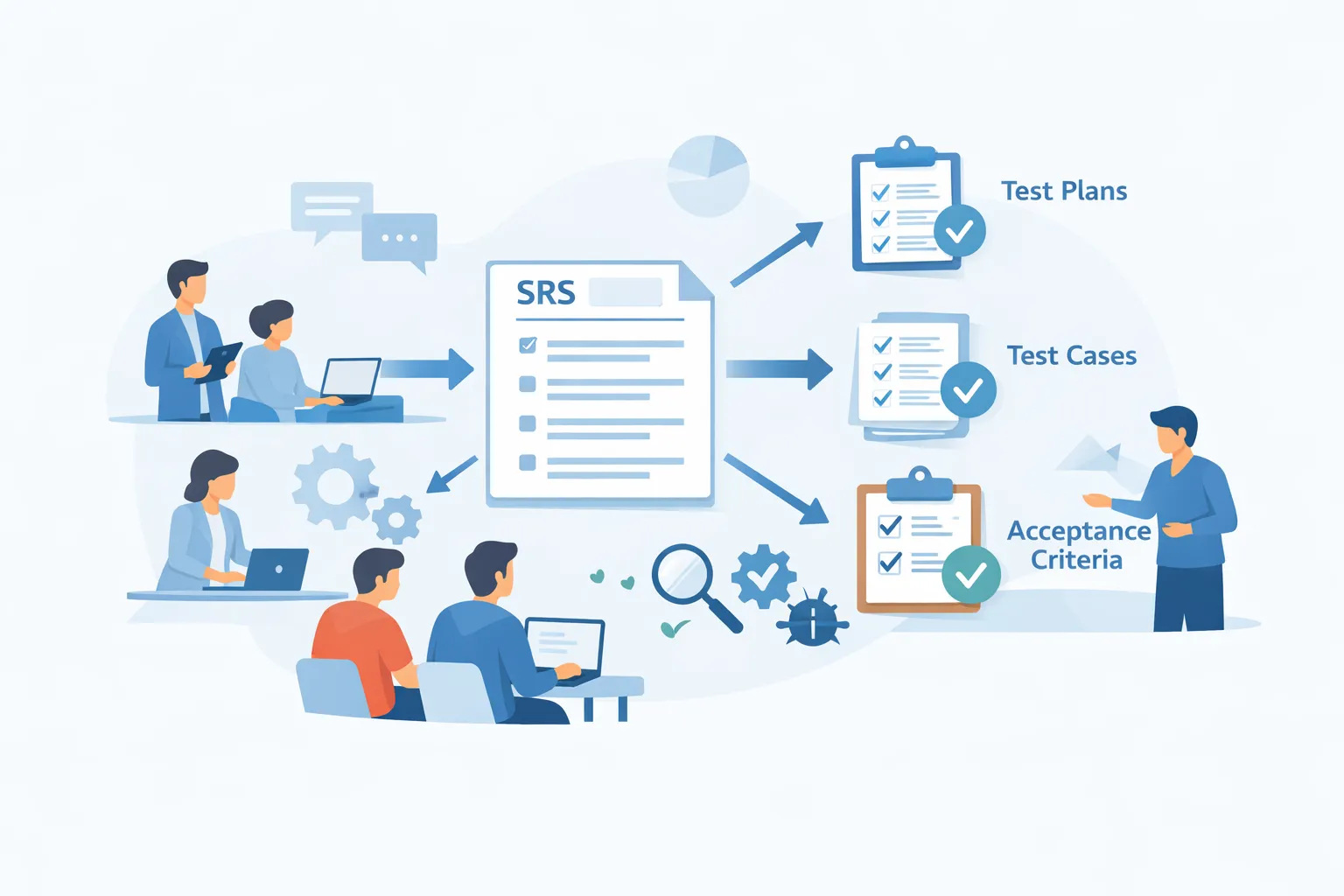
Providing a Testable Foundation
An SRS document forms the basis for:
-
Test plans
-
Test cases
-
Acceptance criteria
When the project requirements are clear and measurable, testing becomes objective, reliable, and easier to automate.
Key Components of SRS Writing
A strong SRS document follows a consistent structure. Below are the key sections commonly included.
Introduction Section
This section establishes the basis for the SRS document and provides the reader with a clear understanding of what the SRS document will cover and who it will target. The introduction section typically includes:
-
Purpose of the SRS
-
Scope of the system
-
Definitions, acronyms, and abbreviations
It helps readers quickly understand what the document covers and who it is for.
Overall Description
The overall description of the system provides a summary of the system and how it fits within the context of a larger product/service ecosystem. The overall description typically includes:
-
Product perspective
-
User characteristics
-
Assumptions and constraints
This section explains where the software fits in the broader ecosystem.
Functional Requirements
This section of the SRS defines the specific behaviours that the system must exhibit to meet the expectations of users, customers, project managers, and others associated with the project. Examples of functional requirements are:
Examples:
-
The system shall allow users to create an account using email and password
-
The system shall generate a monthly usage report
The functional requirements section must be:
-
Clear
-
Atomic (one idea per requirement)
-
Testable
Non-Functional Requirements
The non-functional requirements section of the SRS describes the quality attributes of a system. Examples of quality attributes are Performance, Security, Scalability, Reliability, and Usability. Examples of non-functional requirements are:
-
Performance
-
Security
-
Scalability
-
Reliability
-
Usability
Examples:
-
The system shall respond to user requests within 2 seconds
-
The system shall encrypt sensitive data at rest and in transit
If this section of the SRS is neglected, then while the system may function correctly, it will not function optimally.
External Interfaces
This section defines how the system interacts with external elements, including:
-
User interfaces
-
APIs
-
Hardware or third-party integrations
Clear interface requirements reduce integration risks and dependency issues.
How to Write an SRS (Step-by-Step)
Writing an SRS is a joint effort that takes place in stages. The following is a step-by-step method for writing an SRS:
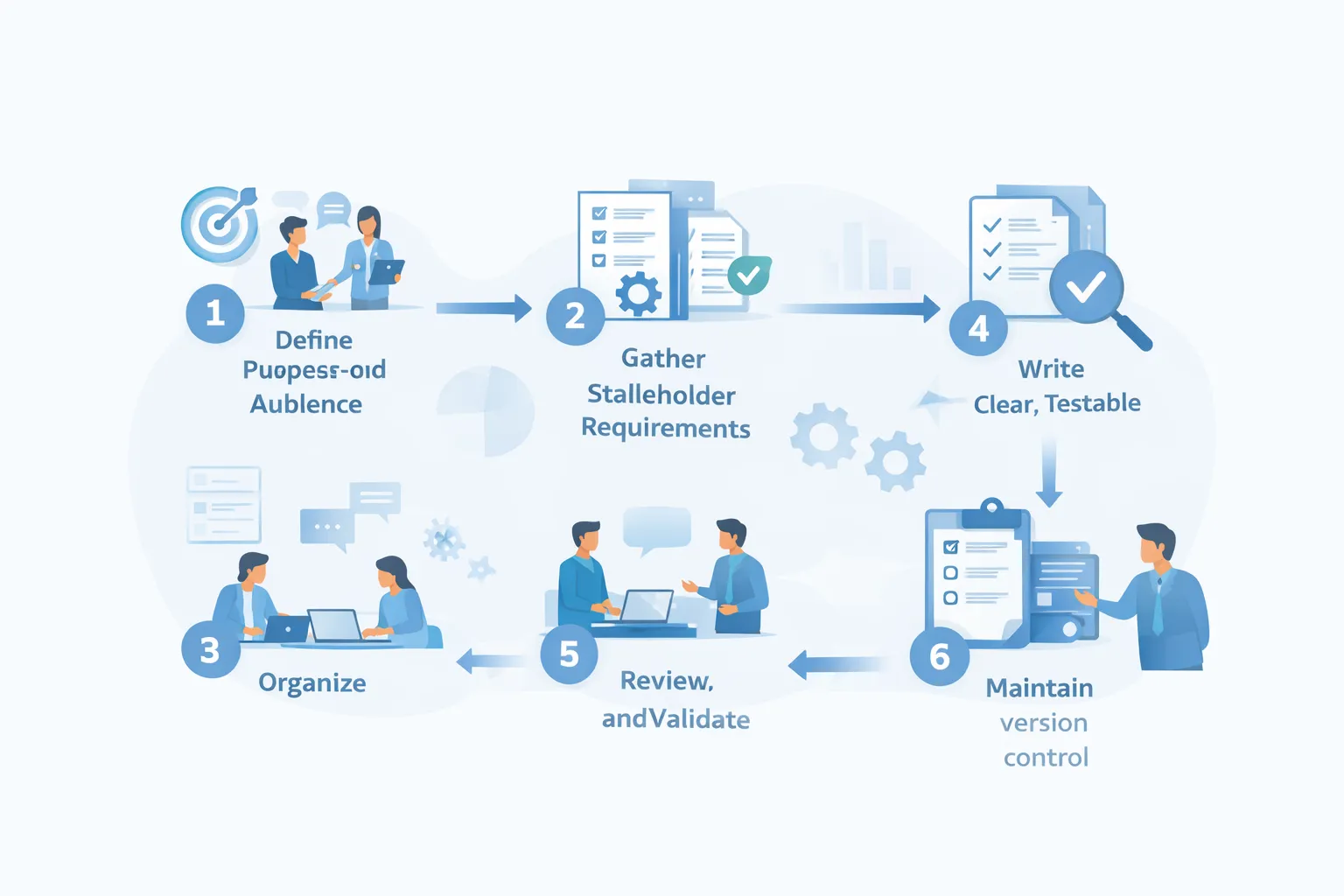
1. Define the Purpose and Audience
Clarify:
-
Why the SRS is being written
-
Who will be using the SRS? For instance: Developers, Testers, or other Stakeholders?
These answers will dictate the level of detail and terminology used in the SRS.
2. Gather Stakeholder Requirements
Gather information from the following:
-
Business stakeholders
-
End users
-
Technical teams
Utilize interviews, workshops, and existing documentation to gather requirements from all stakeholders comprehensively.
3. Organize Requirements Clearly
Organize the requirements into function groups:
-
Functional
-
Non-functional
-
Interface-related
Having structured formats will help with both traceability and readability.
4. Write Clear and Testable Requirements
Keep language clear and as simple as possible. Any requirement must be verifiable by testing to determine if it is complete and correct.
Example of a good requirement: "The system shall allow users to reset passwords via email verification."
Example of a bad requirement: "The system shall be user-friendly."
5. Review and Validate
Engage all stakeholders in review sessions to:
-
Confirm accuracy
-
Resolve conflicts
-
Ensure completeness
If done properly, these validation sessions will prevent you from wasting money due to misunderstanding.
6. Maintain Version Control
Requirements are dynamic. Always keep track of the changes made to the SRS as well as create separate versions of all documents so that there is no confusion about the SRS or the requirements that have been defined.
Tip: Focus on what the system will do, not how it will be constructed. The designs for the system are outside the scope of the SRS.
Common Mistakes in SRS Writing
Even seasoned groups make many of the same mistakes and these are things that you can easily avoid:
-
Vague requirements such as “fast” or “user-friendly”
-
Missing sections, especially non-functional or interface requirements
-
Overloading requirements with design details
-
Ignoring edge cases and error handling
If you can identify these problems early, this will enable you to create better supporting documentation.
Best Practices for Effective SRS Writing
To enhance the quality of your SRS Document:
-
Use consistent structure and terminology
-
Collaborate across roles—don’t write SRS documents in isolation
-
Prefer clarity over cleverness
-
Pair requirements with use cases and acceptance criteria
-
Regularly review and update the document
Good SRS Writing is less about the sheer volume of documentation, than it is about the creation of a common understanding of what the requirements are.
SRS in Different Development Approaches
With a traditional development approach, the SRS is typically both comprehensive and completed early on.
In Agile environments:
-
The SRS may be lighter
-
Requirements evolve incrementally
-
Documentation is updated iteratively
However, the concept of clarity and the need to maintain alignment will remain constant across all development methodologies.
Conclusion
The purpose of SRS documentation is to set precise requirements for software so teams have a clear understanding of what to create and how success is evaluated. A clearly defined SRS creates alignment among all stakeholder groups, lowers project risks, and serves as a solid basis for development and testing.
Time spent creating a clearly written requirement documents ultimately leads to smoother development processes with less chance of defects and a higher quality release. In addition, thorough requirements documentation provides the basis for more effective system testing and, as such, is essential to the success of any organisation’s engineering process.
FAQs
What’s the difference between SRS and SRD?
SRS is generally focused on what a system must accomplish, while the SRD typically contains additional technical or architectural detail(s) about how the system will be developed.
Will the SRS and its contents continue to change?
Yes. The SRS provides the development project’s initial set of requirements but must be revised if the original requirements change or develop (as is often the case in an iterative development model).
Who typically prepares the SRS documentation?
Generally, business analysts or product managers write the SRS with input from developers, testers, and stakeholders.
Does the SRS remain relevant in Agile methodologies?
Yes. SRS documents are still necessary for Agile projects. Clear SRS documentation, whether minimally detailed or very detailed, allows for stakeholder alignment and quality delivery.

Leave a Reply