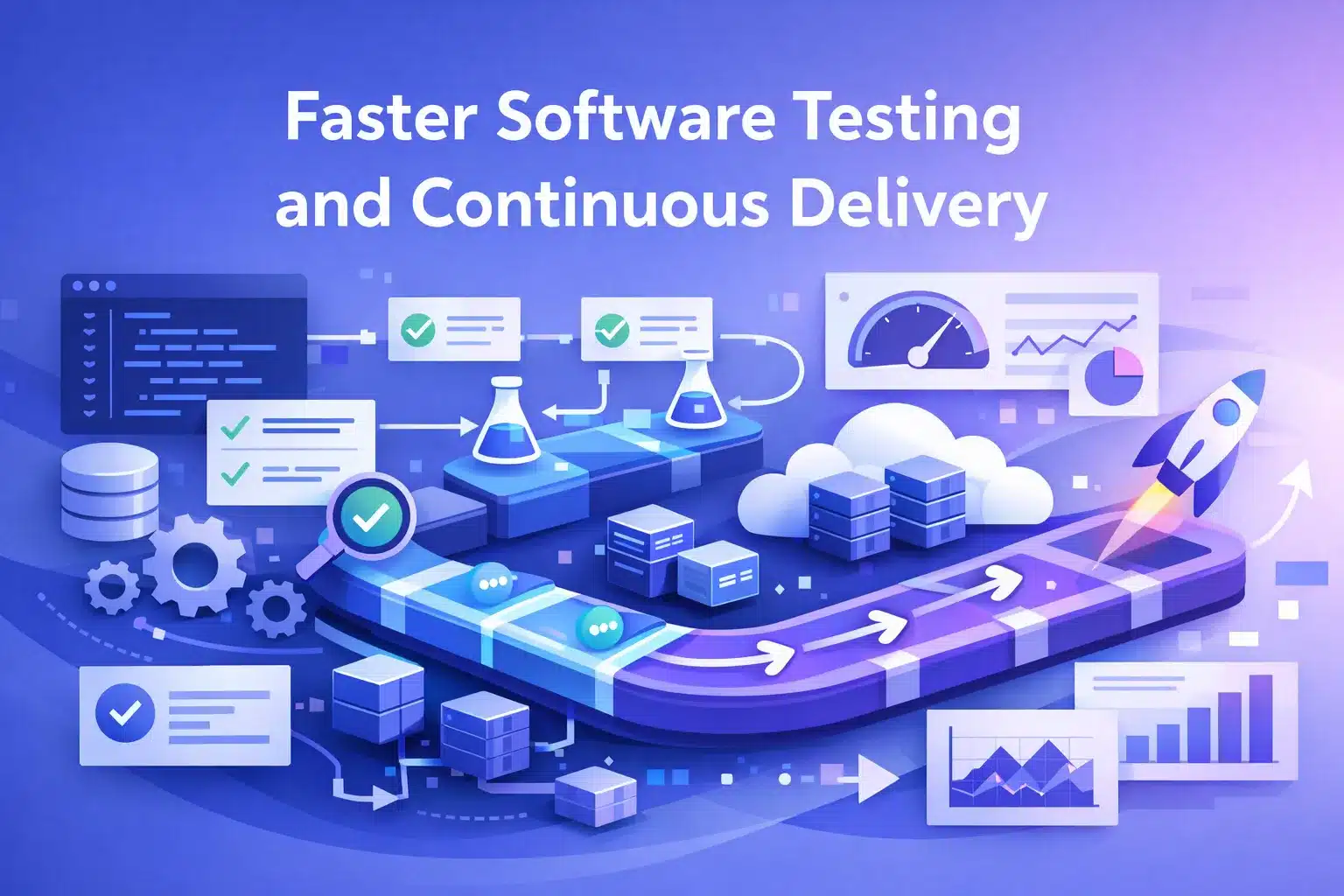
Software teams today are challenged to provide high quality releases at a much faster pace than ever before. As software development cycles become shorter, user expectations continue to increase and products become more complicated, testing becomes a bottleneck in the overall delivery process. Rather than reducing testing, the goal is to evolve testing to be faster, smarter, more automated and more dependable.
This guide will offer effective approaches for both small startups and large enterprises with complex systems and regulatory compliance issues to enable them to conduct faster tests without sacrificing reliability
Why Faster Testing Matters
Testing has always been essential in software development but its role has changed. Earlier testing occurred toward the end of the release cycle. Today it must occur continuously while code evolves.
Slow and inefficient testing leads to
• Delayed releases
• Higher cost of development
• Production bugs that could have been prevented
• Missed customer expectations
• Reduced engineering productivity
Testing needs to support modern development cycles. Faster testing is not just shortened execution time. It is about creating a testing process that is efficient, repeatable, automated and aligned with product velocity.
What Faster Testing Means
A testing process qualifies as fast when it consistently delivers rapid feedback, supports continuous delivery and scales with product growth. Key qualities include:
• Speed Test execution should be optimized across unit integration and end to end layers
• Stability Results must be consistent with minimal flakiness
• Automation CI ready automation reduces manual repetition
• Scalability Test strategy should grow with system architecture
• Maintainability Test design should be easy to update and refactor
The principles of faster testing remain the same across small and large teams. What differs is the scale of implementation.
When Faster Testing Happens: Shift-Left and Shift-Right
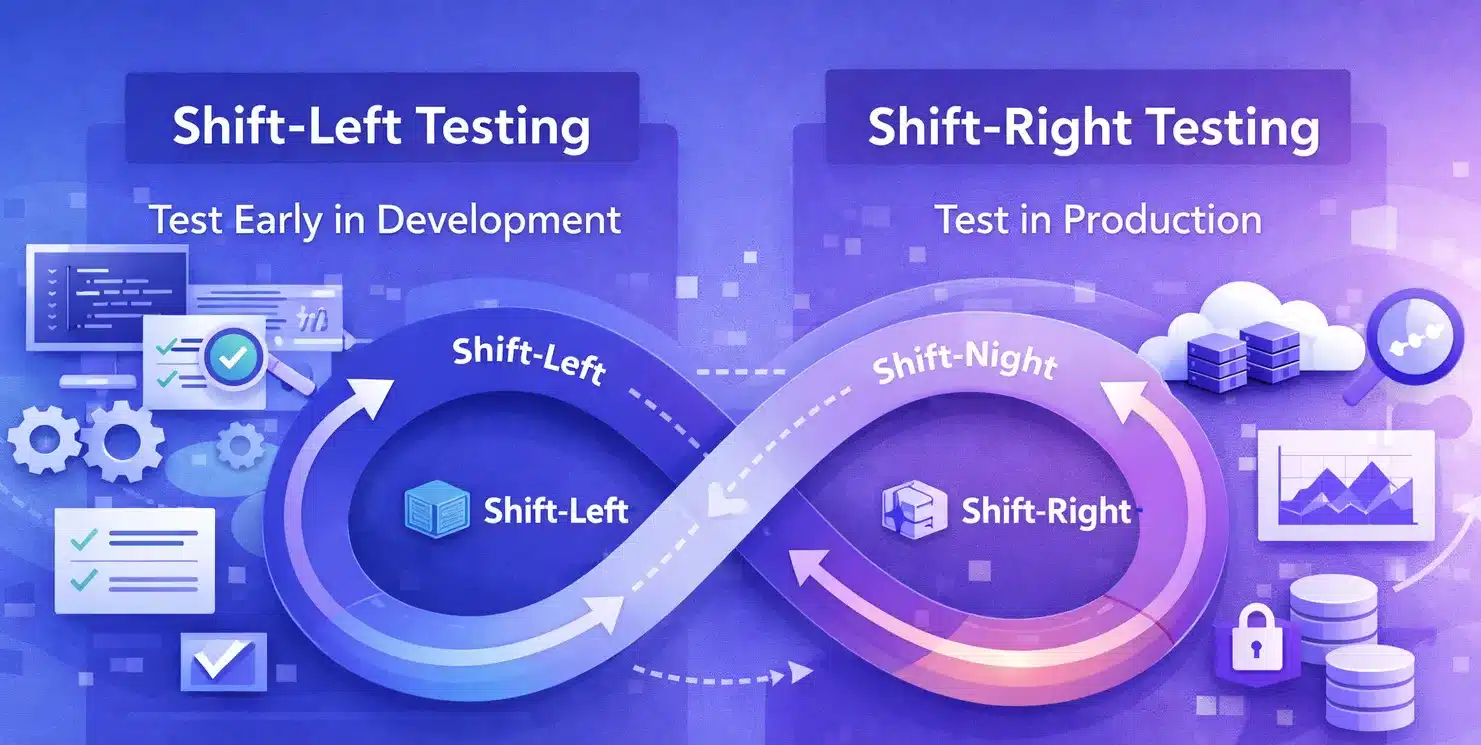
It’s not just about speed of execution, it’s also about when you test. Shift-left testing is to identify and confirm features prior to introduction during the development life cycle to give teams an early understanding and insight into what may go wrong that they will then have the ability to correct prior to incurring high cost to fix after production.
Shift-right testing complements this tactic by confirming the behaviour of features in production-like conditions (production) by monitoring and observing the behaviour and usage patterns of the user in "real world" conditions. These repetitive and numerous cycles create strong behavioural feedback loops that both increase test reliability and provide for improved quality in the long run.
Faster Testing Strategy for Startups
Start-Ups operate under tight timelines, limited financial resources and high urgency for product releases. The manner in which you test should be very supportive of experimentation and constant iterations to design.
Focus on What is Most Important
Not all features need exhaustive testing when they are first released. Focus on:
• Core product features
• Business Logic that is vital to success
• Workflows that customers will be doing with your product
• Some of the code that has recently been changed
Doing this will provide a meaningful amount of effort placed on testing while providing a good platform to rapidly innovate.
Use a Lean Test Pyramid
A Lean Testing Pyramid is the most efficient way to structure a Testing Strategy and maximise execution and reliability.
• Unit tests should represent the majority because they are fast
• Integration tests should validate API flows and service connections
• End-to-End Tests should be limited to only the most "High Value" scenarios.
A Lean Testing Pyramid avoids slow, unnecessarily cumbersome Testing Suites.
Automate Wisely
Start automation with recurring tasks such as smoke tests regression checks and critical workflows. Avoid attempting full automation too early which may create maintenance overhead.
Stabilizing Test Environments Early
Unstable or inconsistent environments can slow testing more than test execution itself. Startups benefit from using reproducible environments that closely resemble production, along with mocked dependencies to reduce failures unrelated to code changes.
Startup Testing Checklists to Speed Up Testing
Automating smoke tests for critical user flows, creating mock-ups of external services/APIs to eliminate dependencies and minimize risk, and using a limited number of scenarios to fully cover an entire process (high impact only), is essential for startup companies. Automated Test Generation is used to produce automated tests that repeat previously defined repetitive workflows. Continuous Integration (CI) runs automated tests for each Pull Request (PR), providing immediate feedback to developers and allowing them to continue building while waiting for test results.
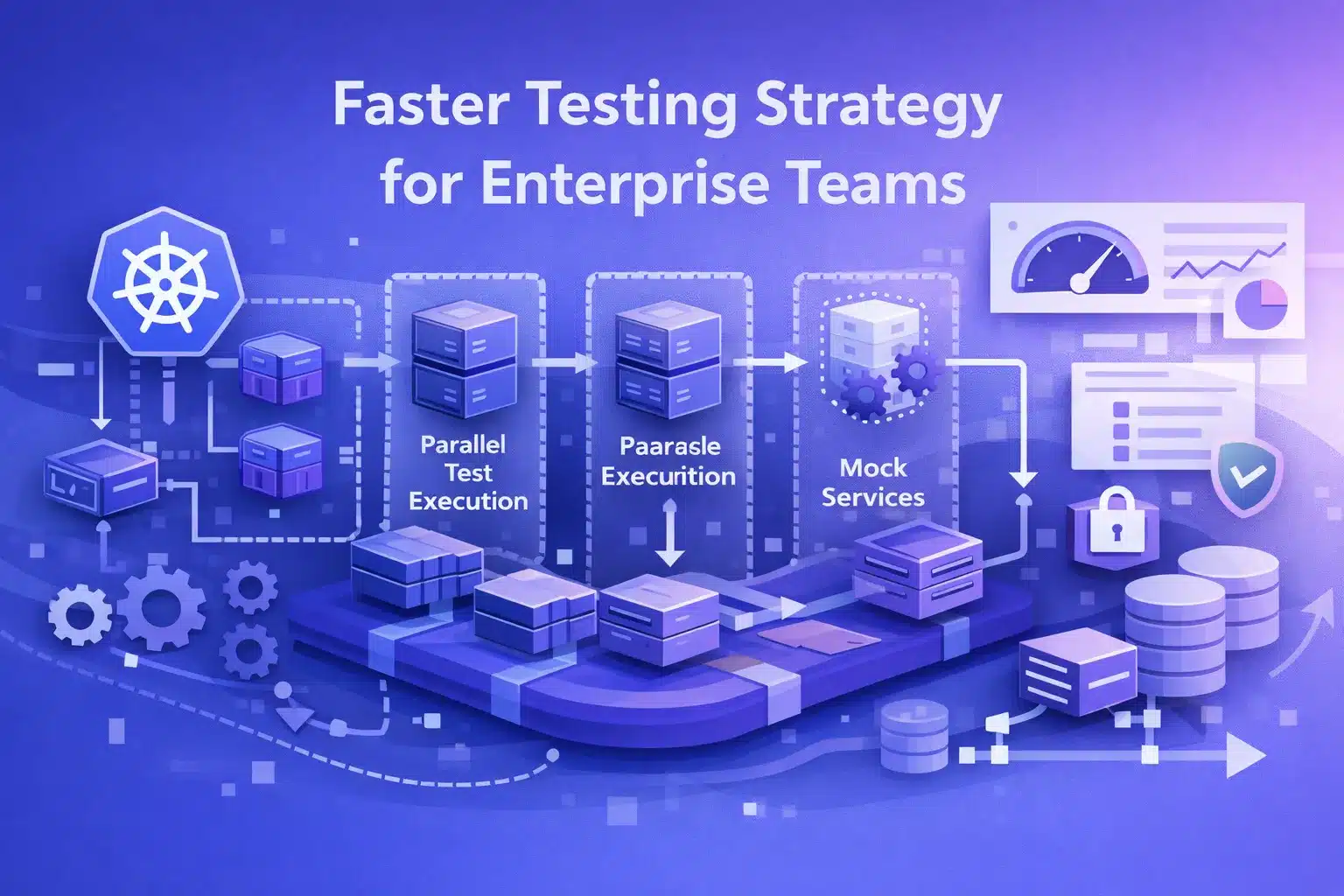
Faster Testing Strategy for Enterprise Teams
Large scale applications distributed systems and diverse integration layers make testing complex in enterprise environments. The goal extends beyond speed to include governance reliability auditability and consistency across teams.
Prioritize Testing By Impacts
Enterprises can cut test execution time and cost by only performing tests related to the most recent code changes instead of executing every test for every change; therefore, they are only running tests that are impacted by code changes.
Test Execution And Distribution (Parallel Testing)
Enterprises can significantly reduce feedback time by
• Running tests in parallel containers
• Using Kubernetes for isolated test environments
• Leveraging caching to avoid repeated setup work
The combined application of these methods allows enterprises to reduce multi hours runs to simple run times.
Mocking And Virtualising Services
Microservice architectures create unstable dependencies that can not only slow down a test’s execution time but can also produce test failures that are independent of recent code changes. The use of mock / simulation tooling such as Keploy allows for consistent test results, as well as a complete and controlled environment for testing that eliminates failed database lookups as an example of an unstable dependency.
Transforming/Test Lifecycle Management And Governance
Enterprises need a structured process to manage and support their test libraries and ensure they remain up to date and provide consistent testing throughout the organisation. Some of the common processes include:
• Clear ownership rules for test libraries
• Removals of redundant tests on a pre-determined schedule
• Almost automatically detect flaky tests
• Application of consistent test design across all teams.
All these processes provide consistency and stability for the testing team through the continued development of their codebase.
Checklist of Strategies to Accelerate Testing
• Concurrent test execution
• Automated detection of flaky tests
• Contract testing for services
• Automated test dependency simulation
• Test prioritization based on changes to the code base
Track Metrics to Measure Testing Improvements
In order for teams to assess their improvement in testing, there are specific metrics that can be used to measure this improvement. These include total test execution length, pull request to deployment time, number of flaky tests, release frequency and test coverage balanced against application performance. Monitoring these metrics will help ensure that testing continues to grow with the product itself.
Faster Testing Is About Confidence, Not Fewer Tests
Faster testing does not mean running fewer tests. It means achieving confidence earlier in the development cycle. Well-designed test strategies maximize signal while minimizing unnecessary execution, allowing teams to move quickly without increasing risk.
Common Pitfalls When Achieving Faster Testing
Teams often struggle because they
• Over automate before stabilizing workflows
• Rely too heavily on end to end testing
• Lack ownership and governance
• Ignore test design maintenance
Faster testing requires strategy not just automation.
Conclusion
Testing faster is the fundamental building block of modern software development; as systems continue to become increasingly complex, and release cycles continue getting shorter and shorter, we must be able to test our system throughout the lifecycle, not just at the end of the cycle.
By taking into consideration the importance of smart automation, prioritizing testing based on risk, focusing on test stability/maintainability, teams can create efficiencies in their ability to test and ultimately enable continuous delivery. When testing can be performed quickly, with repeatability and scalability in mind, it becomes an essential component of product velocity and long-term software quality.
Frequently Asked Questions about Faster Testing
1. What does faster testing mean?
Faster tests mean to shorten the time taken to run the test while still providing accurate results through improvements in automation, feedback cycles and efficiency.
2. How can testing be faster without losing quality?
By making automation more efficient, prioritizing your most important tests, running tests together, using mocks, and removing flaky and/or unused tests.
3. Why is testing slow for many teams?
The majority of delays in test execution stem from the size of the unoptimised test suite, manual steps in the testing plan, flaky tests that do not consistently work or do not perform consistently well enough, environment dependent tests, and inefficient Continuous Integration (CI) pipelines.
4. Should startups automate testing early?
Yes, but in a limited way. Automating core flow tests, smoke tests, and regression tests early will give a high Return on Investment (ROI) and will avoid the need for excessive engineering.
5. How can end-to-end testing be sped up?
Focus on testing only the most important scenarios, using mocks and the ability to run multiple tests together, and replacing manually executed test cases with those recorded in a real environment.

Leave a Reply