API testing services help organizations validate API functionality, performance, security, integrations, and reliability across the software lifecycle. These services are typically delivered by QA teams, testing vendors, or automation platforms to ensure APIs work correctly in real-world environments.
APIs are no longer just backend infrastructure—they are the backbone of modern digital products. Whether you’re building a SaaS platform, fintech application, or healthcare system, APIs connect services, manage data, and power user experiences.
However, API failures remain one of the most common and costly causes of production issues. According to the 2024 Postman State of the API report, over 55% of organizations cite API quality issues as a major blocker to faster releases.
This is where API testing services play a critical role. In this guide, we’ll explore what API testing services are, who provides them, the tools involved, and how modern solutions like Keploy are transforming API testing.
What Are API Testing Services?
API testing services are professional quality assurance solutions designed to validate that APIs function correctly, securely, and reliably across different environments. These services are typically delivered by in-house QA teams, specialized testing vendors, or modern automation platforms.
Unlike UI testing, which focuses on what users see, API testing services operate at the logic and data layer. They verify request-response behavior, authentication, data integrity, performance, and integrations under real-world conditions.
These services are especially critical for businesses operating in regulated industries such as fintech, healthcare, and SaaS. API failures can lead not only to poor user experience but also to compliance violations, including standards like PCI-DSS, HIPAA, and SOC 2.
By ensuring APIs perform consistently and securely, API testing services help organizations deliver stable, scalable, and production-ready applications.
DIY API Testing vs. Professional Services
Open-source tools have made basic API testing accessible to every developer—but tools don’t equal strategy. Here’s what separates teams that test well from those that merely test:
-
Coverage depth: DIY testing often focuses on happy paths. Professional services and platforms like Keploy ensure edge cases, failure modes, and security scenarios are covered.
-
Maintenance overhead: Manually maintained test suites degrade quickly. Keploy’s record-and-replay approach keeps tests aligned with real API behavior.
-
CI/CD integration: Without automation, testing becomes a bottleneck instead of a safeguard.
-
Security coverage: Comprehensive security testing requires both automation and expert review.
Who Provides API Testing Services

API testing services can be delivered by different providers depending on project complexity:
-
In-house QA teams\
Suitable for organizations with strong internal engineering resources. -
Specialized testing vendors\
Offer scalability and expertise for complex testing needs. -
Consulting firms\
Help design testing strategies and optimize frameworks. -
Managed service providers\
Handle end-to-end testing, including execution and monitoring. -
Automation platforms\
Provide scalable, CI/CD-integrated API testing solutions.
Types of API Testing in API Testing Services
API testing services typically include multiple testing approaches to ensure APIs perform reliably, securely, and efficiently across different use cases.

1. Functional Testing
Validates that API endpoints return correct responses for given inputs, including edge and negative cases.
2. Performance & Load Testing
Evaluates API performance under traffic using tools like Apache JMeter or k6 to identify bottlenecks.
3. Security Testing
Detects vulnerabilities such as broken authentication, data exposure, and injection attacks.
4. Integration Testing
Ensures APIs work correctly with databases, services, and third-party systems.
5. Contract Testing
Validates that APIs adhere to agreed schemas and behaviors between providers and consumers.
How to Get Started with API Testing Services

1. Audit your current API coverage: Identify which APIs are untested or rely on manual QA. Prioritize customer-facing and data-sensitive endpoints first.
2. Choose the right API testing approach or service provider based on your team’s needs, system complexity, and scalability requirements.
3. Integrate into CI/CD: API tests only provide value when they run automatically. Set up GitHub Actions or your preferred pipeline to trigger API test suites on every pull request.
4. Define quality gates: Set minimum pass thresholds for coverage, response time SLAs, and security scan results. Fail builds that don’t meet them.
5. Monitor in production: Testing doesn’t end at deployment. Use API monitoring to catch regressions and performance degradation in production before your users do.
Tools Engineering Teams Rely On
Keploy
Keploy is best suited for teams looking to automate API testing without writing manual test cases. It captures real API traffic and converts it into test cases and mocks automatically. This makes it ideal for fast-moving development teams working with microservices and CI/CD pipelines. However, teams may still need additional tools for advanced performance testing or deep security analysis.
Postman
Postman is widely used for manual API testing and team collaboration. It provides a user-friendly interface for creating and managing API requests, making it ideal for frontend developers and QA teams. However, it requires manual effort to maintain test collections and is not designed for large-scale automated regression testing.
RestAssured
RestAssured is a Java-based framework used by backend developers for automated API testing. It is powerful for writing custom test logic and integrating into development workflows. However, it requires programming knowledge and can be time-consuming to maintain as APIs evolve.
Apache JMeter
JMeter is primarily used for performance and load testing. It allows teams to simulate high traffic and evaluate how APIs behave under stress. It is best suited for DevOps and performance engineering teams, but it is not ideal for functional API testing or test case management.
SoapUI / ReadyAPI
These tools are designed for enterprise-level API testing, supporting SOAP, REST, and GraphQL. They offer advanced scripting and testing capabilities, making them suitable for large QA teams. However, they can be complex to use and may require licensing for full features.
Karate DSL
Karate DSL combines API testing, mocking, and performance testing in a single framework. It is useful for teams looking for a unified testing approach. However, adoption can be slower due to its specific syntax and learning curve.
How Modern Platforms Are Changing API Testing
Traditional API testing often comes with several challenges. Teams need to write and maintain test cases manually, manage test environments, and deal with flaky tests caused by external dependencies. As APIs evolve, maintaining test suites becomes time-consuming and resource-intensive.
Modern API testing platforms are addressing these challenges by introducing automation and real traffic-based testing approaches. Instead of relying entirely on manually written test cases, these platforms can capture actual API interactions and convert them into reusable tests.
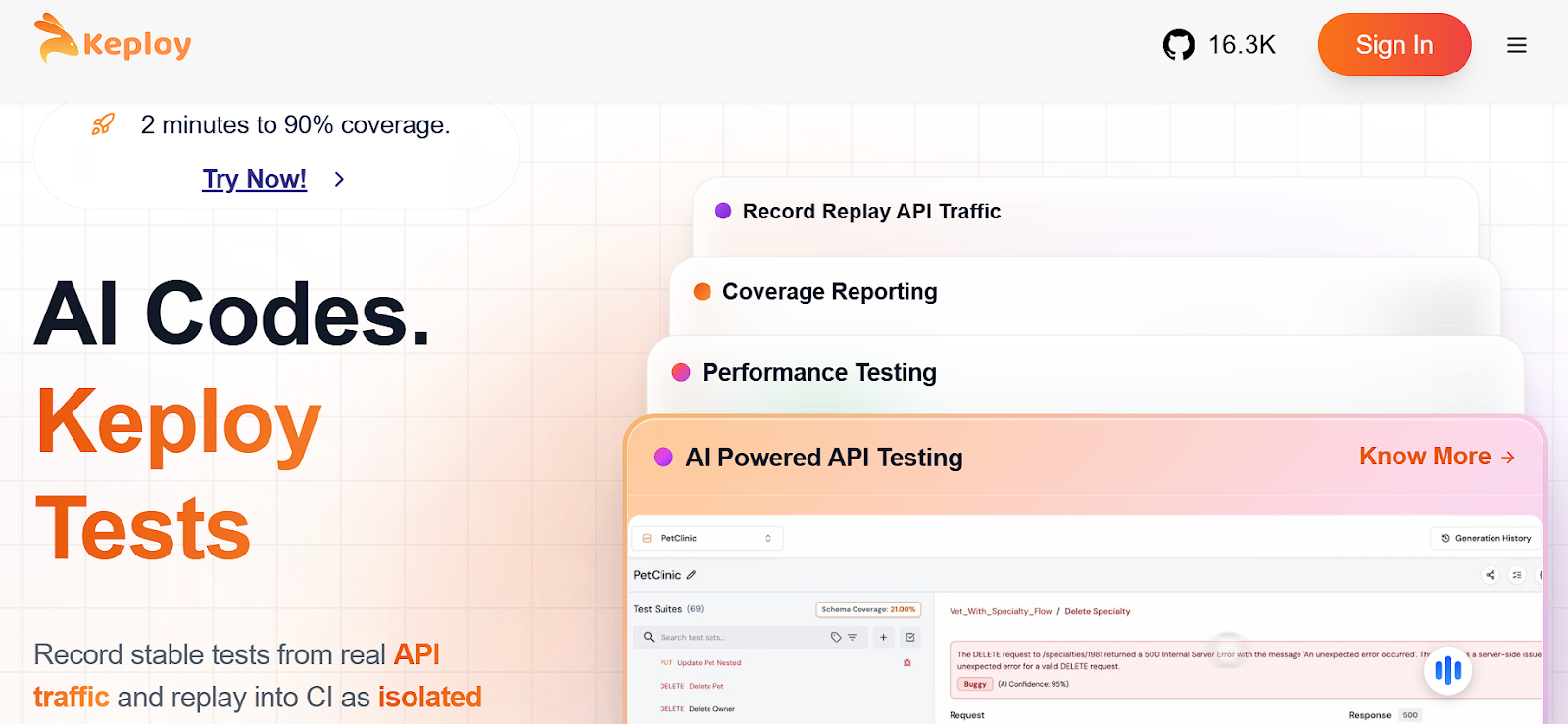
Most API testing tools require you to write tests manually, a time-consuming process that slows down already-stretched engineering teams. Keploy takes a fundamentally different approach: it records real API traffic from your running application and automatically converts it into test cases and mocks.
How Keploy Simplifies API Testing
Keploy follows a record-and-replay approach that helps teams reduce manual effort and improve test coverage.
-
Automatic test generation
Keploy captures real API traffic and converts it into test cases, reducing the need for manual scripting. -
Dependency mocking
External services such as databases or third-party APIs are automatically mocked, helping teams avoid flaky tests. -
CI/CD integration
Tests can run automatically in CI/CD pipelines, allowing teams to validate API behavior with every code change. -
Faster regression testing
By reusing captured traffic, teams can quickly validate API changes without rebuilding test scenarios from scratch.
This approach makes Keploy particularly useful for development teams working with microservices and continuous delivery environments.
API Testing Services by Industry Vertical
Different industries face different API testing challenges. Here’s what teams need to prioritize:
Fintech & Banking
Payment APIs, authentication flows, and transaction processing require rigorous functional, security, and performance testing. PCI-DSS compliance mandates regular security assessments of any API handling cardholder data.
Healthcare
FHIR and HL7 APIs connecting EHR systems, insurance platforms, and patient apps must be tested for HIPAA compliance, data integrity, and availability. A failed API in a clinical workflow isn’t just a bug, it’s a patient safety risk.
E-Commerce & Retail
Inventory, checkout, and shipping APIs must handle peak traffic spikes, like holiday sales, without degrading. Load testing and chaos engineering are essential for retailers with high seasonal demand.
SaaS & Cloud Platforms
Multi-tenant SaaS platforms must ensure API isolation between customers and consistent uptime across regions. Contract testing and regression suites are critical as APIs evolve across multiple versions simultaneously.
The Bottom Line
API quality directly impacts product quality. For fast-moving engineering teams, API testing services are essential for ensuring reliability, performance, and security.
Organizations should evaluate whether to:
-
Use in-house testing
-
Outsource to vendors
-
Adopt automation platforms
The right choice depends on scale, complexity, and delivery goals.
What to Look for in API Testing Services
When selecting an API testing service provider, consider the following factors:
-
Testing capabilities — Ensure the provider covers functional, performance, security, and integration testing
-
Automation and tooling — Look for strong automation support and CI/CD integration
-
Scalability — The service should handle growing API complexity and traffic
-
Security and compliance — Important for industries like fintech and healthcare
-
Pricing model — Understand whether pricing is fixed, usage-based, or subscription-driven
SLA and reliability — Evaluate uptime guarantees, reporting, and issue resolution timelines
A well-chosen API testing service can significantly improve software quality while reducing long-term maintenance effort.
Final Thought
Modern API testing platforms are reducing manual effort while improving coverage and speed. Tools like Keploy enable teams to automate testing using real traffic and integrate seamlessly into development workflows.
By combining professional services with automation, organizations can build faster, more reliable, and scalable software systems.

Leave a Reply