
In the digital-first world of today, many applications depend on RESTful APIs as the connectivity placeholder: whether between microservices, mobile applications, third-party integrations or SaaS platforms, it is important for ensuring these APIs are reliable, secure and performant. This is where you can utilize REST API testing.
Key Takeaway: REST API testing validates endpoints for correct status codes, response payloads, headers, authentication, and error handling across HTTP methods. While tools like Postman and REST Assured handle manual and scripted API tests, Keploy automates REST API test generation by capturing real traffic and replaying it with auto-generated assertions and mocks.
No matter your role as a developer, tester, DevOps engineer or automation engineer, an effective REST API testing strategy also helps to ensure that the services you make use of are working as expected, integrate with other services well, and provide good quality user experiences. In this article, we will explain what REST API testing is all about, why it is important, what particular tests you should undertake, how to construct an automation strategy, and what best practices you can apply and pitfalls to avoid.
What is REST API Testing?
REST API testing is the process of verifying the endpoints of a RESTful service function properly and consistently. This involves checking that all endpoints return the proper data, manage valid and invalid inputs, meets performance requirements, and meets security requirements. So, we are "validating the behavior, reliability, performance, and security of your REST API."
Unlike traditional UI testing, which focuses on user interface flows, REST API testing focuses on the backside of the application, that is, the backend data exchange and the HTTP method (GET/POST/PUT/DELETE), request-parameters, response payloads, status codes, headers, etc.
Key characteristics of REST APIs:
-
Stateless: Each request contains all the information needed.
-
Resource-based: URLs represent resources (nouns) rather than actions (verbs).
-
Utilization of HTTP methods (GET, POST, PUT, DELETE etc).
Why REST API Testing Is Important
-
Early feedback & shift-left: As pointed out in Postman’s handbook, performing API testing earlier in the lifecycle (vs waiting to perform GUI testing) will provide faster feedback, discover bugs earlier, and generally support agile/ continuous integration workstreams.
-
Reliability & stability: API errors are downstream (in mobile apps, in integrations) and will affect your end-users. Testing your endpoints will ensure you are not breaking them unexpectedly.
-
Performance & scalability: APIs are often high-velocity, high-demand; testing helps to ensure they respond under load and scale.
-
Security & compliance: APIs are entry points to your data and systems – testing will help you expose vulnerabilities (e.g., authentication, authorization, injection threats).
-
Integration & reuse: In a microservices or SaaS architecture; APIs are reused across client/service; retail/robust testing will ensure safe reuse and compatibility for versions.
Types of REST API Testing
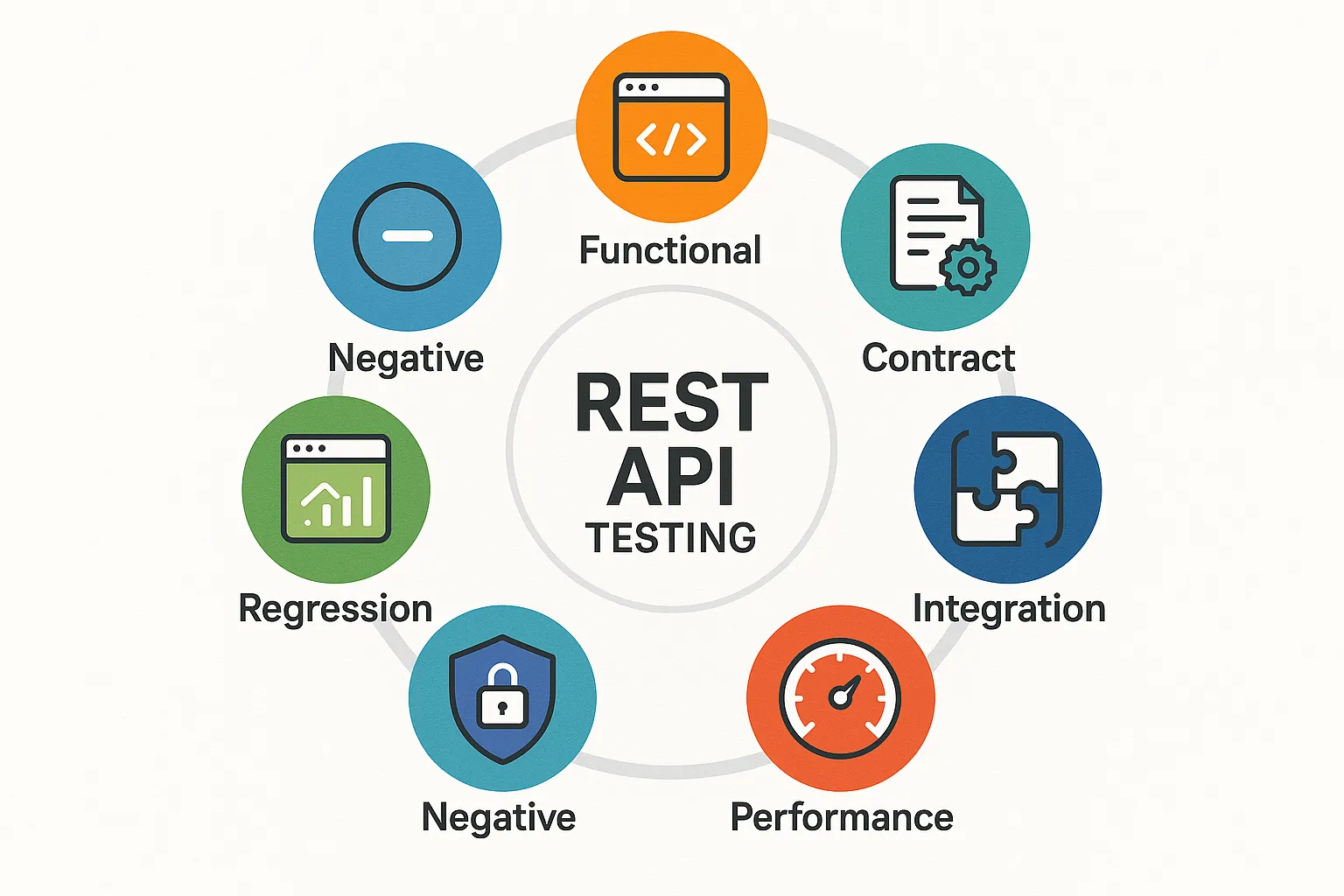
Here are the major kinds of tests you should incorporate:
-
Functional testing
-
Verify that each endpoint responds as expected with valid input values.
-
Test error responses (404 ignoring) for invalid input values, missing values, and incorrect HTTP verbs.
-
validate response payload structure (JSON schema), status codes, headers.
2. Contract / Schema testing
-
Verify that the API is compliant to a defend contract (e.g., OpenAPI/Swagger spec).
-
Detect inadvertent changes to payload response structure and parameter format.
- Integration / End-to-End test
-
Activities that will require multiple calls to different apis in a sequence (e.g. creating resource -> updating > deleting).
-
Verify that this series of API calls work well together across services.
4. Performance & Load testing
-
Measure latency with expected and peak loads.
Test for throughput, concurrency, and stability over time.
5. Security testing
-
Validate authentication, authorization, validation of input, rate limiting, and encryption.
-
Search for the usual vulnerabilities within APIs (injection, over-privileged APIs).
6. Negative and edge-case testing
-
Perform checks of invalid parameter values, edge-cases, omitted fields, unexpected types.
-
Make sure your API includes error handling and resiliency against malformed requests.
7. Regression testing
- After an update, run your complete tests and validate that your endpoint still behaves the same as before (SaaS platforms where external clients rely on the API remaining stable is a good example.)
-
Building a REST API Test Strategy
Here is a hands-on process for establishing a REST API test strategy.
Step 1: Understand and Document APIs
-
Obtain the API specification (OpenAPI/Swagger).
-
Determine all endpoints, methods, parameters, response schemas, authentication flows.
-
Identify all consumer use-cases: internal apps, external clients, partner integrations.
Step 2: Document Test Cases and Coverage
-
For each endpoint, document covering both positive and negative scenarios.
-
Don’t miss to consider any edge-case scenarios. Document your schema validation tests, schema validation will be direct to validate the payload/type of parameters.
-
Define your contract tests (including tests that test – communication with API).
-
Define integration tests (with all of the above). – Identify performance benchmarks (such as response times of less than 500ms, servicing concurrent users over 1000).
Step 3: Tooling for Automated Testing
-
Choose your tooling – Keploy widget for API functional tests along with automated contract/behavioral tests, JMeter or k6 for load/performance tests.
-
Write automation scripts (Python or Java, or in-built tooling).
-
Leverage your CI/CD pipeline to execute API tests continuously on every commit or build (either successful or failed builds) (this is termed as shift-left culture).
Step 4: Integrate into CI/CD & Monitor
-
Insert API testing into your CI/CD pipeline: (example contract tests early or before functional tests on feature builds, performance tests nightly).
-
Set up monitoring key endpoints from the application in production for uptime, error rate, latency.
-
Incorporate versioning and alerting: if a contract fails a test, notify your stakeholders.
Step 5: Maintain & Evolve
-
Maintain your test suites: as API’s evolve, update your existing tests, add or archive old tests.
-
Version your API contract and your test suites/dependency: when breaking changes occur, if you don’t manage to deprecate, you have broken your clients.
-
Periodically review test coverage, endpoint usage, error logs and optimize tests if needed.
Modern Considerations & Advanced Topics
-
Microservices / Chained workflows: REST APIs (or setups) in more complicated systems will often follow calls that depend on each other (for example create a resource in service A, then update the same resource via service B). Your end-to-end tests need to reflect the order of calls and/or state.
-
Contract testing and consumer‐driven testing: Particularly in SaaS ecosystems or partner integrations, you might use consumer-driven contract testing (e.g., Pact) so that your API changes don’t break clients.
-
Fuzz & mutation testing: According to Code Intelligence, fuzzing (randomizing the large combinations of parameters) can uncover edge-bugs that current testing does not discover.
-
Versioning & backward compatibility: Whenever you launch v2 of your API, you must continue to support v1 in some meaningful way for consumers.
-
Security at scale: APIs are increasingly frequent attack surfaces. Tools and tests around authentication, authorisation, rate-limiting, threat detection (OWASP API top10) are essential.
-
Automation & AI-driven testing: New research (e.g. using LLMs) demonstrates data-driven approaches using ML/AI methods to train test generations for REST APIs.
-
Your automation context: Considering your interest in Python, automated workflows, and SaaS, you can use Python libraries and develop test suites integrated with your analytics APIs to enable both functional and performance tests as part of your publishing flow.
Best Practices & Pitfalls to Avoid
-
Treat APIs like first-class product: Define contracts, document, and version it.
-
Shift-left: Test early and often.
-
Use mocks/stubs to isolate tests from dependent services.
-
Automate your tests as much as possible: Functional, contract, performance, security tests.
-
Have an environment that closely mirrors production.
-
Monitoring and measurement: Observe test coverage, latency, errors.
-
Add tests to your CI/CD pipeline (build → tests → deploy).
-
Version gracefully: Support multiple versions, communicate deprecation.
-
Utilize schema validation and contract tests to reduce the opportunities for payload modifications and for causing unintended side effects.
-
Employ a data-driven approach in testing processes and design tests to be parameterizable, and reused when possible.
-
Think of load/performance tests in the early, not only later on in the cycle.
Pitfalls to avoid:
-
Always relying on GUI tests and omitting API tests (slow, brittle).
-
Having a process to manually run ad-hoc API tests assuming the tests are automated; they are not.
-
Forgetting to also think about test cases that are negative/edge/state (only are happy path).
-
Failing to consider API-versioning and backward-compatibility of the API.
-
Not having an appropriate level of documentation or working off obsolete specs causing confusion.
-
Running your performance tests toward the end of the process (driving up resolution costs).
-
Treating API testing as isolated tests rather than from workflows of integration.
-
Not giving adequate priority to security and performance testing of APIs
Example: Python Automation Snippet
Here’s a simple Python test snippet using requests and pytest to validate a REST API endpoint:
xml
import requests
import pytest

BASE_URL = "https://api.yourservice.com/v1"

def test_get_users_success():
    response = requests.get(f"{BASE_URL}/users",
                             headers={"Authorization": "Bearer Keploy-TOKEN"})
    assert response.status_code == 200
    body = response.json()
    assert "users" in body
    assert isinstance(body["users"], list)

@pytest.mark.parametrize("user_id", [1, 9999, "abc"])
def test_get_user_edge_cases(user_id):
    response = requests.get(f"{BASE_URL}/users/{user_id}",
                             headers={"Authorization": "Bearer TOKEN"})
    if isinstance(user_id, int) and user_id < 1000:
        assert response.status_code == 200
    else:
        assert response.status_code in (400, 404)
This is a starting point. In real automation you’d add schema validation, contract tests (maybe using schemathesis), integrate into CI, run performance tests, etc.
Conclusion
Testing REST APIs is not optional; it is a requirement best practice for generating quality, reliability, performance, and performance in the modern software ecosystem. A considered, "structured" approach may include defining test versions, establishing test automation throughout the software lifecycle, connecting versioning and dependencies, CI/CD pipeline requirements, etc.
Indeed, a structured approach provides you (and/or your team) the opportunity to identify issues sooner, lower maintenance costs, facilitate better scaling, and provide better business value.
Since you’re focused on automation, since you program in Python, and since you’re working with SaaS tools like Keploy, you are in a position to take REST API testing approaches, beyond just the fundamentals – to incorporate into your blog workflows, tool-stack, data pipelines, and open partner APIs. Maybe this can be a model for you when designing a solid API testing framework.
FAQs
Q1. What are some good tools for testing a REST API?
There are many: Postman, Insomnia, JMeter, k6, SoapUI, Testfully, etc. Each one has its own value or advantages depending on functional testing vs load testing vs monitoring.
Q2. How frequently should I fire off API tests?
Ideally, you are running functional/contract tests on every commit (CI build). Performance/security tests you could run nightly or before a large release.
Q3. Should I test via UI or API first?
API tests provide faster feedback, more stable tests, and should be an early part of your automation strategy. UI tests still matter, but they should not be your only layer.
Q4. What is contract testing?
Contract testing is verifying that your API implementation matches the pre-defined spec (e.g. OpenAPI), which is especially useful when you have multiple clients/consumers depending on your API.
Q5. How should I manage API versioning in tests?
Maintain test suites by each version (v1, v2, etc). When one is deprecated, test the fallback behavior. Communicate clearly to consumers.
Q6. What are common mistakes in testing REST APIs?
Skipping negative/edge-cases, not testing performance/security, documentation becomes stale/outdated, insufficient tests and automation, not accounting for workflow/chained calls.

Leave a Reply