Service virtualization tools don’t all solve the same problem. One team needs to simulate a single flaky HTTP dependency in CI. Another is dealing with mainframe middleware and legacy messaging protocols that most tools don’t touch. A third is running microservices on Kubernetes and wants traffic captured automatically without writing a single stub file.
The category has expanded fast. There are legacy enterprise platforms, open-source stub servers, Kubernetes-native sandboxes, and a newer generation that generates virtual services automatically from observed traffic. Getting the evaluation right upfront saves more time than the evaluation itself takes.
What are Service Virtualization Tools?
Service virtualization tools create simulated versions of external dependencies: APIs, databases, message queues, or third-party services – so development and testing can continue without the real system being available, stable, or cost-effective to call. Unlike mocks, which live inside test code, virtual services run as independent processes that intercept real network traffic and return controlled responses across the full team’s test environment.
What to Look for in a Service Virtualization Tool
The criteria that matter in 2026 are different from the ones that mattered five years ago. Protocol breadth still matters, but it’s not where the decision lives for most teams.
-
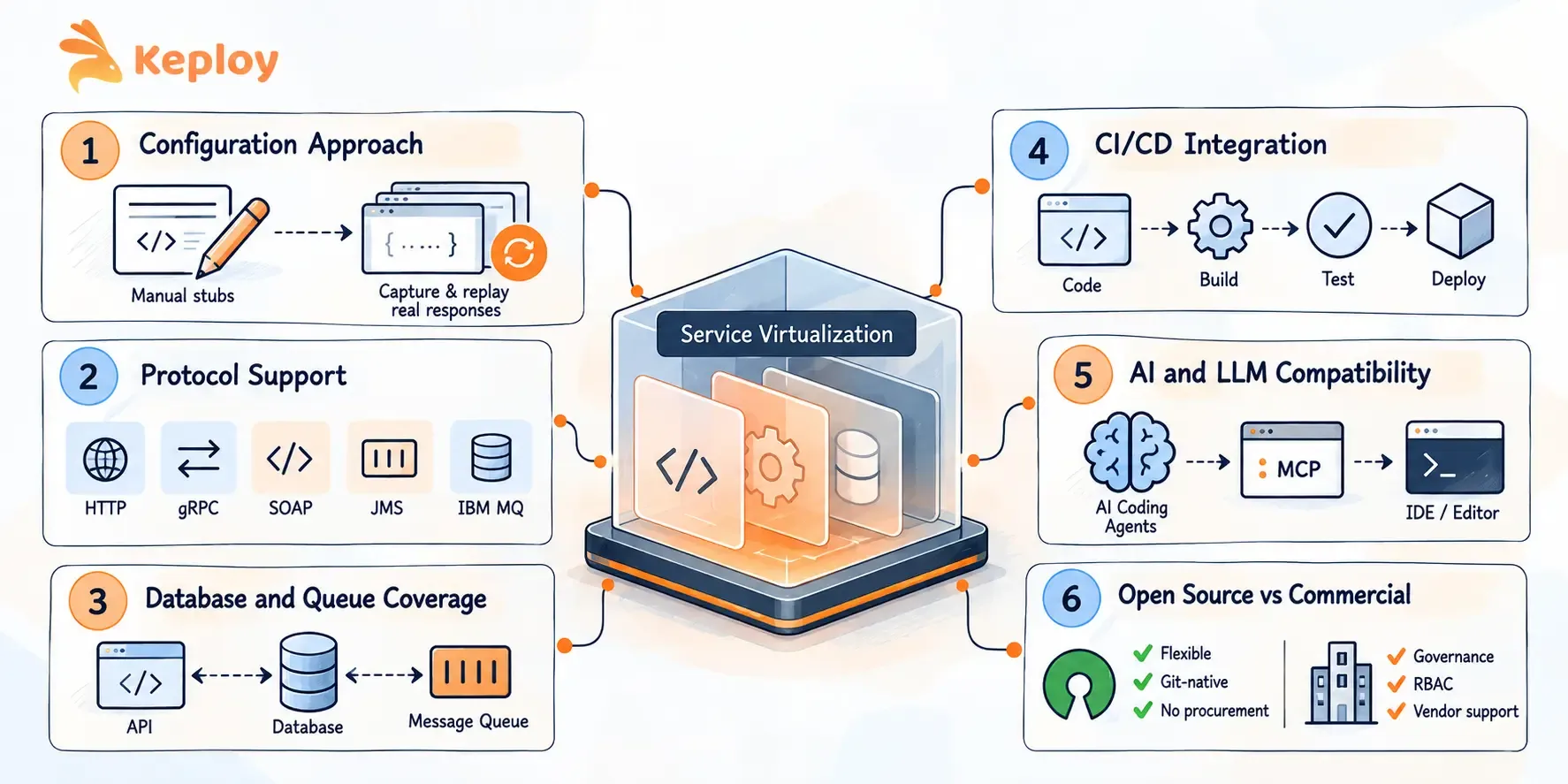
Configuration approach. Traditional tools require manual stub authoring: an engineer specifies which requests the virtual service should match and what it should return. Smart service virtualization tools work differently. They capture what the real service actually returned during a live run and replay those responses automatically. The difference in ongoing maintenance cost between these two approaches is significant.
-
Protocol support. HTTP is baseline. Teams with legacy environments need SOAP, JMS, or IBM MQ. Kubernetes-native teams typically add gRPC and Kafka. Know your actual dependency landscape before evaluating feature lists.
-
Database and queue coverage. Most HTTP-focused tools miss the full dependency chain. When an API endpoint queries a database and publishes to a queue before it responds, virtualizing only the HTTP surface leaves gaps. Very few open-source tools cover all three.
-
CI/CD integration. A tool that runs fine on a developer laptop but needs manual steps in CI is a hidden cost. Check whether configuration lives in code, whether there’s a CLI, and whether the tool runs as a container.
-
AI and LLM compatibility. Tools that expose MCP servers let AI coding agents like Claude Code and Cursor interact with virtual services directly from the development environment. For teams where AI-assisted development is already part of the workflow, this matters more than most feature comparisons show.
-
Open-source vs commercial. Open-source tools skip the procurement loop and fit naturally into git workflows. Commercial tools add governance, RBAC, and vendor support. The right answer depends on team size and compliance constraints.
Top 10 Tools at a Glance
|
Tool |
Type |
Protocol support |
Open source |
DB and queue coverage |
Best for |
|
Keploy |
Traffic-capture |
HTTP, gRPC + DB, queues |
Yes (Apache 2.0) |
Yes: SQL, NoSQL, Kafka, RabbitMQ |
Modern teams, Kubernetes, AI-native workflows |
|
Parasoft Virtualize |
Enterprise SV |
REST, SOAP, JDBC, JMS, MQ, 120+ formats |
No |
JDBC only |
Legacy enterprise, mainframe dependencies |
|
WireMock |
Stub server |
HTTP, HTTPS, gRPC (extension) |
Yes (OSS) |
No |
HTTP-focused CI, quick stub setup |
|
Hoverfly |
Traffic-capture |
HTTP, HTTPS |
Yes |
No |
Git-versioned simulation files |
|
Signadot |
Kubernetes sandbox |
HTTP, gRPC |
No |
Via real services |
Microservice teams on Kubernetes |
|
Speedscale |
Traffic-capture + perf |
HTTP, gRPC |
No |
Yes: Postgres, Kafka, others |
Traffic replay with performance validation |
|
Testcontainers |
Test infrastructure |
Real service protocols |
Yes |
Yes (real containers) |
Integration tests needing real instances |
|
LocalStack |
Cloud simulation |
AWS service APIs |
No (free Hobby plan, non-commercial) |
AWS: DynamoDB, SQS, S3 |
Testing AWS-dependent code locally |
|
Traffic Parrot |
Multi-protocol SV |
REST, SOAP, gRPC, JMS, IBM MQ, Thrift |
No |
Queues only: IBM MQ, JMS, RabbitMQ, ActiveMQ (no DB) |
IBM MQ and JMS-heavy environments |
|
Broadcom (CA LISA) |
Enterprise SV |
SOAP, REST, JMS, IBM MQ, JDBC |
No |
JDBC |
Organizations maintaining legacy LISA libraries |
How I Evaluated these Tools
Every tool on this list was assessed against the same criteria:
-
Protocol coverage beyond HTTP
-
How virtual services get created (manual configuration vs. traffic capture)
-
CI/CD integration without extra setup steps
-
Database and queue coverage alongside API-level simulation
-
How well each tool fits modern cloud-native stacks.
Pricing transparency, open-source licensing, and active maintenance status were also factored in, since a tool that’s effectively abandoned is a real risk for teams building long-term test infrastructure.
The 10 Best Service Virtualization Tools in 2026
1. Parasoft Virtualize
Parasoft Virtualize covers ground that most tools on this list don’t touch: SOAP, JDBC, JMS, IBM MQ, RabbitMQ, and over 120 message formats. For organizations where mainframe dependencies and messaging middleware are real constraints rather than edge cases, that protocol breadth is a genuine differentiator.
Parasoft is built around a centralized testing model. Virtual services are typically authored in desktop tooling and deployed to Virtualize servers, which Parasoft ships as official Docker images with Kubernetes deployment support. Since the 2026.1 release, a Virtualize MCP server lets LLM clients and AI-enhanced IDEs generate, deploy, and manage REST virtual services. Teams upgrading from older versions need an updated license to use the MCP features.
Setup is heavier than lightweight stub servers, and the licensing model is built for enterprise procurement. If your dependency landscape genuinely includes mainframe CICS, IBM MQ, and JDBC together, Parasoft is one of the few tools that handles all of them. For teams whose dependencies are HTTP and gRPC, the cost and complexity are hard to justify.
Key features:
-
120+ protocol and message format support including SOAP, JDBC, JMS, and IBM MQ
-
Visual tools for building response logic without scripting
-
Test environment orchestration integrated with API and load testing
-
AI Assistant for natural-language virtual service creation, plus a Virtualize MCP server for LLM clients and AI IDEs (2026.1+)
Best for: Large enterprise teams with mainframe, MQ, or legacy protocol dependencies.
Pricing: Enterprise license, quote-based. No public pricing available.
Limitations: Enterprise licensing with quote-based pricing, heavier setup than lightweight stub servers, and authoring centred on desktop tooling. MCP features require an updated license for existing customers.
2. Keploy
What separates Keploy from most tools on this list is how much of the dependency chain it records automatically. Most tools require an engineer to write stubs manually, specifying what each request should return. Keploy runs the application in record mode and captures what the real dependencies actually returned: HTTP calls, database queries, gRPC interactions, queue operations, all in one session at the kernel level via eBPF. No code changes. No proxy configuration. No stub files to author.
Keploy is built for modern teams and modern stacks. It runs natively on Kubernetes. Teams can deploy it as part of a cluster, capture traffic from staging or canary environments, and replay that traffic in CI without any live dependency present. The tech is cloud-native from the ground up, not a desktop tool adapted for containers.
In 2026, Keploy also integrates natively with AI coding environments. The MCP server integration means Claude Code, Cursor, and other LLM-powered development tools can interact with Keploy directly to generate, inspect, and replay virtual services with full codebase context. For teams where AI-assisted development is already part of the workflow, virtual service generation happens alongside code generation rather than as a separate manual step.
The coverage goes beyond what HTTP-only tools can see. When an endpoint queries PostgreSQL, calls a downstream service, and publishes to Kafka before responding, Keploy captures all three in one recording session and replays all three in CI. That’s the full dependency chain, not just the HTTP surface.
Key features:
-
eBPF traffic capture at the kernel level: HTTP, gRPC, SQL, NoSQL, Kafka, RabbitMQ in one session
-
MCP server integration (Keploy platform) with Claude Code, Cursor, GitHub Copilot, and other AI coding environments.
-
Native Kubernetes support for cluster-level traffic capture and replay
-
No code changes, no proxy setup, no stub files required
-
Automatic noise detection handles timestamps and generated IDs in replay
-
Open source under Apache 2.0
Best for: Modern backend teams with microservice architectures, Kubernetes deployments, and AI-assisted development workflows who want full dependency coverage without manual configuration.
Pricing: Open source (Apache 2.0). Keploy Enterprise adds team features and centralized capture management.
Limitations: Requires Linux for eBPF (standard in most CI and Kubernetes environments). Capture-based approach needs real traffic to start. Greenfield services with no traffic yet are better served by configuration-based tools initially.
3. WireMock
WireMock has been the default choice for HTTP service virtualization for over a decade, and the fundamentals are solid. JSON or DSL stub configuration, strong CI integration, wide language support for configuration clients, and an active open-source community with deep documentation.
The OSS version runs as a standalone JAR or Docker container. WireMock Cloud adds a SaaS layer with team collaboration features, OpenAPI import, and an MCP server for AI coding tool integration, launched in 2025.. Both versions share the same stub matching engine, so migration between them doesn’t require rewriting virtual service definitions.
Key features:
-
JSON and DSL stub configuration with Handlebars templating
-
Request matching on URL, method, headers, body, and query parameters
-
Stateful scenario support for multi-step flows
-
Docker and CLI support for CI pipelines
-
gRPC mocking via the official WireMock gRPC extension
-
WireMock Cloud adds MCP server, OpenAPI import, and team collaboration
Best for: Teams virtualizing HTTP dependencies who want the most widely supported open-source option with a clear path to enterprise capabilities.
Pricing: OSS is free. WireMock Cloud has usage-based pricing with a free tier.
Limitations: HTTP and HTTPS natively, gRPC through an official extension. Stub maintenance is manual when real services change.
4. Hoverfly
Hoverfly uses a proxy-based architecture: run your application through Hoverfly in Capture mode and it records every HTTP exchange. Switch to Simulate mode and Hoverfly returns the captured responses without touching the real service. The simulation files are plain JSON and commit naturally to git.
The six operating modes (Capture, Simulate, Spy, Synthesize, Modify, and Diff) give teams. Diff mode is particularly useful: it compares live API responses against recorded simulations and surfaces changes automatically, which gives teams an early signal when a real service’s behavior has drifted from what the simulation reflects.
Key features:
-
Six operating modes for different testing scenarios
-
Simulation files in JSON format, git-friendly and version-controlled
-
Proxy-based capture without application code changes
-
Diff mode surfaces drift between live service and simulation
-
Go binary and Docker image available
Best for: Teams wanting lightweight HTTP traffic capture with git-versioned simulations and no configuration overhead.
Pricing: Open source (Apache 2.0). Hoverfly Cloud has paid tiers.
Limitations: HTTP and HTTPS only. No database or queue coverage. Limited stateful scenario support compared to WireMock.
5. Signadot
Signadot takes a different approach from every other tool on this list. Rather than simulating a dependency, Signadot creates isolated test environments within a real Kubernetes cluster. A developer creates a sandbox containing only the changed service. Test requests are routed to it, while every other dependency is served by a shared baseline environment, usually staging. RouteGroups combine several sandboxes when a feature spans multiple services.
The result is integration testing against real services. There’s no mock drift because there are no mocks. Dependencies are real services running in the baseline environment, and only requests carrying the sandbox’s routing key reach the changed version.
Key features:
-
Kubernetes-native: sandboxes isolate test traffic at the request level without duplicating the environment.
-
Tests run against real services, eliminating simulation accuracy concerns
-
No stub configuration or maintenance required
-
Supports any Kubernetes service regardless of language or framework
Best for: Microservice teams on Kubernetes who want integration testing against real services without maintaining a separate simulation layer.
Pricing: Commercial, usage-based. Free tier available.
Limitations: Requires Kubernetes infrastructure. Real service dependencies must be running in the cluster. Not applicable for teams that need to virtualize unavailable or expensive third-party services.
6. Speedscale
Speedscale captures live API traffic from production or staging environments using eBPF and replays that traffic against new service versions to validate both functional behavior and performance characteristics. The focus is dual: functional regression and performance SLO validation in one replay run.
The traffic capture is language-agnostic and doesn’t require code changes. Speedscale deploys as a sidecar or node-level agent in Kubernetes environments and captures all inbound and outbound traffic automatically. Snapshot testing compares the new version’s behavior against a baseline captured from the previous version. Speedscale also auto-generates service mocks from recorded traffic, covering REST, gRPC, databases such as Postgres, queues such as Kafka, and cloud services.
Key features:
-
eBPF traffic capture from production or staging
-
Traffic replay with performance metrics: latency, throughput, error rate
-
Assertions on both functional correctness and performance SLOs
-
Kubernetes-native deployment as a sidecar or node agent
-
Snapshot testing compares new versions against established baselines
-
Auto-generated service mocks from captured traffic, including Postgres and Kafka
Best for: Teams wanting to validate both functional correctness and performance of new service versions against recorded production traffic in a single run.
Pricing: Commercial SaaS, usage-based. Trial available.
Limitations: Commercial product. Strongest fit for Kubernetes teams that want replay and performance validation alongside mocks.
7. Testcontainers
Testcontainers doesn’t simulate dependencies. It starts real Docker containers running the actual dependency and tears them down after the test. PostgreSQL integration test? Testcontainers pulls the official image, starts it, runs the tests, and cleans up. The test runs against the real database engine, not a simulation.
That’s the distinction worth understanding before evaluating it as a service virtualization tool. Testcontainers is test infrastructure for running real service instances in CI. It belongs in this comparison because teams use it to solve the same problem that SV tools address (test without a live shared dependency), but through a different mechanism: real containers rather than simulations.
Key features:
-
SDKs for Java, Go, Python, Node.js, .NET, and more
-
Integrates with JUnit, pytest, Go testing package, and other test frameworks
-
Supports any service with a Docker image: databases, queues, search engines
-
Ryuk reaper handles container cleanup automatically
-
Testcontainers Cloud runs containers remotely for faster startup
Best for: Teams that want integration tests running against real database and queue implementations, and have Docker available in their CI environment.
Pricing: Open source. Testcontainers Cloud is commercial.
Limitations: Requires Docker in CI. Container startup time adds to test duration. Not applicable for third-party external APIs where running a local container isn’t possible.
8. LocalStack
LocalStack runs AWS services locally. S3, SQS, Lambda, DynamoDB, API Gateway, SNS, Kinesis, and more, all running on a developer’s machine or in CI without touching real AWS. Code that calls s3.putObject() hits LocalStack instead. The application doesn’t know the difference. Tests don’t run up AWS bills or touch real AWS accounts.
Like Testcontainers, LocalStack is better described as cloud service simulation rather than traditional service virtualization. It belongs here because it solves a real dependency problem that AWS-native teams face in testing: how to test AWS-dependent code without real AWS accounts, costs, or connectivity.
Key features:
-
Emulates 100+ AWS services across paid plans, including S3, SQS, Lambda, DynamoDB, and API Gateway
-
Drop-in replacement: point AWS SDK endpoint at localhost:4566
-
Docker-based, with CI runs authenticated by a CI auth token
-
Integrates with Terraform, CDK, and AWS SAM
-
Paid plans add wider service coverage and advanced features
Best for: Teams building on AWS who need to test AWS-dependent code locally and in CI without real AWS costs or connectivity.
Pricing: Community edition is open source. LocalStack Pro has subscription pricing.
Limitations: Requires a LocalStack account and auth token since March 2026, when the Community edition was discontinued. Simulation completeness varies by service. Some edge cases in real AWS behavior aren’t replicated. Not applicable for non-AWS dependencies.
9. Traffic Parrot
Traffic Parrot targets a specific gap that WireMock leaves open: teams that need to virtualize non-HTTP protocols alongside HTTP. REST, SOAP, gRPC, IBM MQ, JMS, and Thrift are all supported in one tool, which matters in financial services and enterprise environments where IBM MQ is still in active use.
Licensing is based on floating licenses and the protocols used, quoted on request.
Key features:
-
REST, SOAP, gRPC, IBM MQ, JMS, Thrift, and file transfer support
-
JSON-based HTTP stub configuration
-
Git-based definition storage for version control
-
Maven, Gradle, and CLI support for CI integration
-
Stateful scenarios for multi-step flows
-
Built-in MCP endpoint for AI assistants
Best for: Teams that need REST or gRPC virtualization alongside IBM MQ or JMS in the same test environment.
Pricing: Commercial, priced by floating licenses and protocols used. Quote-based.
Limitations: Commercial only, with quote-based pricing for on-premise installs. No database virtualization. No Kafka support listed.
10. Broadcom Service Virtualization (CA LISA)
CA LISA defined enterprise service virtualization for a decade. ITKO built the original LISA platform, CA Technologies acquired ITKO in 2011, and Broadcom acquired CA in 2018. The product still runs in large enterprise environments where virtual service libraries built over years represent significant institutional investment.
The platform is still maintained: version 10.9 (December 2025) added Kubernetes-based scaling for the Virtual Service Environment, and earlier releases added Jenkins and API integrations for CI/CD. Authoring remains workstation-centric, and pricing is enterprise and quote-based. Teams with large existing LISA libraries are the strongest fit, while teams starting fresh usually find lighter tools quicker to adopt.
Key features:
-
SOAP, REST, JMS, IBM MQ, and JDBC protocol support
-
Magic Strings and Magic Dates for dynamic response customization
-
Handles multi-layered enterprise architectures
-
Large installed base with mature tooling ecosystem
Best for: Organizations already running CA LISA virtual service libraries that aren’t yet ready to migrate.
Pricing: Enterprise contract, quote-based.
Limitations: Enterprise licensing with quote-based pricing. Workstation-centric authoring. Best suited to teams with existing LISA/DevTest assets.
How to Choose the Right Service Virtualization Tool
The decision comes down to what your dependencies look like, what infrastructure you’re running on, and how much manual work you’re willing to accept on an ongoing basis.
-
Kubernetes with modern AI-assisted workflows: Keploy captures the full dependency chain via eBPF and integrates with Claude Code, Cursor, and other LLMs via MCP. It generates virtual services automatically from recorded traffic, covering HTTP, database, and queue calls in one session with no stub files.
-
HTTP-only dependencies, need a reliable open source service virtualization tool: WireMock is the safe choice. The community is large, documentation is thorough, and WireMock Cloud provides a clear path if you outgrow the self-hosted model.
-
AWS infrastructure testing: LocalStack gives you S3, SQS, Lambda, DynamoDB, and more locally and in CI without real AWS costs or network requirements.
-
Real service behavior rather than simulation: Testcontainers runs actual Docker containers for your dependencies. Real PostgreSQL, real Kafka, real Redis with no simulation gap to worry about.
-
Multi-protocol including IBM MQ: Traffic Parrot or Parasoft Virtualize cover the protocol combinations that open-source HTTP tools don’t. Traffic Parrot fits teams that need IBM MQ or JMS simulation without a full enterprise platform; Parasoft fits environments where the additional protocol depth and enterprise support justify the cost.
-
HTTP-only, fast setup, minimal configuration: Hoverfly’s capture-and-replay model gets from zero to working simulations faster than any tool requiring manual stub authoring.
-
Kubernetes, real services over simulations: Signadot’s Routegroup model isolates test traffic in the real cluster. No mock files, no drift.
-
Functional correctness and performance regression together: Speedscale captures production traffic and replays it with performance assertions. One run covers both.
Where Service Virtualization Is Heading
A few shifts are already underway that will shape which tools matter most over the next two to three years.
-
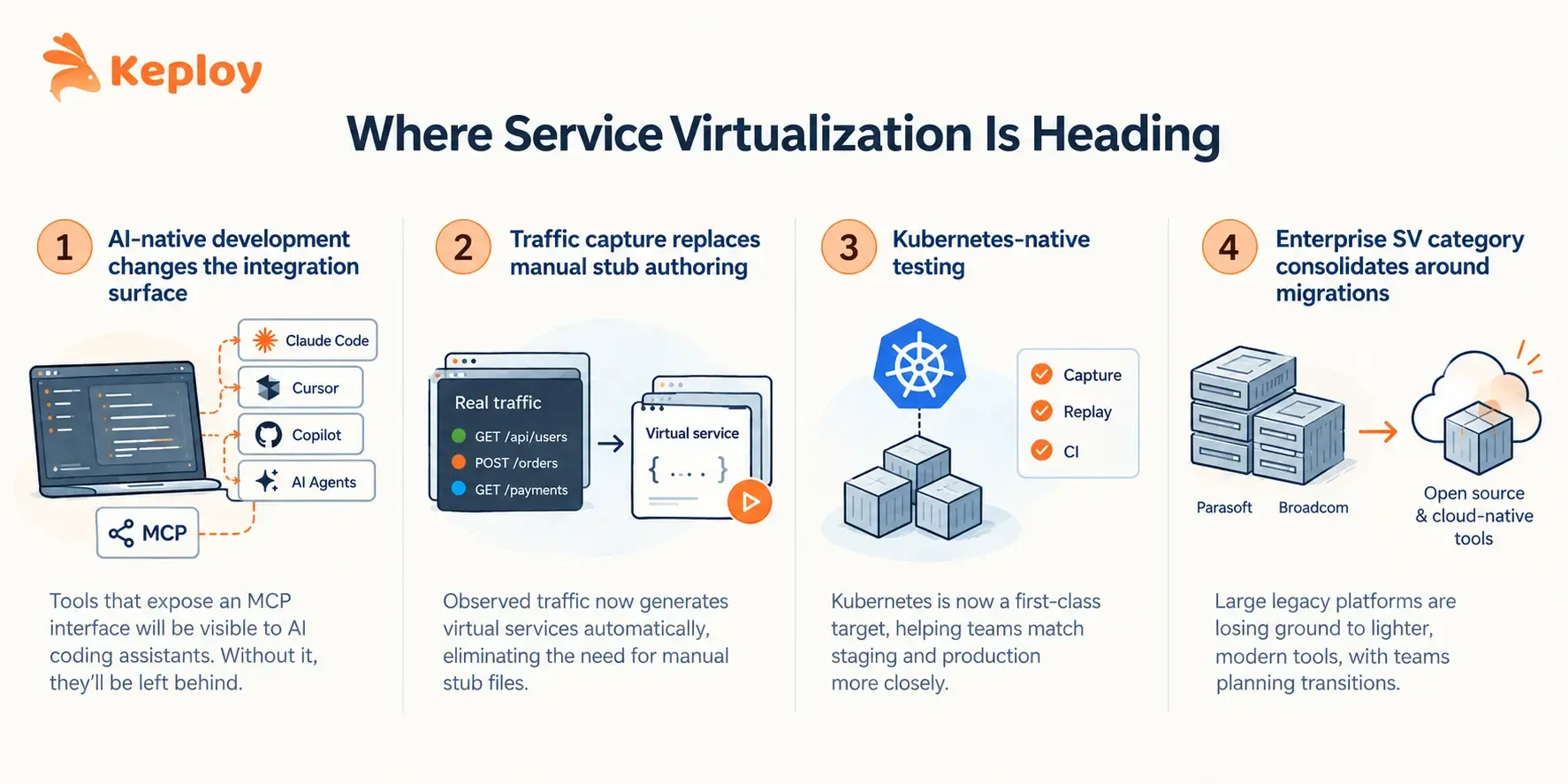
AI-native development changes the integration surface. As more engineering teams adopt AI coding assistants – Claude Code, Cursor, Copilot, and the generation of agents that follows – the tools that matter are the ones those agents can use directly. MCP integration is the current standard for connecting a development tool to an LLM context. Tools that don’t expose an MCP interface will increasingly be invisible to AI-assisted workflows. This is not a distant trend; it is already factoring into tool evaluations in 2026.
-
Traffic capture will replace manual stub authoring as the default. Configuration-based tools require someone to write and maintain stub files. Traffic-capture tools generate that configuration automatically from observed behavior. As real traffic becomes the primary source of truth for virtual services, the maintenance overhead that historically slowed adoption of service virtualization disappears. Teams that currently write stubs by hand are already asking why they’re doing it manually.
-
Kubernetes-native testing closes the gap between staging and production. Tools like Signadot and Keploy treat Kubernetes as a first-class deployment target, not an afterthought. As more teams run on cloud-native infrastructure, the ability to capture traffic from real cluster environments and replay it in CI without any dependency on shared environments becomes a standard expectation, not a differentiator.
-
Enterprise SV platforms are modernizing under pressure. Enterprise platforms are adapting rather than standing still: Parasoft added an MCP server in 2026, and Broadcom added Kubernetes-based scaling in late 2025. The open question is whether their licensing and authoring model can compete with open-source tools that a team can adopt within a single sprint.
How Modern Open-Source Service Virtualization Tools Are Challenging Enterprise Alternatives
Enterprise service virtualization platforms dominated the market for over a decade. The pitch was simple: pay for Parasoft or CA LISA, get protocol breadth, vendor support, and a centralized testing model. For large organizations with mainframe dependencies, that tradeoff made sense.
Modern open-source tools now cover ground that once required an enterprise contract:
-
Full dependency capture – tools like Keploy record HTTP, database, and queue traffic in one session at the kernel level, with no manual stub authoring
-
Cloud-native deployment – container images, CLI tooling, and Kubernetes-native support are standard, not add-ons
-
Active communities – WireMock, Hoverfly, and Keploy ship regular open-source releases.
The procurement cycle alone used to be a reason to stay on enterprise platforms. Open-source tools skip it entirely – a team can evaluate, deploy, and integrate in a single sprint without a vendor conversation.
Conclusion
The service virtualization tools market in 2026 is wider than most lists suggest. Legacy enterprise platforms still serve specific needs. Open-source stub servers are more capable than they’ve ever been. And a generation of traffic-capture and Kubernetes-native tools has emerged that removes the manual configuration work that historically made service virtualization expensive to adopt at scale.
The teams getting the most value out of service virtualization today are not the ones running the most sophisticated tooling – they’re the ones with the clearest picture of what they’re actually trying to simulate and why. Start there. The right tool follows from that answer more reliably than any feature matrix will suggest.
Frequently Asked Questions
What is the best open-source service virtualization tool?
For HTTP-only dependencies, WireMock. For contract-first teams that need async protocols like Kafka, Microcks. For teams that want virtual services generated automatically from real traffic, including database and queue calls, Keploy records the full dependency chain in one session with no stub files. All three have active open-source communities.
What is the difference between service virtualization and API mocking?
API mocking simulates a single endpoint for one test, usually within application code, and is scoped to unit test isolation. Service virtualization simulates the full behavior of an external system at the network level, runs independently of application code, and gets reused across many tests and teams. The practical difference: a mock lives in your test file. A virtual service runs as a separate process, intercepts real network calls, and can be shared across the team’s entire test suite without each test setting it up individually. Dependency mocking and service virtualization are complementary approaches – the scope of what you’re replacing decides which to reach for.
What is smart service virtualization?
Smart service virtualization refers to tools that generate virtual services automatically from observed traffic rather than requiring manual configuration. Instead of an engineer specifying what each response should return, the tool captures what the real service actually returned during a representative run and uses those captures as the simulation. Keploy implements this via eBPF. The "smart" framing also describes tools that integrate with AI coding environments to generate and manage virtual services through LLM interfaces, which is where 2026 tooling is heading.
What is API virtualization?
API virtualization is service virtualization applied specifically to REST, gRPC, and GraphQL APIs. It simulates the HTTP and gRPC dependencies a service calls, using lighter tooling than enterprise SV platforms built for SOAP and mainframe protocols. Most tools on this list (WireMock, Hoverfly, Keploy, Speedscale) fall into the API virtualization category.
How do service virtualization tools integrate with CI/CD pipelines?
Tools that run as Docker containers or CLIs integrate most naturally. WireMock, Hoverfly, LocalStack, and Testcontainers all have straightforward container or CLI integration. Keploy captures in record mode during staging, commits those captures to the repository, and replays them in CI without any live dependency present. Enterprise tools like Parasoft and Broadcom offer CI plugins and container or Kubernetes deployments, but usually involve more setup and licensing configuration.

Leave a Reply