Tag: software-testing
-

What is API testing? The complete guide (2026 update)
API testing is a software testing practice that validates application programming interfaces directly at the message and logic layer, rather than through a user interface. It checks that endpoints return correct responses, handle errors, enforce security, and perform reliably under load, verifying functionality, data integrity, and reliability before an application reaches production. API testing operates…
-

Dynamic Testing: Your Complete Guide to Runtime Software Testing
Every developer has been there, our code looks perfect on paper, passes all static checks, and seems bulletproof. Then the production cause hits, and suddenly everything falls apart under real user behaviour. The gap between “code that looks right“ and “code that works right“ is where dynamic testing shines. In this blog, we will learn…
-

What is Negative Testing?
Most software testing aims to verify whether a system is functioning as intended. This is what is referred to as positive testing, or testing the "happy path." But what happens when users enter in the wrong input, skip required steps, or use your application in a way that you did not expect? That’s where negative…
-
Quality Assurance vs Quality Control in Software Engineering
Quality assurance and quality control are both under quality management but serve opposite purposes. QA is proactive and process-focused – it prevents defects by improving how software is built, spanning the entire SDLC. QC is reactive and product-focused – it detects and fixes defects in what was built, primarily during testing. A useful distinction: testing…
-
Regression Testing Services for Teams
Software development is a field that never stands still; whether it is new features, bug fixes, or performance improvements, whatever code you change has the potential to break the software functionality that currently exists. To combat the risk of accentuating existing software functionality when making changes during software development cycles, companies often employ Software Regression…
-

Introduction To Selenium Software Testing
In the field of agile development, software testing can be a difficult task. Much of the exhaustive testing is conducted manually, which can slow release schedules, as well as make errors more likely. Selenium is a great fit here. Selenium is an open-source tool that allows you to automate web browsers, which, one could argue,…
-
Reliability Testing – A Complete Guide
Reliability testing measures whether software performs consistently and without failure over a sustained period under expected conditions. It evaluates metrics like mean time between failures (MTBF), failure rate, and recovery behavior. The aim is to confirm the system holds up over time, rather than just passing a single functional check. Reliability Testing is the measure…
-
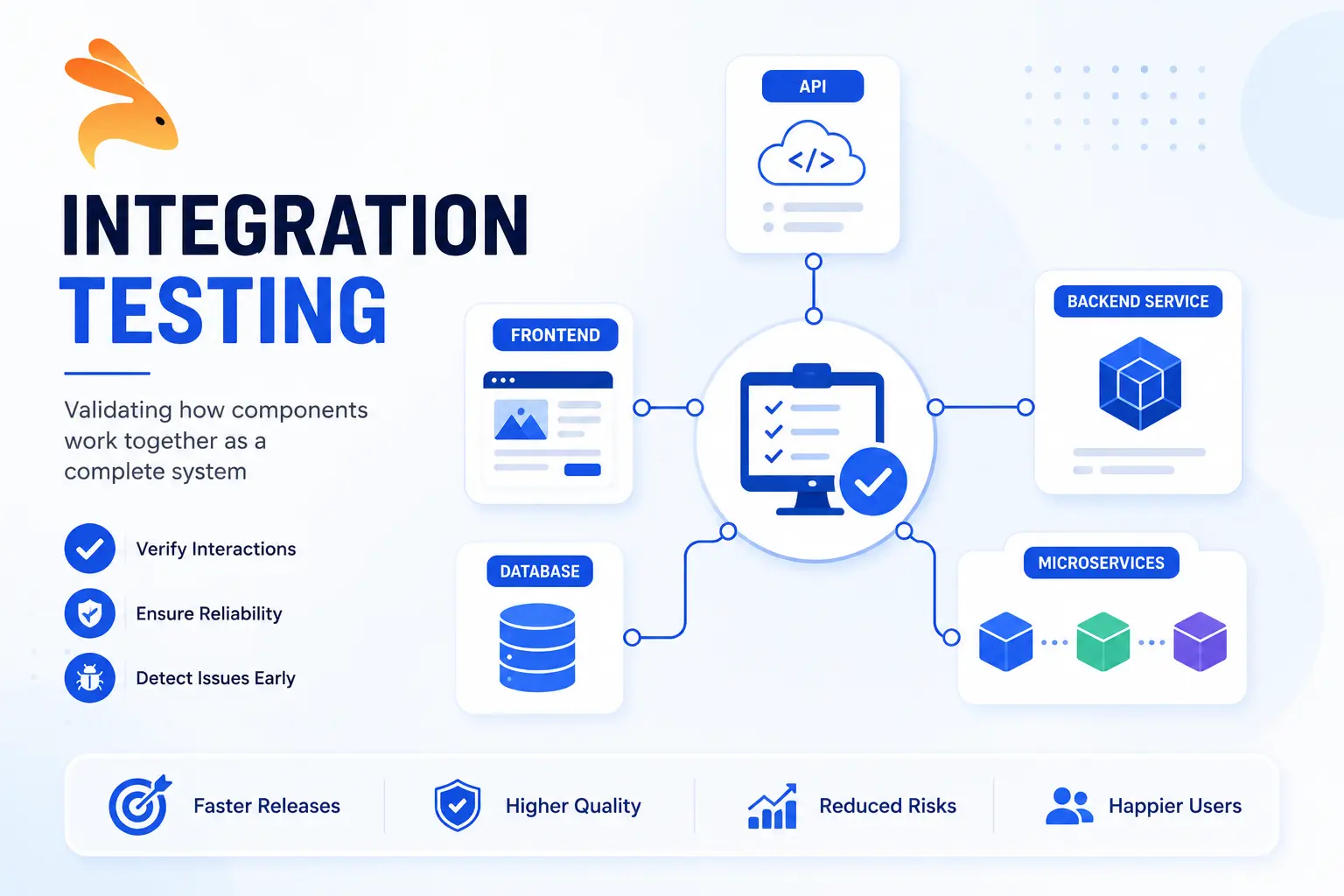
Integration Testing: Complete Guide (Types, Tools & Examples) 2026
Integration testing verifies that independently built modules or services work correctly when combined, focusing on the interfaces and data passed between them. It catches mismatched contracts and communication errors that unit tests miss. Keploy speeds this up with an automation-first approach, recording real service traffic and generating integration tests and mocks from it. In the…
-
Defect Management in Software Testing: Process, Tools, and Best Practices
Defect management is the systematic process of detecting, documenting, prioritizing, fixing, and verifying software defects throughout the development lifecycle – from the moment a bug is reported through assignment, resolution, retesting, and closure. The most effective defect management reduces what needs managing in the first place: catching issues earlier in CI, before they reach production,…
-
Flaky Test Guide (2026): Causes, Examples, and Fixes
In modern software development, fast and reliable automated testing is essential for maintaining high-quality applications and efficient CI/CD pipelines. However, one of the biggest challenges teams face is dealing with flaky tests —tests that pass or fail inconsistently even when the application code hasn’t changed. These unpredictable failures create confusion, slow down deployments, waste engineering…