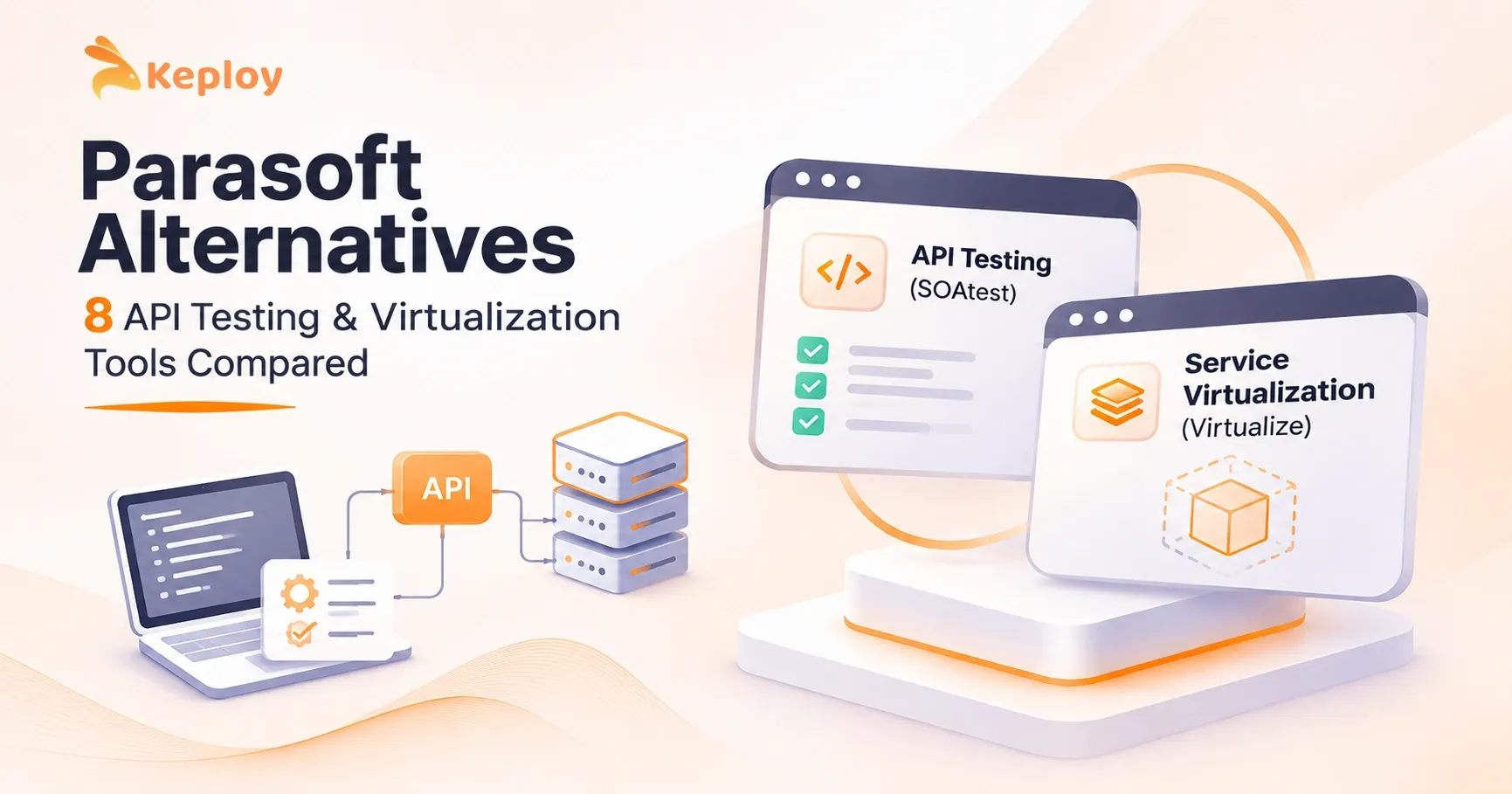
Parasoft is an enterprise automated software testing company whose API products are SOAtest, for API testing, and Virtualize, for service virtualization. Parasoft alternatives replace one or both. For SOAtest, teams usually compare Postman, ReadyAPI, SoapUI, REST Assured, and Tricentis Tosca, while WireMock and Broadcom Service Virtualization lead for Virtualize. Keploy, a modern, lower-cost open-source option, covers both by generating API tests and mocks from real traffic.
Parasoft alternatives tend to come up at renewal time, not during an outage. The tools still work. What changes is the team around them: more developers writing API tests, more services in the pipeline, and a license that grows with every person who needs access.
The harder question is what "replace it" actually means. Parasoft sells API testing and service virtualization as separate products, and plenty of teams run both. So swapping one without the other can leave a gap that stays invisible until a dependency goes down in CI and half the suite fails for reasons nobody can reproduce.
What Parasoft Alternatives Replace: SOAtest and Virtualize
Parasoft’s API toolset rests on two products, and most migrations involve one or both:
- SOAtest is an API testing tool for functional, load, and security testing. It supports 120+ protocols and message formats, including REST, GraphQL, gRPC, Kafka, and SOAP, with scriptless and AI-assisted test creation.
- Virtualize creates and manages virtual services and test data, so tests can run when real dependencies aren’t available. It supports 120+ message formats and protocols, including REST, SOAP, JMS, MQ, and JDBC, with stateful and data-driven responses.
Both are enterprise products sold under quote-based licensing. This guide covers alternatives to these two tools only, not Parasoft’s other development testing products.
Why Do Teams Look for Parasoft Alternatives?
Most teams don’t leave Parasoft because it lacks features. Instead, they leave because the way they build and test software has changed.
- Licensing grows with the team. Quote-based enterprise licensing fits a dedicated QA group, but it’s harder to justify once every developer needs access.
- Tests live in a separate tool. Low-code authoring helps testers, however code-first teams often want tests in the repository, next to the service they cover.
- Virtual services need an owner. Someone has to update them whenever the real dependency changes, and that work rarely has a clear home.
- Not every stack needs 120+ protocols. REST- and gRPC-centric teams can end up paying for coverage they’ll never touch.
- Open-source options have matured. Code-first and traffic-based tools now handle much of the day-to-day API work that used to require an enterprise suite.
How to Evaluate a Parasoft Alternative
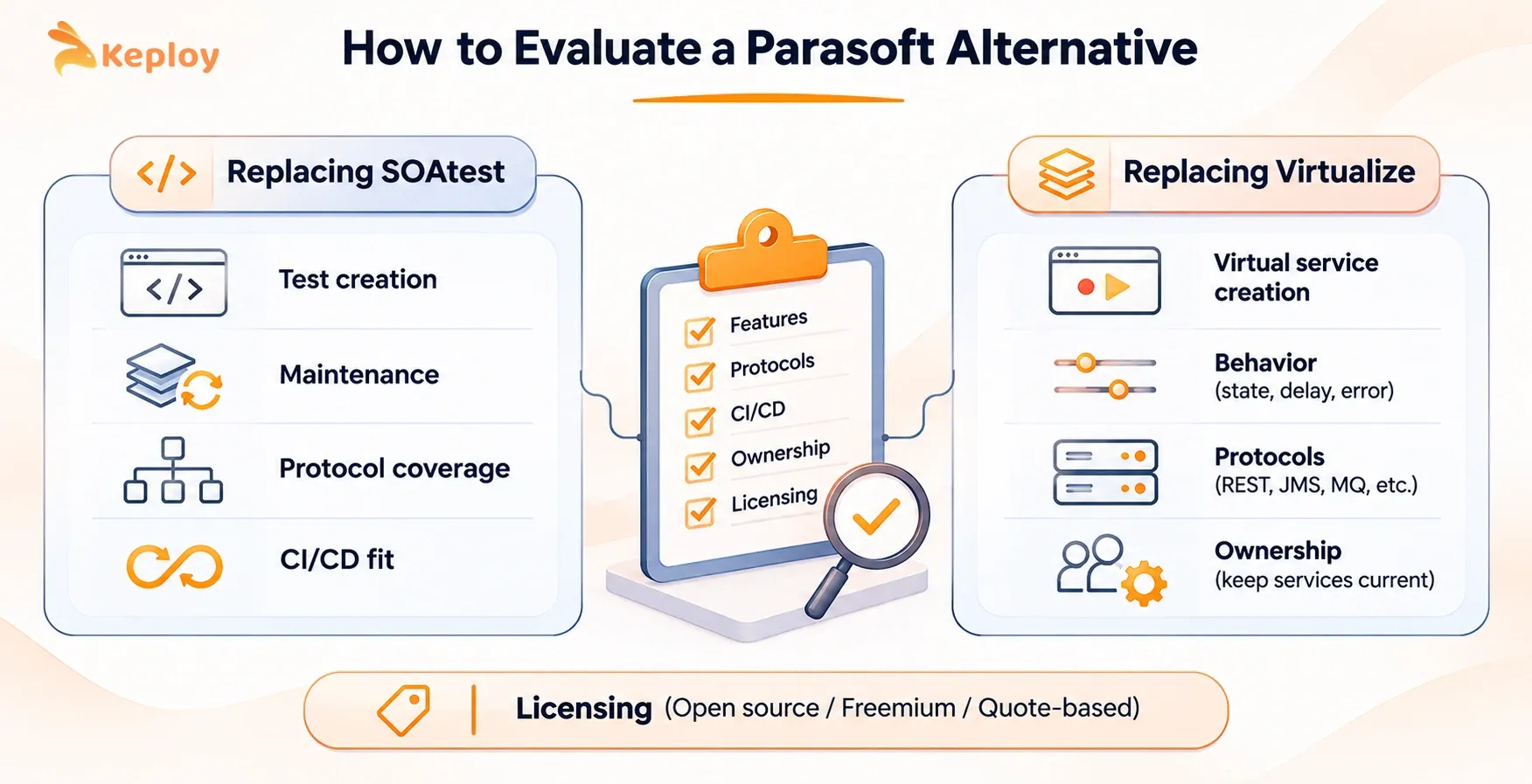
Start by naming which product you’re replacing, because the questions differ.
If You’re Replacing SOAtest
- Test creation: Are tests written in code, built in a GUI, or generated from real traffic?
- Maintenance: What happens to existing tests when an API response changes shape?
- Protocol coverage: Does it support every protocol your services actually use, including SOAP, JMS, or MQ if you have them?
- CI/CD fit: Can the suite run headless from the command line in your pipeline?
If You’re Replacing Virtualize
- Creation: Are virtual services recorded from real traffic, written by hand, or generated from API specs?
- Behavior: Can they return stateful responses, delays, and error cases on demand?
- Protocols: Which transports can they simulate, and does that include messaging or mainframe systems?
- Ownership: Who keeps them current when the real dependency changes?
Licensing applies to both. Check whether the tool is open source, freemium, or quote-based, and whether cost scales per user.
Parasoft Alternatives at a Glance
|
Tool |
Replaces SOAtest |
Replaces Virtualize |
Approach |
License |
|
Keploy |
Yes, for REST and gRPC APIs |
Yes, with mocks from recorded traffic |
Traffic-based |
Open-source core |
|
Postman |
Yes |
Partly, through mock servers |
GUI collections |
Free and paid plans |
|
ReadyAPI |
Yes |
Yes, through its virtualization module |
Low-code |
Commercial |
|
SoapUI Open Source |
Yes, for functional testing |
Partly, through basic mocks |
GUI |
Open source |
|
WireMock |
No |
Yes, for HTTP APIs |
Code or recorded stubs |
Open source, paid cloud |
|
Broadcom Service Virtualization |
No |
Yes, including mainframe |
Recorded virtual services |
Commercial |
|
REST Assured |
Yes, for Java teams |
No |
Code-first |
Open source |
|
Tricentis Tosca |
Yes |
Not its focus |
Model-based, codeless |
Commercial |
The Best Parasoft Alternatives
1. Keploy
Keploy is a modern, open-source alternative to Parasoft that records real API traffic and turns it into API testing suites and dependency mocks. It captures traffic with eBPF, so services need no code changes. In practice, the split in Keploy vs Parasoft comes down to protocol breadth versus authoring effort.
- Best for: REST and gRPC teams that want regression tests and mocks without writing or maintaining scripts
- Strengths: a free Apache 2.0 core with no per-seat enterprise licensing, so cost doesn’t grow with the team, plus tests and mocks that come from one recording, built-in noise handling and time freezing keep fields that change on every run from failing tests, and a native CLI replays the suite in any CI pipeline
- Limitations: doesn’t match Parasoft’s coverage of SOAP, JMS, MQ, and mainframe protocols, and it isn’t a GUI test designer for business testers
- Pricing model: Apache 2.0 open-source core, with paid plans
2. Postman
Postman is an API platform where teams build request collections, add test scripts, and run them in CI through the Postman CLI. It also offers mock servers that stand in for APIs that aren’t ready yet.
- Best for: teams that already keep their APIs in Postman collections
- Strengths: a familiar interface, shared workspaces, mock servers, and command-line runs in pipelines
- Limitations: test logic lives in per-request scripts that get harder to maintain as collections grow, and mocks return saved example responses rather than stateful behavior
- Pricing model: free plan, with paid team and enterprise plans
3. ReadyAPI (SmartBear)
ReadyAPI is SmartBear’s commercial API platform, with modules for functional testing, performance testing, and API virtualization. It validates REST, SOAP, Kafka, JDBC, and JMS APIs in one low-code tool.
- Best for: enterprise teams that want the closest like-for-like replacement for SOAtest and Virtualize together
- Strengths: broad protocol support, tests created from API definitions or live traffic, and virtualization in the same platform
- Limitations: the modules are licensed separately, and it’s still a GUI-first tool for teams that prefer code
- Pricing model: commercial, with a free trial
4. SoapUI Open Source
SoapUI Open Source is SmartBear’s free API testing tool for SOAP and REST services, with basic mock services built in.
- Best for: teams with SOAP and WSDL-heavy suites that need a free starting point
- Strengths: no license cost, strong SOAP and WSDL support, and a large community
- Limitations: fewer reporting, data-driven, and CI features than ReadyAPI, and its mocks are basic
- Pricing model: free and open source
5. WireMock
WireMock is an open-source tool for mocking HTTP APIs. It supports record and playback, response templating, request verification, and fault simulation such as delays and malformed responses.
- Best for: developer teams replacing Virtualize for HTTP dependencies
- Strengths: runs inside tests or as a standalone server, simulates faults on demand, and has a large ecosystem
- Limitations: focused on HTTP, so messaging and mainframe virtualization need another tool, and enterprise features such as hosted, stateful mocking sit in the paid WireMock Cloud
- Pricing model: open source, with paid WireMock Cloud
6. Broadcom Service Virtualization
Broadcom Service Virtualization, part of the DevTest suite and formerly CA Service Virtualization, records the traffic between systems "on the wire" and replays it as virtual services.
- Best for: large enterprises replacing Virtualize across mainframe and distributed systems
- Strengths: mainframe protocol support, including CICS Link, CICS Transaction Gateway, IMS Connect, and DRDA, plus transports such as HTTPS, MQ, JMS, and JDBC
- Limitations: heavyweight to set up and operate, and not aimed at lightweight developer workflows
- Pricing model: commercial enterprise licensing
7. REST Assured
REST Assured is an open-source Java library for testing REST services with a readable given, when, then syntax.
- Best for: Java teams that want API tests in code, next to the service
- Strengths: JSON and XML path assertions, authentication helpers, Spring MockMvc support, and it runs anywhere Maven or Gradle runs
- Limitations: Java only, no GUI, and no built-in mocking or virtualization
- Pricing model: free and open source
8. Tricentis Tosca
Tricentis Tosca is an enterprise, codeless test automation platform built on model-based testing. It covers web, APIs, and enterprise applications such as SAP and Oracle.
- Best for: large organizations that want one codeless tool for API and end-to-end tests
- Strengths: model-based tests that business testers can maintain, broad enterprise application coverage, and AI-assisted test creation
- Limitations: heavyweight and enterprise-priced, and more than an API-only team needs
- Pricing model: commercial, with a free trial
Which Parasoft Alternative Fits Your Team?
No single tool replaces both Parasoft products for every team, so match the tool to the job:
- SOAP, JMS, or MQ-heavy suites: ReadyAPI is the closest match, and Tosca fits if you also automate enterprise apps.
- Replacing Virtualize at enterprise scale, mainframe included: Broadcom Service Virtualization.
- HTTP mocks that developers control in code: WireMock.
- Java services with tests in the same repository: REST Assured.
- Teams already working in Postman collections: Postman.
- A free way to keep SOAP tests running: SoapUI Open Source.
- A lower-cost, open-source replacement for both SOAtest and Virtualize, with tests and mocks from real traffic: Keploy.
Many teams end up with two tools rather than one. For example, a code-first testing tool often pairs with a separate virtualization tool for the few dependencies that need special protocols.
How to Migrate From Parasoft SOAtest and Virtualize
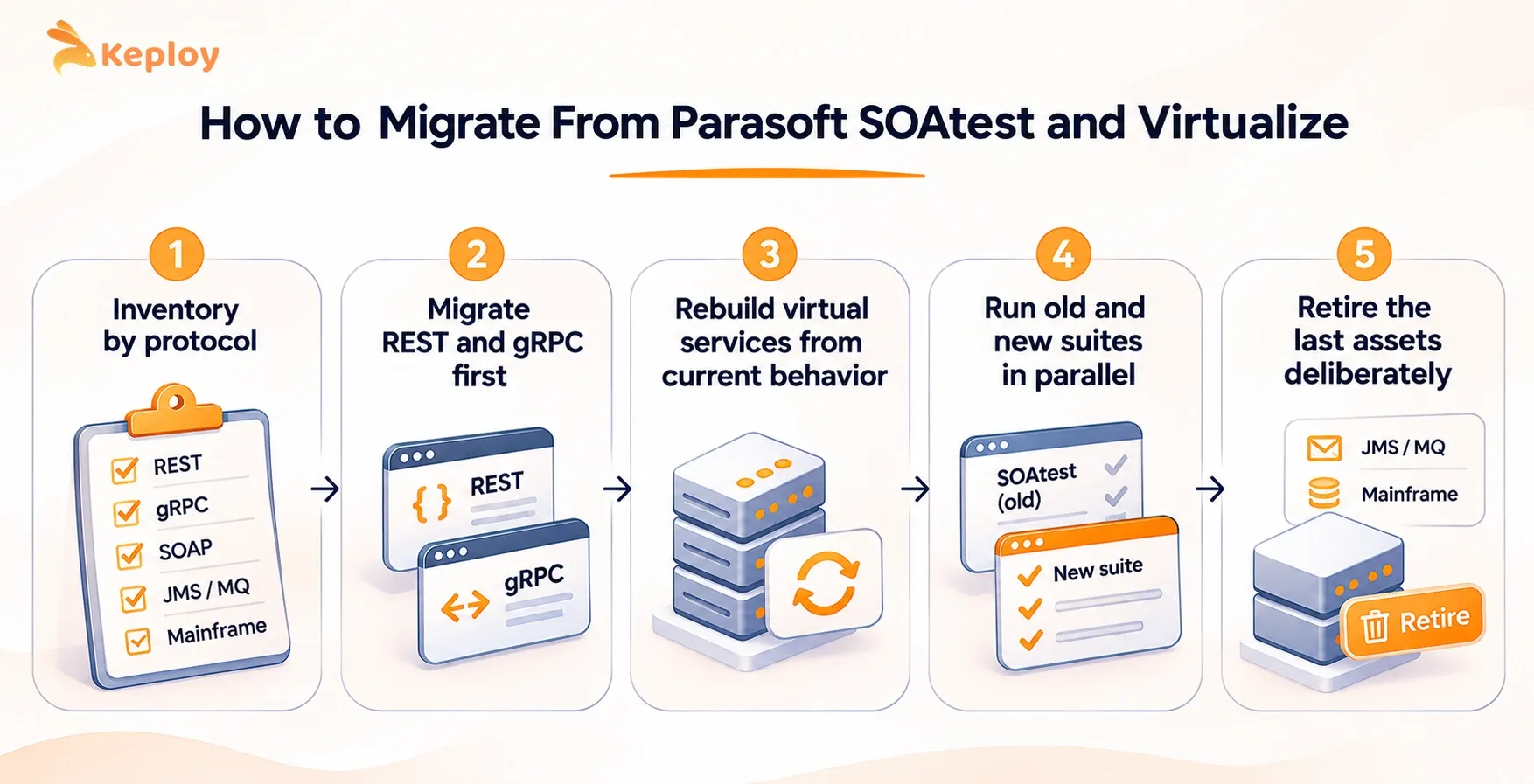
A Parasoft migration goes smoothest in stages, with SOAtest suites and Virtualize assets moving on their own schedules rather than all at once.
- Inventory by protocol. List every SOAtest suite and Virtualize asset by protocol, because that tells you which tool can take over each one.
- Migrate REST and gRPC first. These suites usually move fastest, and they’re where most new tests get written.
- Rebuild virtual services from current behavior. Older Virtualize assets often describe how a dependency worked when they were created, so capture or define them again from how it behaves today.
- Run old and new suites in parallel. Keep both in CI until the new suite catches the same failures for a few release cycles.
- Retire the last assets deliberately. Messaging and mainframe virtual services often move last, so plan their replacement instead of leaving them behind.
Conclusion
API testing is moving closer to the code. As AI assistants write more of each service, the volume of API changes per release keeps rising, and tests that live outside the repository struggle to keep pace with it.
Licensing models will feel that shift too. When pipelines and coding agents run more of the tests than people do, tools priced around how many humans sit in front of them will be the first ones teams question at renewal.
FAQs
What is Parasoft SOAtest used for?
Parasoft SOAtest is used for functional, load, and security testing of APIs. It supports 120+ protocols and message formats, including REST, SOAP, GraphQL, gRPC, and Kafka.
What is Parasoft Virtualize used for?
Parasoft Virtualize is used to create virtual services and test data that stand in for dependencies that are unavailable, incomplete, or too costly to access during testing. It supports 120+ message formats and protocols, including REST, SOAP, JMS, MQ, and JDBC.
How much does Parasoft SOAtest cost?
Parasoft doesn’t publish list prices for SOAtest. It’s sold under quote-based enterprise licensing, so the cost depends on the number of users and modules, and it isn’t free for regular commercial use. Parasoft offers trials and demos, while teams that need a free option often turn to open-source tools such as SoapUI Open Source, REST Assured, or WireMock.
Does Parasoft SOAtest work in CI/CD pipelines?
Yes. SOAtest integrates with CI/CD tools such as Jenkins, Azure DevOps, Bamboo, and TeamCity to run automated API tests on every build. Teams that switch usually aren’t leaving because SOAtest can’t run in CI, but because they want tests in the repository next to the service, maintained by the same developers who change it.
Can one tool replace both SOAtest and Virtualize?
Yes, for some teams. ReadyAPI combines testing and virtualization in one commercial platform, and Keploy generates both tests and mocks from recorded traffic for REST and gRPC services. Teams with mainframe or heavy messaging needs often still use two tools.

Leave a Reply