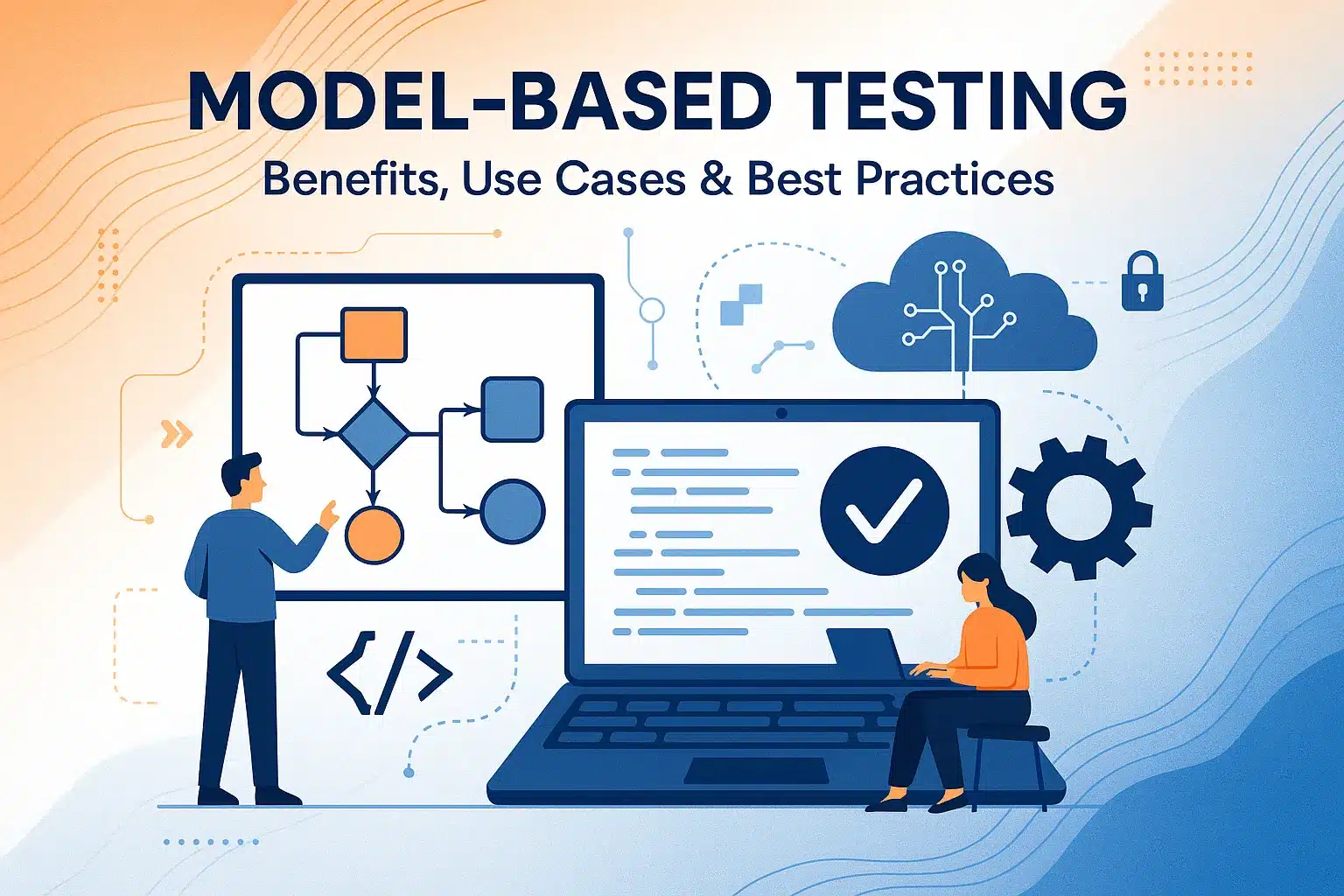
Model-based testing (MBT) has changed how companies develop automation for testing modern software. Every digital experience we use, from booking a cab to transferring money, relies on dynamic systems that evolve rapidly. Traditional testing approaches struggle to keep up: manual test scripts break when functionality changes, automated suites require continuous maintenance to remain effective, and confidence in releases decreases over time.
MBT addresses these challenges by converting system behavior into structured visual or mathematical models that automatically generate adaptive and maintainable test cases.
What is Model Based Testing?
Model-based testing (MBT) is a software testing methodology that uses visual or mathematical representations of expected system behavior to automatically generate executable test cases. The model acts as a blueprint of how the system should behave under different conditions. The mathematical and/or visual representation of expected software behavior (the "model") describes:
-
What users can do and how the system is expected to respond
-
Valid and invalid user inputs
-
How users can navigate in the system (the navigation flows) and what logical rules govern the users’ ability to navigate through the system
-
Expected outcomes during state transitions
Once the model is defined, automated tests are generated directly from it. This enables scalable test design while keeping tests aligned with business logic and system requirements.
Why Should Teams Care about Model Based Testing?
Traditional testing approaches can be time-consuming, fragile, and disconnected from evolving requirements. Script-based automation often requires frequent updates, especially when UI or workflows change. In contrast, model-based testing keeps tests aligned with real system behavior because they are derived directly from behavioral models.

| Benefit | What It Means |
|---|---|
| Faster automation | Update model once → regenerate all tests |
| Better test coverage | Captures hidden logic paths and edge cases |
| Lower maintenance | No more fixing endless scripts |
| Improved collaboration | Shared behavioral model across Dev + QA |
This shift reduces maintenance overhead while improving long-term test reliability.
How Does Model Based Testing Work?
MBT typically follows a 4-step workflow:
1. Model the system behavior using state diagrams, flowcharts, or decision graphs.
2. Define logical rules, constraints, and valid state transitions.
3. Automatically generate executable test cases from the model.
4. Execute the tests and analyze coverage, failures, and behavioral gaps.
The model becomes a shared source of truth for both development and QA, improving traceability and ensuring validation aligns with intended system behavior.
What are the Core Modeling Concepts in Model-Based Testing?
The common modeling techniques are:

-
State-based models (i.e. login → dashboard → profile → logout transitions), flow models (user journeys/business process validation)
-
Data models (input constraints/transformation checks)
-
Decision tables/finite state machines (verification of every rule based outcome).
The base of these models will allow model based testing to be scalable, sustainable, and not obsolete in the future.
How to Generate Executable Tests from Models?
There are several techniques that tools use to convert a model into an actual executable test.
Some examples are:
-
Path Coverage Algorithms,
-
Constraint Solving
-
Equivalence Partitioning
-
Risk-Based Selection
Path coverage techniques ensure that critical system paths and edge cases are explored systematically, reducing redundant scenarios while maximizing meaningful coverage.
Methods for Execution:
-
Offline Execution: An offline approach to generating executable tests will first generate the tests from the model, and then execute each separately against the SUT. This is useful when you want to perform regression tests, or when you have an environment where you want to separate the creation of tests from their execution.
-
Online Execution: Tests are generated and executed at the same time in an online method, allowing rapid verification of the behavior of the system and providing feedback in near real-time to Agile and DevOps pipelines.
This approach is especially useful in Agile and DevOps environments where rapid feedback is essential.
Use of Model-Based Testing for APIs and Microservices
Using model-based testing (MBT) for testing APIs and microservices provides significant advantages over traditional approaches to testing in today’s distributed environments, such as:

-
Assists with validating the workflow of APIs
-
Verifies the dependencies of microservices and testing service contracts.
-
Performs reliable regression testing without having to rewrite test scripts.
-
API-first architecture complements the rule-based model structures.
In distributed architectures, model-based testing helps visualise and validate service interactions that may otherwise be difficult to test comprehensively.
When to Use Model-Based Testing and When Not to?
Utilize Model Based Testing When:
-
Requirements Change Frequently
-
Systems Have Many Complex State Transition Paths
-
Requirements Require Complete Logical Validation
-
Collaboration Between QA & Dev Is Important
Do Not Use Model Based Testing When:
-
The Application Is Too Simple To Require Modeling
-
Requirements are unclear or not yet stable enough to model effectively
-
The team lacks the initial modeling expertise or tooling support
What are Real Model-Based Testing Examples that Teams Can Try?
Practical examples where model based testing delivers measurable value include:

-
Multi-factor authentication in the signup/login process.
-
Transaction rules for Fintech or Wallet.
-
Synchronizing the Shopping cart inventory.
-
API Throttling/Rate-Limiting Paths.
-
Validating Role Based Authorization.
Introducing Model Based Testing (MBT) can be done by adding one feature at a time and building your model library.
Which Model-Based Testing Tools Should Teams Evaluate?
When considering various options from several popular model based testing, you can consider the following widely adopted tools:
-
GraphWalker (open source — supports FSM and path-based generation)
-
Conformiq (enterprise MBT with graphical modeling)
-
AccelQ (model-driven testing for enterprise workflows)
-
Spec Explorer (Microsoft — strong for .NET model testing)
These tools operate at their most effective when integrated with existing test automation tools and CI workflows.
How to Integrate Model Based Testing into CI/CD Pipelines?
Here are some steps for integrating model based testing into CI/CD pipelines:

-
Store and version models in Git
-
Auto-generate test cases whenever a pull request is made.
-
Run MBT scenarios in CI pipelines
-
Track coverage and model change histories
-
Update models as the requirements shift.
As a result, software will continue to be tested as fast as it is released. This ensures that model-based testing evolves alongside the codebase and continuously validates new changes.
What are Common Pitfalls in Model Based Testing Adoption?
The most common pitfalls of implementing model-based testing in software testing include the following:
-
Creating overly complex models at the start.
-
Modelling too much of irrelevant details.
-
Using tools with steep learning curves often makes it difficult for testers who are not familiar with the tools.
-
Missing traceability with requirements.
So the key lies in simplicity: Start small → Validate → Iterate. Starting with small, high-impact workflows reduces risk and accelerates adoption.
Best Practices for Model Based Testing
The following five foundational best practices will maximize the value of model-based testing for teams.

-
Begin by focusing on the most important aspect of the system that can be modelled (i.e. the most critical flows) instead of trying to capture all of the functionality of the application at once.
-
Ensure your models stay relevant and easily maintainable by putting them in Version Control and revising them as the requirements change.
-
Use automated test generation but make sure to regularly validate that the tests created by the automated testing tool still accurately reflect what a business considers to be accurate results and are representative of user behaviour or application edge-cases.
-
Apply CI/CD processes to automatically integrate your models into your CI/CD environment so that you receive feedback sooner on build quality and allow developers to validate new code as it goes through an automated test process.
-
Encourage collaboration between QA, Development, and Product Teams to create models that accurately represent how the system is expected to behave.
How does Model Based Testing Complement Keploy?
Model based testing focuses on validating expected behavior derived from system models, while Keploy validates real-world behavior using recorded API traffic. Together, they provide both intention-based and reality-based validation.
Together, these solutions provide:
-
Intention (the expected behavior) Validation
-
Reality (actual behavior from users) Validation
-
More reliable and quicker application deployment.
-
Higher test coverage and lower manual maintenance.
Combining model-based testing with Keploy enables teams to verify both designed logic and real production interactions – increasing confidence, reducing regressions, and accelerating release cycles.
Looking Ahead
Model based testing introduces a structured, scalable approach to validation for high-speed engineering teams. Instead of writing scripts directly (hardcoding), testers create models that will automatically adapt with the changes in business logic. With the movement towards distributed microservices, dynamic processes (e.g., event-driven architectures), and more complex interactions (e.g., IoT), MBT is a viable option way forward for improving quality assurance.
FAQs
What is the Benefit of Using Model-based Testing for User Interface (UI) Testing?
Model-based testing focuses on the user’s behaviour by modelling the user’s actions instead of relying solely on the user’s click-path (which is usually very fragile). By using model-based testing, companies will reduce their reliance on flaky UI automation.
How to Combine Model Based Testing and Risk-based Testing for Effective Test Case Generation?
Risk-based testing will allow testers to create test cases for only the most critical transition points, thereby enabling only the most impactful scenarios to become executable test cases.
Can MBT Generate Maintainable Tests for API-driven Microservices?
Yes – as the model evolves with the service, complete verification of the entire workflow is maintained.
How does Model-based Testing Differ from Script-based or Record-replay Approaches?
Model-based testing is focused on the logic of the behaviour and state transitions of the software. Record-and-replay and script-based testing capture only what a user does (the UI action).
What Modeling Languages are Best for Model Based Testing?
The most commonly used modeling languages in MBT within enterprises are UML, BPMN, DSLs, and statecharts.

Leave a Reply