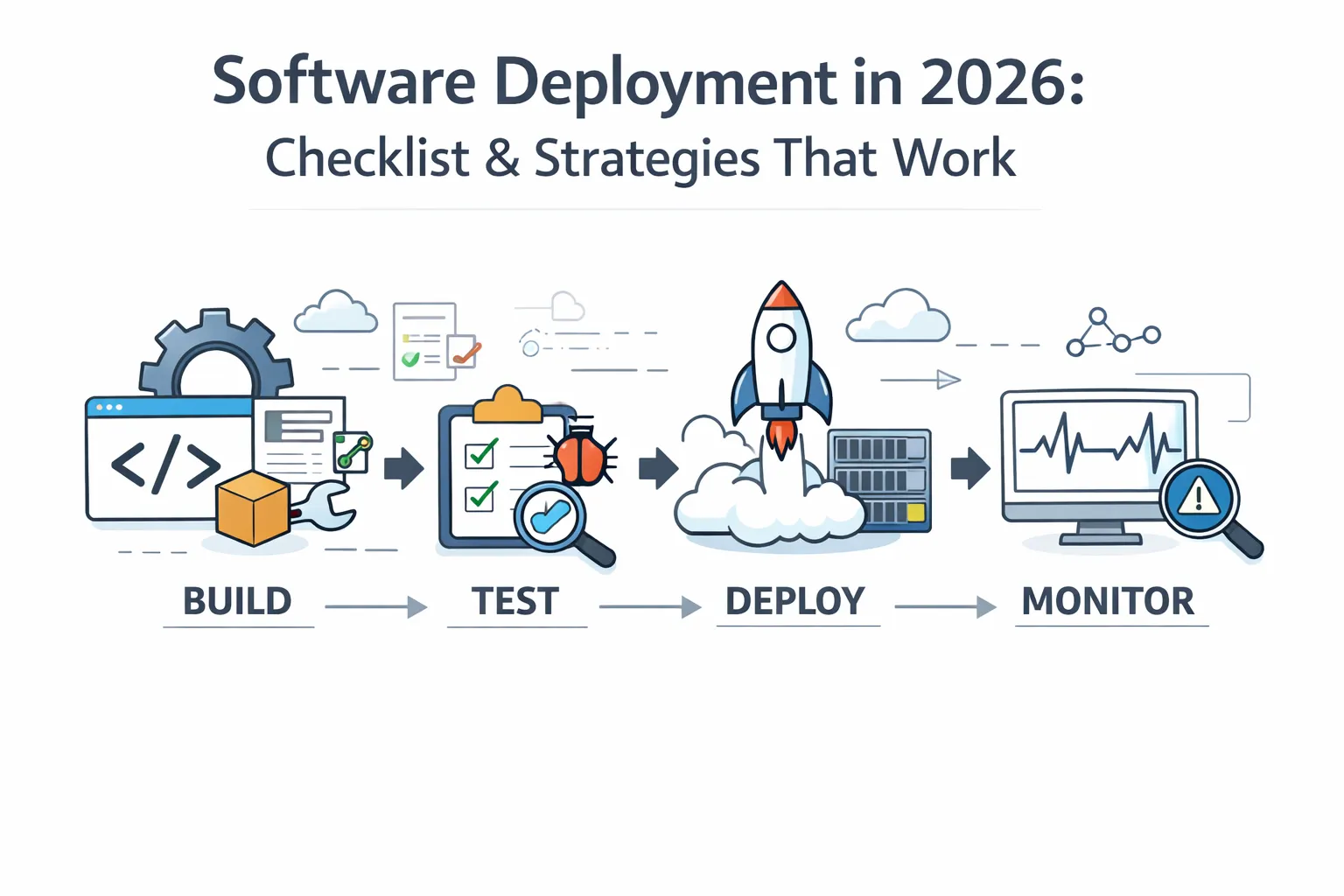
Software deployment looks simple on paper, but in real projects, it’s where most failures show up. Even stable code can break when deployment isn’t planned well. In 2026, software deployment is no longer just about pushing code – it’s about reliability, speed, and control. Let’s explore how modern teams can deploy smarter, faster, and safer in 2026.
What Is Software Deployment?
Software deployment is the act of taking an application that has been developed and making it available to users in a production environment. Software Deployment consists of several steps such as:
-
Preparing an Application Package
-
Configuring Target Environments
-
Releasing Updates
-
Verifying Health of Systems Post-Deployment
Therefore, when we discuss deploying software, we are referring to all of the technical steps associated with deploying software, rather than simply clicking on the "Deploy" button.
Why Software Deployment Matters in Modern Software Development?
Since modern applications are updated frequently, having a clearly defined process for deploying software is critical to maximising that frequency, while limiting risk associated with it.
The right software Deployment processes also enable Development teams to:
-
Minimise downtime when performing updates to the product
-
Identify problems at an early stage so users are not impacted.
-
Deploy features more efficiently and safely
-
Maintain System Reliability and Stability at Scale
For any DevOps-driven team specifically, Deployment Quality has a very direct relationship to Product Quality and Reliability.
What Are the Core Stages of the Software Deployment Process?
Every software deployment process follows a clear flow. Skipping any stage usually leads to production issues.
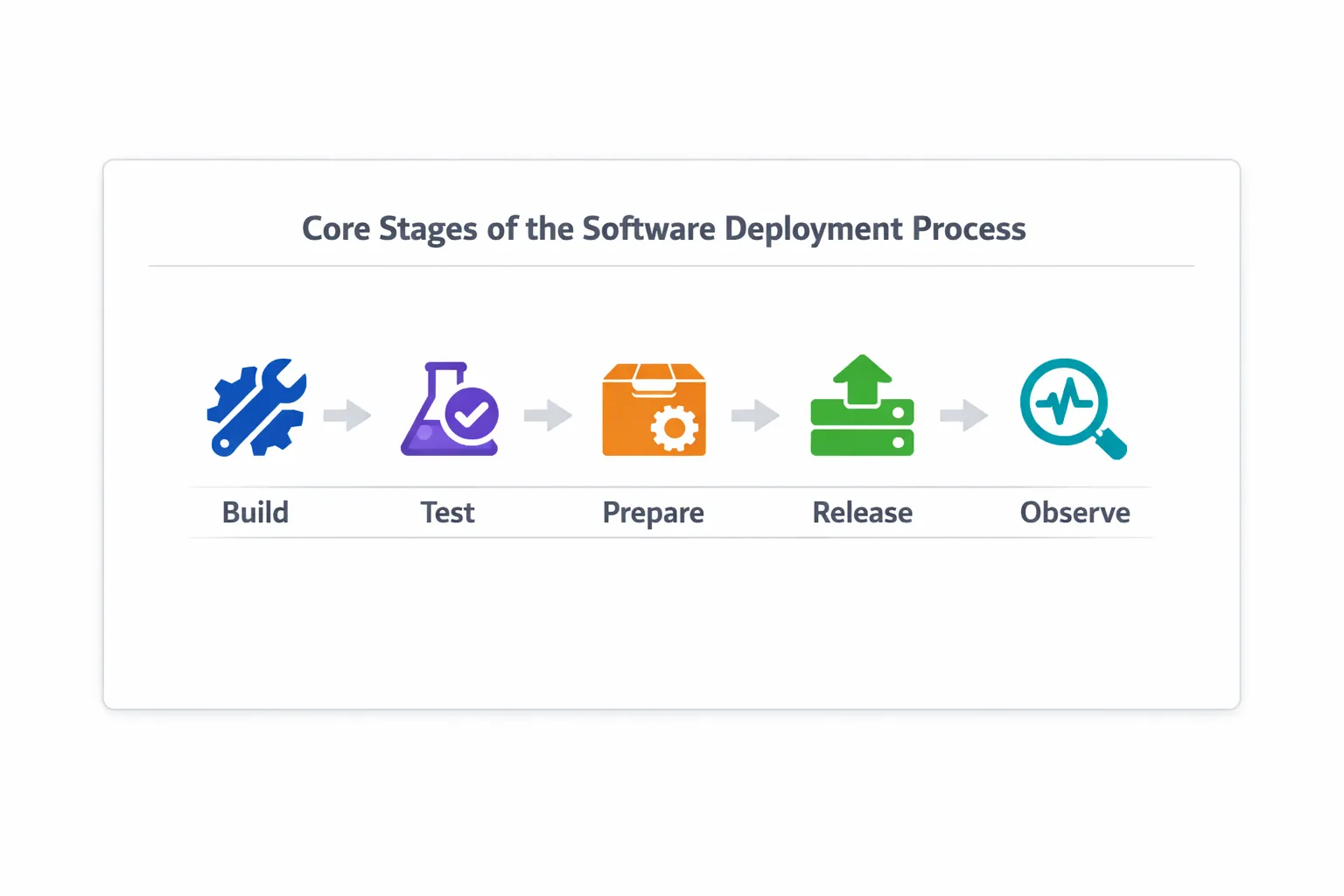
1. Build and Package
The build and pack stage is where deployable artifacts are created from source code. For example:
-
Container images for back-end services
-
Static builds for front-end applications
-
Version-controlled configuration items in conjunction with the code
It ensures that all artifacts used are identical between environments with a clean build.
Common tools used in this stage include:
| Task | Tools Commonly Used |
|---|---|
| Build automation | Maven, Gradle, Make |
| Containerization | Docker |
| Artifact management | GitHub Packages, Artifactory |
| Version control | Git |
2. Testing and Validation
Automated and manual tests are run prior to deployment to confirm the application is valid for deployment.
This includes:
-
Unit and integration tests
-
API and contract tests
-
Performance checks in staging
-
Staging Performance Checks
Industry statistics indicate that the majority of production incidents are not caused by failure of the code, but rather by when APIs behave differently on the live site (live traffic) compared to testing (test traffic). By validating how the system will behave in these scenarios, teams can significantly reduce their risk during the deployment phase.
Most teams now have a level of testing hierarchy that includes functional, regression, contract, and end-to-end testing during this phase. Keploy supports this by allowing teams to automatically generate and validate their real-world API behavior before they deploy through its testing layer.
Common testing activities and tools at this stage:
| Testing Type | Purpose | Tools |
|---|---|---|
| Unit & Integration | Validate individual components | JUnit, pytest, Go test, Keploy |
| API & Contract | Validate request/response behavior | Keploy, Postman, Pact |
| Functional & Regression | Ensure existing behavior remains unchanged | Selenium, Cypress, Keploy |
| End-to-End | Validate complete workflows | Keploy, Cypress, Playwright |
| Performance (staging) | Catch latency and load issues | k6, JMeter, Keploy, Locust |
3. Environment Preparation
In continuing with the preparation of the environments that have been targeted for deployment, some of the more typical steps here include:
-
Updating infrastructure configuration
-
Setting environment variables
-
Checking database compatibility
A common cause for failure when deploying is an environment that has been created in staging rather than production, which can lead to a multitude of problems.
Common tools used for environment preparation:
| Task | Tools |
|---|---|
| Infrastructure provisioning | Terraform, CloudFormation |
| Configuration management | Ansible |
| Secret management | Vault, AWS Secrets Manager |
| Container orchestration | Kubernetes |
4. Deployment Execution
This phase of the application development process involves deploying the software release into production. Depending on the particular strategy used to move an application into production, deployment can be executed in a variety of ways, including:
-
Gradual rollout
-
Parallel environment switch
-
Limited user exposure
Within this phase of application deployment, automation plays a critical role in allowing for fewer manual errors and more repeatability.
Common deployment execution tools:
| Deployment Type | Tools |
|---|---|
| Application rollout | Kubernetes, Helm |
| Pipeline execution | GitHub Actions, GitLab CI/CD |
| Release orchestration | Argo CD, Spinnaker |
5. Monitoring and Feedback
Monitoring as well as feedback are critical systems, following deployment. For constant monitoring, teams typically track:
-
Error rates
-
User impact
If any issues arise, rollback &/or fixes should happen immediately.
Common monitoring and feedback tools:
| Metric Type | Tools |
|---|---|
| Logs & errors | Datadog, ELK Stack |
| Metrics & performance | Prometheus, Grafana |
| Alerts & incidents | PagerDuty, Opsgenie |
| User experience | New Relic |
Common Software Deployment Strategies and Models
Selecting the most appropriate strategy depends on a company’s level of risk tolerance, project traffic behaviours, and system complexities.
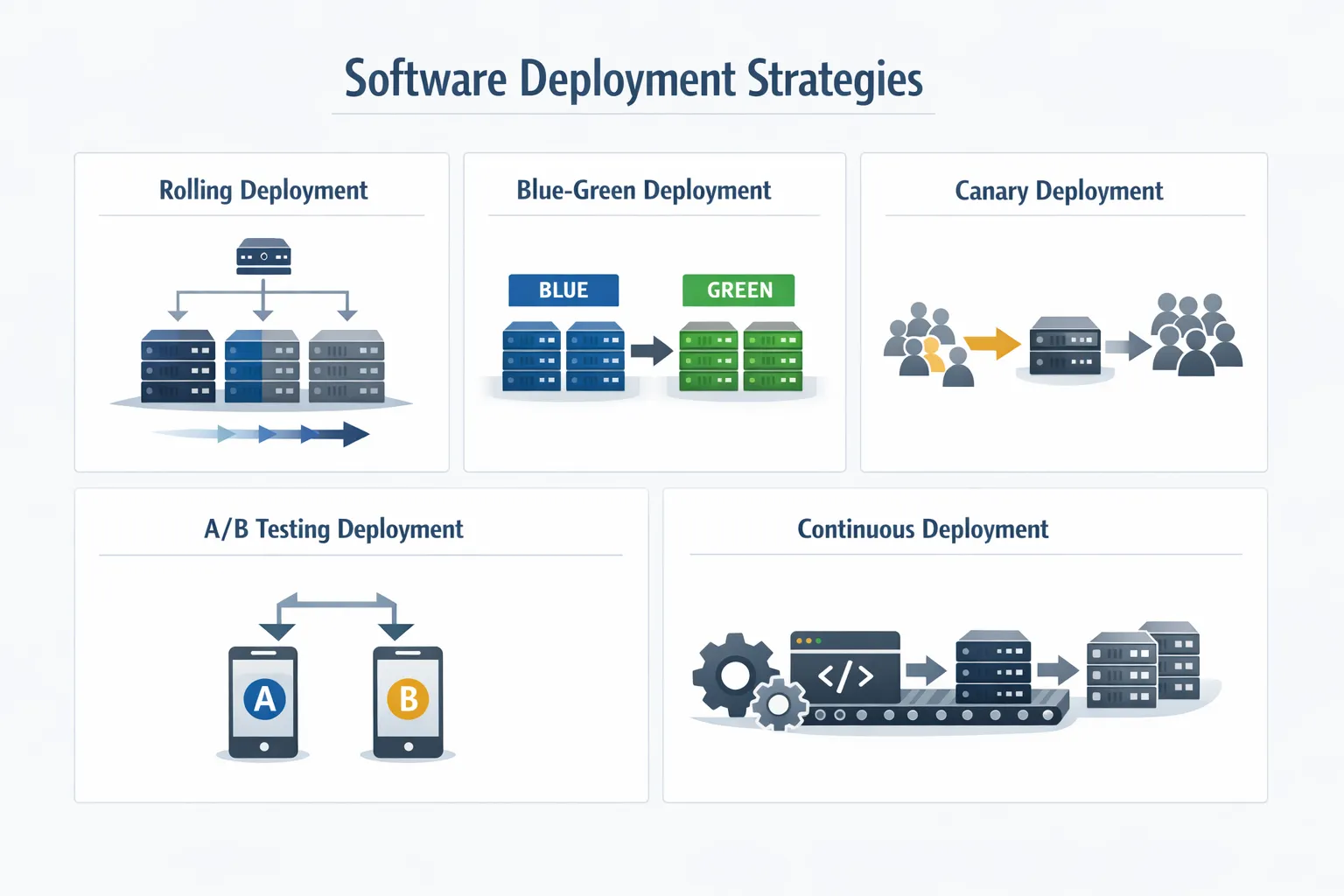
Rolling Implementation
This type of Implementation updates servers in increments versus installing the Implementation on all servers at one time. Rolling Implementations are most applicable when:
-
The system is required to remain operational 24/7.
-
Downtime cannot be tolerated by users.
-
The system has adequate load balancing available/hardware.
Rolling Implementations are usually gated by the results reported from prior implementations. Rolling Implementation teams may require minimum coverage of test cases (for example: ≥ 80%), stable API validation results, and acceptable performance thresholds prior to increasing traffic.
Rolling Implementations are often essential for large microservices-oriented platforms that rely on rolling Implementations to eliminate service interruptions.
Blue-Green Deployment
Utilizes two equivalent environments. Recommended Use cases include:
-
Immediate rollbacks are like a requirement
-
High risk of release failures
-
Switching of Traffic is clearly defined and simple.
Modern engineering teams use this step to simulate actual user interaction in a secure manner, as well as providing teams with the opportunity to develop test scenarios from successful production interaction. Tools such as Keploy and GoReplay provide teams with the ability to copy production traffic and analyze the behavior of an application in an inactive environment, without altering a production database.
This provides the ability to build confidence before making a traffic change. This model is very effective with payment processing systems and enterprise applications, as both can incur drastic costs if there is a system failure.
Canary Deployment
Introduces changes to a limited number of users at first. This approach is most beneficial when:
-
The behaviour of actual users is important
-
The performance impact of changes must be tested
-
Decisions are based on data.
For example, you might test a new recommendation algorithm with five per cent of your audience before launching it marketplace-wide.
A/B Testing Deployment
Reveals which version a user will respond to. This type of deployment is most helpful when:
-
You want to collect data that helps determine user behaviour
-
You aim to measure the effect an application or feature update has on the customer experience
-
Business metrics influence decisions.
Connecting application deployments with business results will enable your company to improve its overall bottom line.
Continuous Deployment
Automatically pushes every validated change to production.
Best used when:
-
CI/CD pipelines are mature
-
Automated tests are reliable
-
Monitoring and alerting are strong
Adopting this delivery model enables successful DevOps teams to deploy several updates to their products each day. Many teams, however, blend several deployment techniques consistent with risk and application functionality.
Automated Software Deployment: How Automation Changes Deployment?
The use of Automation in software deployment has changed how we deploy software by removing the element of ‘manual’ intervention from repetitive deployment tasks.
Some key advantages include:
-
Faster release cycle times
-
Consistent deployment of the same software across your various environments
-
A reduced risk of human error
-
Simplified rollback if something goes wrong
Automation can only succeed if all of your pipelines are monitored, and tracking failures for easy diagnostics is made simple by observing how a system behaves at the production level and validating it against earlier environment behaviour.
Automation in software deployment will be as standard and necessary in the near future as it currently is. Furthermore, many teams are now validating API behaviour that has been automated as a way to ensure production behaviour is consistent throughout all environments of their software.
Software Deployment Checklist for Reliable Releases
A checklist is the best way to align and focus your teams around software deployments.
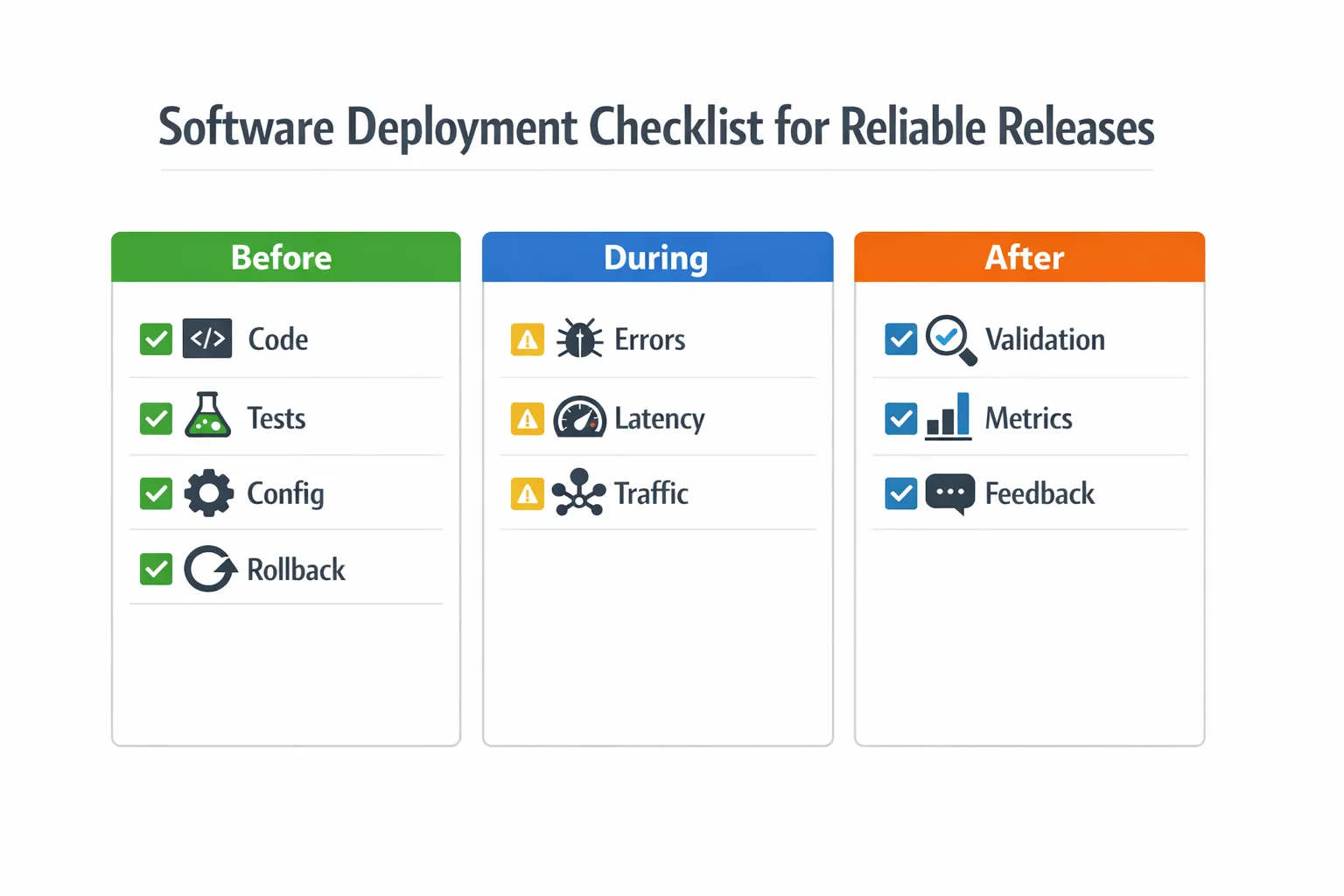
Here are some important checkpoints to consider during each stage of the deployment process:
Before Deployment
-
Code is merged and reviewed
-
Tests are passing in CI
-
The configuration of your environment is verified
-
Rollback plan is in place
During Deployment
Watch for logs from your deployment – this can be used to see errors by the number of times job_id has errors.
-
Track your error rate (4xx/5xx error %)
-
Track your trends for latency and response times
-
Traffic is shifted gradually based on your health metrics.
After Deployment
-
Complete the validation of new feature.
-
Review the performance metrics.
-
Track user feedback.
Teams that do not use checklists are likely to make the same deployment mistakes repeatedly.
Software Deployment vs Software Release Management
Deployment involves making your code available for use both in a production environment and within your application, while release management helps you decide when to give users access to new features. Modern teams are frequently using feature toggles to hide their deployments until they’re ready to roll out new functionality.
Challenges in Deploying Software and How to Overcome Them
As the software development life cycle progresses, teams may encounter different types of challenges, including:
-
Undetected API regressions
-
Environment mismatches
-
Gaps in manual testing
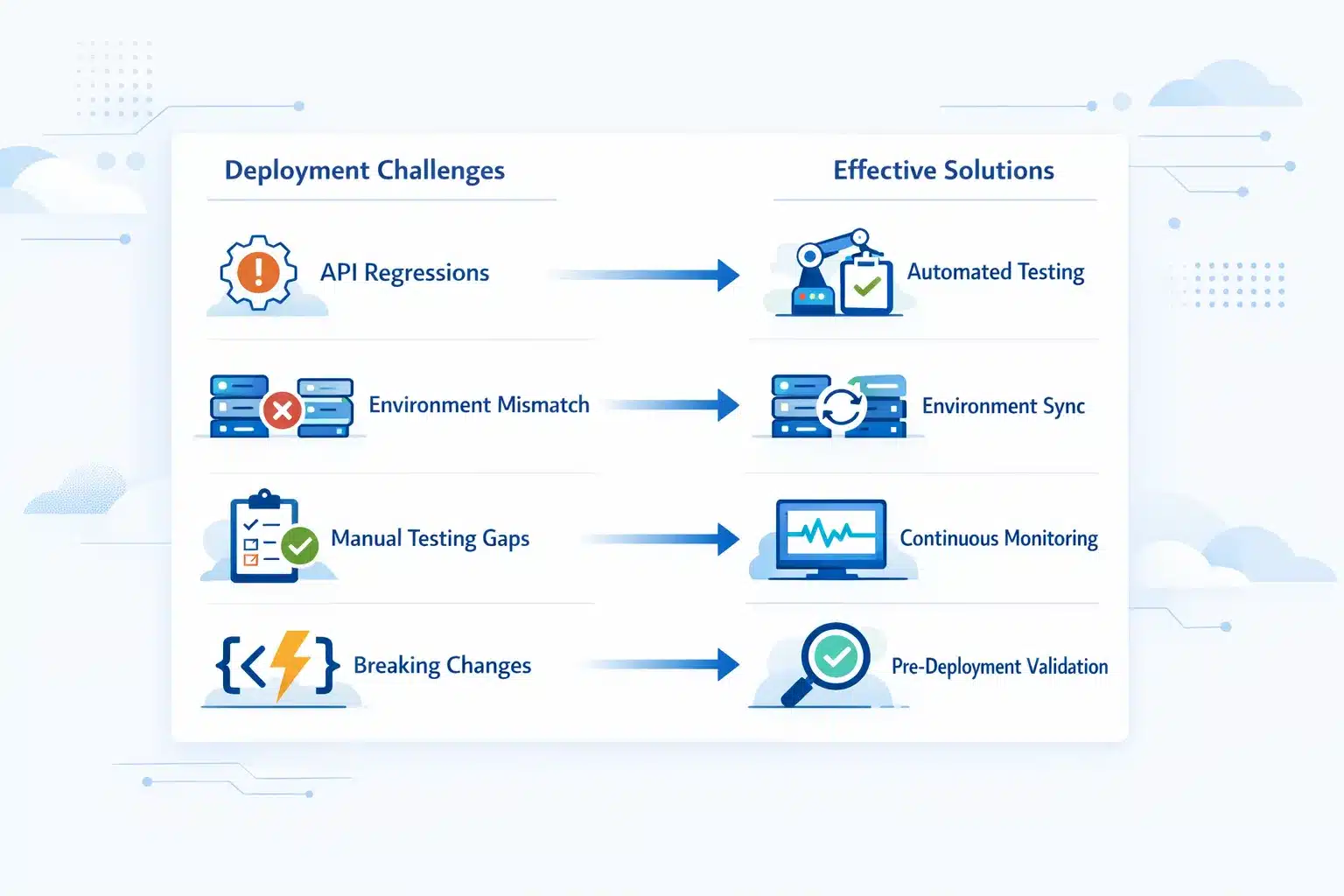
The most challenging aspect of deploying software stems from APIs not functioning as expected or changing, where dependent services rely on them, breaking silently without notice.
Keploy offers teams a way to capture the real-time functioning of APIs and to validate the API’s running configuration within a live production environment during the deployment process. This helps to mitigate unanticipated failures that may occur once the software goes live.
Future Trends in Software Deployment
The future trends involving software deployment involve increased use of confidence-based intelligence. Some of the major trends include:
-
An enhanced level of observability in the software pipeline.
-
Improved safety with regard to rollout strategy and the alignment of Software Lifecycle Objectives (SLOs).
-
Improved AI-assisted failure detection as part of rollbacks.
-
A move towards using behavioral validation as opposed to using static checks.
To sum up, the focus has changed from speed to confidence in the deployment.
Conclusion
Software delivery in recent times has evolved from merely transferring a codebase from one system to another into an ongoing, structured process that utilizes various forms of automation to improve the quality & reliability of the software deployment workflow. With smarter automation, real-time monitoring, and tools like Keploy, teams can deploy confidently, reduce errors, and scale efficiently. Looking ahead, AI-driven pipelines, predictive analytics, and adaptive validation will make deployments faster, safer, and increasingly self-optimizing.
FAQs
What is the hardest part of software deployment?
The complexity of controlling risk while deploying code changes quickly with minimal downtime is often the most difficult part of the software deployment process.
How difficult is it to change a software deployment environment?
The difficulty increases significantly when the environments are inconsistent. However, standardizing and automating these environments greatly reduces that difficulty.
How often should software deployment happen in modern teams?
For a highly effective team, they would deploy many times throughout the day using a frequent, small, safe approach.
Is automated software deployment suitable for large systems?
Yes, as long as you incorporate appropriate testing methods, monitoring systems, and rollback procedures, you can effectively scale the use of automated software deployments to any program, regardless of how complex.
What metrics should teams monitor post-deployment for success?
After the deployment, teams should monitor for error rates, response time, and health metrics for the APIs, their influence on overall system performance, and user experience on production systems.

Leave a Reply