
Software testing methodologies are structured frameworks that define when testing starts and how it fits into the development lifecycle: not just what gets tested, but the rhythm it follows. Waterfall tests after development completes; Agile embeds testing within every sprint; V-Model pairs each phase with a corresponding test; XP starts with tests through TDD. Picking the right one shapes everything that follows.
Software testing methodologies are structured approaches that determine how testing activities are planned, executed, and managed throughout the software development lifecycle. With increasing complexity in modern applications, implementing the right testing methodology is crucial for delivering high-quality software products on time and within budget. This guide explores various software testing methodologies and their practical applications in today’s development environments.
What is software testing?
Software testing is the systematic process of evaluating a software application to identify defects, verify functionality, and ensure the product meets specified requirements. Effective testing helps reduce development costs, enhance user experience, and minimize risks associated with software failures in production environments.
Who performs software testing?
Software testing is performed by various professionals depending on the testing methodology and organizational structure:
- QA engineers: Specialists focused exclusively on testing activities
- Software developers: Conducting unit testing and peer code reviews
- DevOps engineers: Implementing and maintaining automated testing pipelines
- Business analysts: Performing user acceptance testing
- End users: Participating in beta testing and providing feedback
When to start software testing?
The timing of testing activities depends largely on the chosen methodology. Modern approaches advocate for "shift-left" testing, where testing begins early in the development cycle rather than after coding is complete. Early testing helps identify defects when they are less costly to fix and ensures requirements are properly understood before significant development effort is invested.
Software testing methodologies
1. Waterfall model
The Waterfall model is a linear and sequential approach where testing is performed after the development phase is complete. Testing is meticulously planned during the requirements and design phases but executed only after coding is complete. This model enforces a rigorous documentation process with detailed test plans, test cases, and test procedures prepared well in advance. The testing phase is divided into distinct stages: unit testing, integration testing, system testing, and acceptance testing.
The model’s structured nature provides clear milestones and deliverables, making it easier to track progress and manage expectations. However, its sequential nature means that any defects discovered during testing may require significant rework and potentially delay the entire project timeline. Many organizations implementing Waterfall maintain separate development and testing teams, with formal handoffs between phases.
Despite its limitations in flexibility, the Waterfall model remains relevant for projects where requirements are well understood from the start and regulatory compliance demands comprehensive documentation of each development phase.
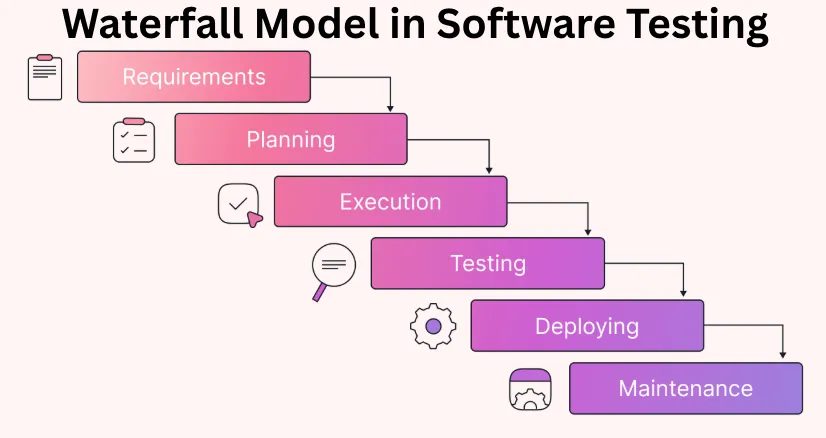
Key characteristics:
- Testing begins only after development is complete
- Each phase must be completed before the next begins
- Comprehensive documentation at each stage
- Limited flexibility for requirement changes
Best suited for:
- Projects with well-defined, stable requirements
- Small to medium-sized projects with predictable outcomes
- Systems requiring high reliability (e.g., medical devices, aviation)
2. Agile model
Agile testing is significantly more dynamic than traditional methodologies, with testing activities occurring concurrently with development in short iterative cycles. In a typical Agile implementation, each user story includes specific acceptance criteria that serve as the foundation for test case development. Testing isn’t viewed as a separate phase but as an integral part of the development process.
Daily stand-up meetings facilitate quick resolution of testing challenges, while sprint retrospectives provide opportunities to refine the testing approach. Test automation plays a crucial role in Agile, enabling rapid feedback through continuous integration pipelines. Many Agile teams practice test-driven development (TDD) or behavior-driven development (BDD), writing tests before implementing features. When teams apply behaviour driven development in agile sprints, the acceptance criteria on each user story are written as Given-When-Then scenarios and automated as tests.
The Agile testing pyramid guides test distribution, with numerous unit tests at the base, service/API tests in the middle, and fewer UI tests at the top. This approach maximizes test coverage while minimizing execution time. Cross-functional teams mean developers and testers collaborate closely, often pair programming and reviewing each other’s work, which leads to higher code quality and shared ownership of testing responsibilities.
The emphasis on working software over comprehensive documentation means test documentation is often lightweight but sufficient, focusing on automated test code as living documentation.
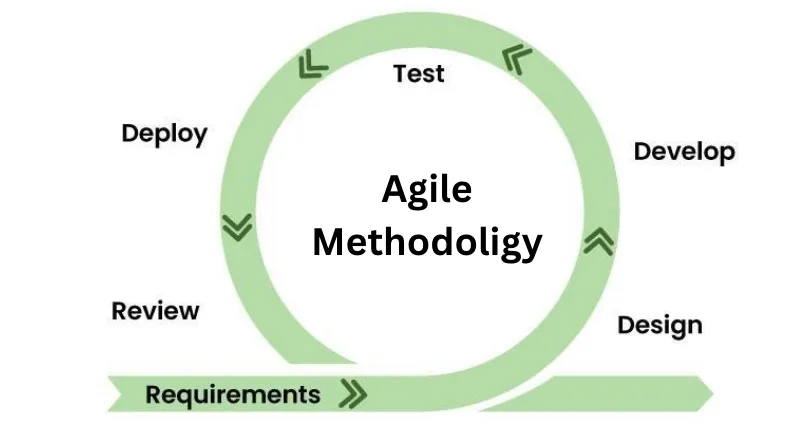
Key characteristics:
- Testing is performed continuously within each sprint
- Test cases evolve as requirements change
- Emphasis on collaboration between development and testing teams
- Frequent feedback from stakeholders
Best suited for:
- Projects with evolving requirements
- Customer-centric applications requiring frequent feedback
- Products needing rapid delivery to market
3. Iterative model (iterative and incremental development)
In the Iterative model, the system is built and tested in incremental pieces, with each iteration representing a complete development cycle including requirements analysis, design, coding, and testing. Each iteration delivers a working subset of the full system, with functionality expanding with each cycle until the complete product is built.
Testing in this model follows a pattern where baseline tests verify core functionality across iterations, while new tests are added for each increment’s features. This creates a growing test suite that expands alongside the application. Regression testing becomes increasingly important as the system grows, verifying that new changes don’t break previously working features.
A key advantage of the Iterative approach is the ability to incorporate feedback from stakeholders after each iteration, allowing for course corrections and requirement refinements throughout development. Test data management becomes crucial as the system evolves, with test data needing to be carefully maintained and expanded to support growing functionality.
The model often employs a risk-based testing strategy, focusing testing efforts on high-risk areas or frequently used features. As iterations progress, the testing emphasis typically shifts from basic functionality validation in early iterations to more complex scenarios, edge cases, and non-functional aspects in later cycles.
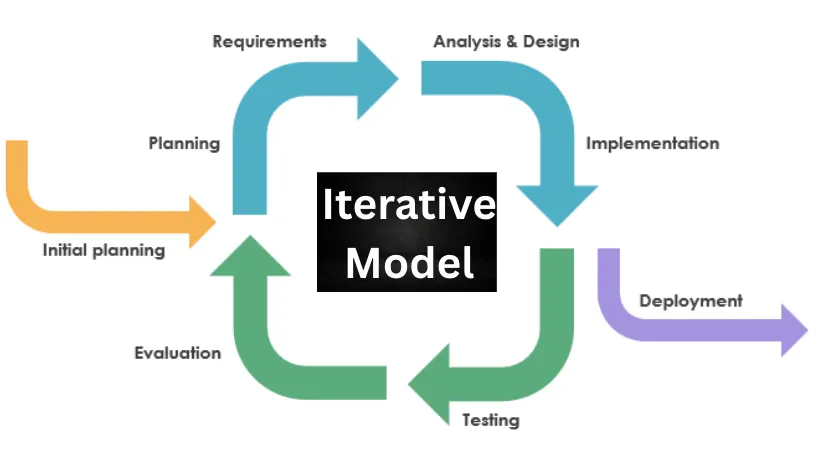
Key characteristics:
- Testing is performed after each iteration
- Defects are identified and fixed early
- Requirements can be refined based on feedback
- Progressive improvement of software quality
Best suited for:
- Large-scale projects that can be broken into smaller components
- Projects where requirements are expected to evolve
- Systems requiring frequent releases with enhanced features
4. Verification and validation methodology (V-Model)
The V-Model’s distinctive structure pairs each development phase with a corresponding testing phase, creating a V-shaped workflow. The left side represents development activities (requirements, design, coding), while the right side represents testing activities (unit testing, integration testing, system testing, acceptance testing).
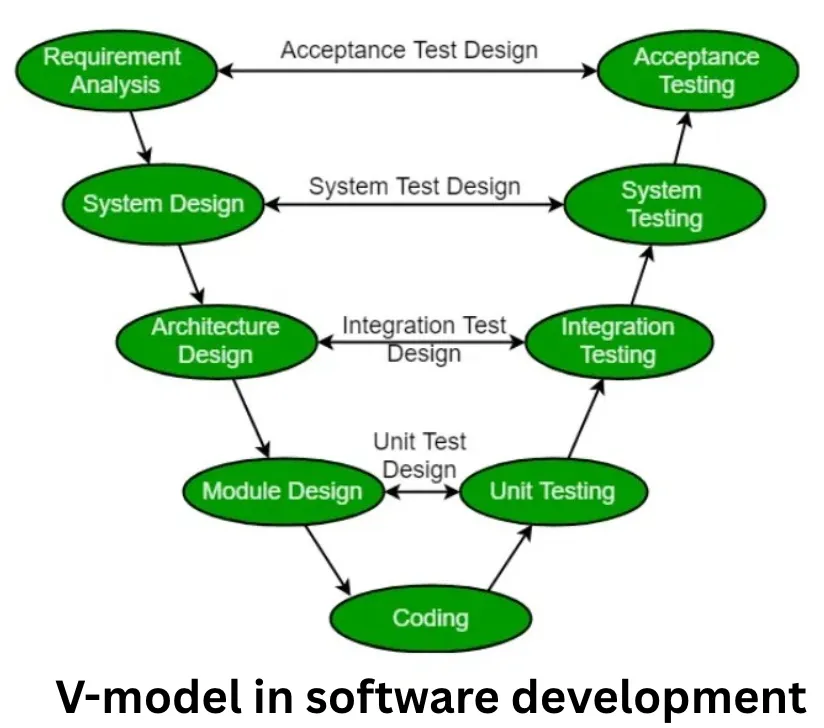
A key advantage of this methodology is that test planning begins in parallel with the corresponding development activities. For example, acceptance test planning starts during requirements gathering, system test planning during high-level design, and unit test planning during detailed design. This ensures that testing considerations influence the development process from the beginning.
The verification process on the left side includes reviews, walkthroughs, and inspections of requirements and design documents, catching potential issues before coding even begins. The validation process on the right side involves executing tests against the developed code to ensure it meets specifications.
Traceability is a cornerstone of the V-Model, with each test explicitly linked to specific requirements and design elements. This rigorous traceability ensures complete test coverage and makes it easier to assess the impact of requirement changes.
The V-Model enforces formal entry and exit criteria for each phase, preventing progression until quality gates are passed. While this ensures thoroughness, it can also introduce delays when defects are found, as the model doesn’t inherently support iterative development or easy backtracking. Modern adaptations incorporate some flexibility, allowing for overlapping phases and iterative mini-cycles within the overall structure.
Key characteristics:
- Each development phase has a corresponding testing phase
- Test planning begins with requirements specification
- Verification (static testing) and validation (dynamic testing) processes
- Formal entry and exit criteria for every phase
Best suited for:
- Small to medium-sized projects with clear requirements
- Safety-critical systems requiring thorough validation
- Projects where requirements stability is high
5. Spiral model
The Spiral model organizes development into four quadrants: planning, risk analysis, engineering, and evaluation. The system evolves through multiple spirals, with each cycle passing through these quadrants while expanding outward as the project progresses.
Risk analysis is the defining characteristic of this methodology, with each spiral beginning by identifying, analyzing, and prioritizing risks. Testing activities are then planned to address these risks, with the highest-risk elements receiving the most thorough testing. This ensures that limited testing resources target the most critical aspects of the system.
Each spiral typically produces a prototype that undergoes evaluation, with testing focused on validating risk mitigation strategies and gathering feedback for the next cycle. Early spirals may employ exploratory testing techniques to better understand the problem domain, while later spirals transition to more structured testing approaches as the system stabilizes.
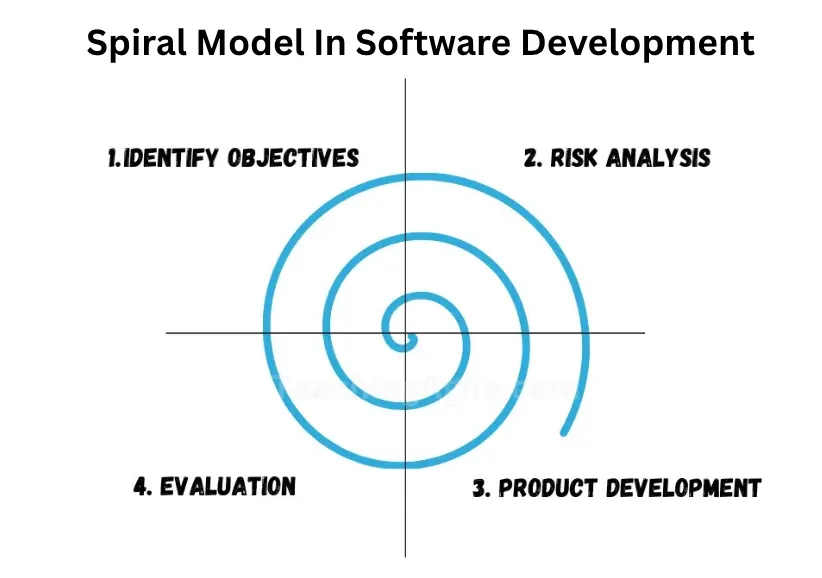
Documentation in the Spiral model is progressive, with each cycle refining and expanding test artifacts. Rather than creating comprehensive test plans upfront, test documentation evolves alongside the developing system, which prevents wasted effort on features that might change after risk assessment.
The model incorporates formal reviews at the end of each spiral, evaluating whether to proceed to the next cycle or terminate the project based on risk assessment outcomes. This go/no-go decision point makes the Spiral model particularly effective for projects with significant uncertainties or technical challenges.
Key characteristics:
- Testing is risk-driven and performed throughout development
- Multiple rounds of risk assessment and prototyping
- Go/no-go reviews at the end of each spiral
- Test techniques borrowed from other methodologies to fit each spiral’s risk profile
Best suited for:
- High-risk, mission-critical applications
- Large, complex systems requiring early identification of risks
- Projects with significant unknowns or experimental features
6. Extreme Programming (XP) model
Extreme Programming makes testing the driving force behind development rather than a subsequent activity. The test-driven development (TDD) practice at XP’s core follows a "red-green-refactor" cycle: first write a failing test (red), then implement just enough code to make it pass (green), and finally refactor the code while ensuring tests continue to pass.
This approach results in comprehensive test coverage, as every feature begins with a test. The unit test suite serves as both a verification tool and living documentation of expected system behavior. XP teams typically separate customer-facing acceptance tests (often written with business stakeholders using tools like FitNesse or Cucumber) from developer-facing unit tests.
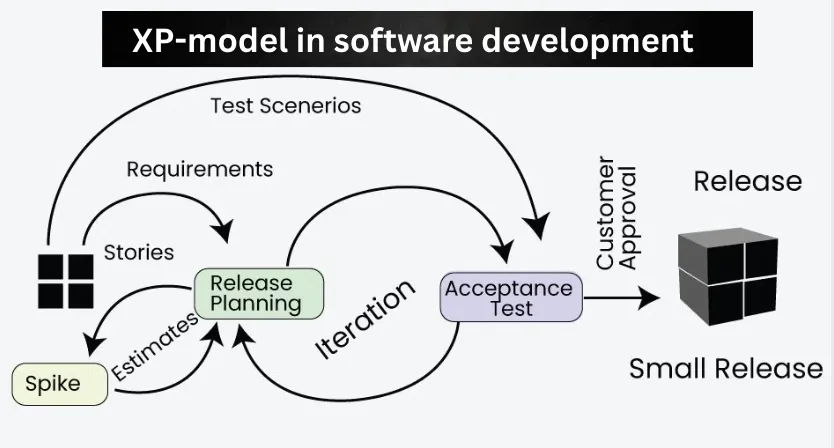
Continuous integration in XP means code is integrated and tested multiple times daily, with the entire test suite run automatically after each integration. This practice catches integration issues immediately, and many XP teams use automated build systems that reject any change that causes test failures.
Pair programming provides continuous peer review during development, catching many defects before they reach the testing phase. Pairs frequently rotate, ensuring knowledge sharing and diverse perspectives on code quality.
XP’s emphasis on simplicity, captured in "You Aren’t Gonna Need It" (YAGNI) and "Do The Simplest Thing That Could Possibly Work", extends to testing practices, focusing efforts on high-value tests rather than attempting to test every possible scenario.
The methodology embraces collective ownership, where any team member can modify any part of the codebase. This is made possible by the comprehensive test suite, which gives developers confidence that their changes don’t break existing functionality.
Key characteristics:
- Test-Driven Development (TDD) approach
- Continuous integration and testing
- Pair programming for built-in code review
- Frequent small releases with continuous feedback
Best suited for:
- Projects requiring rapid development and deployment
- Teams experienced with agile practices
- Applications where requirements change frequently
Manual vs automated software testing
Manual testing
Manual testing involves human testers executing test cases without automated tools.
Advantages:
- No initial setup costs for automation
- Effective for exploratory and usability testing
- Better suited for visual components and UI evaluation
- Valuable for one-time test scenarios
Disadvantages:
- Time-consuming for repetitive tests
- Prone to human error
- Limited coverage in regression testing
- Not scalable for large applications
Automated testing
Automated testing is the process of using specialized software tools and scripts to execute tests, compare actual and expected results, and report outcomes. Instead of manually performing test steps, automated testing runs tests with minimal human intervention, allowing for rapid, repeatable validation of software functionality.
Advantages:
- Faster execution of repetitive test cases
- Consistent results with less human error
- Higher test coverage and depth
- Reusable test scripts reducing long-term costs
- Enables continuous testing in CI/CD pipelines
- Allows parallel test execution across multiple environments
Disadvantages:
- High initial investment in tools and script development
- Requires programming expertise
- Not suitable for all testing types (e.g., exploratory testing)
- Maintenance overhead as the application evolves
- Potential for false positives or negatives without proper test design
- Can be complex to implement for dynamic UI elements
Keploy’s approach to automated testing
The biggest cost in automated testing is creating and maintaining test cases. Traditional automation requires substantial upfront investment in writing scripts that simulate user behavior and validate system responses. Keploy takes a different approach:
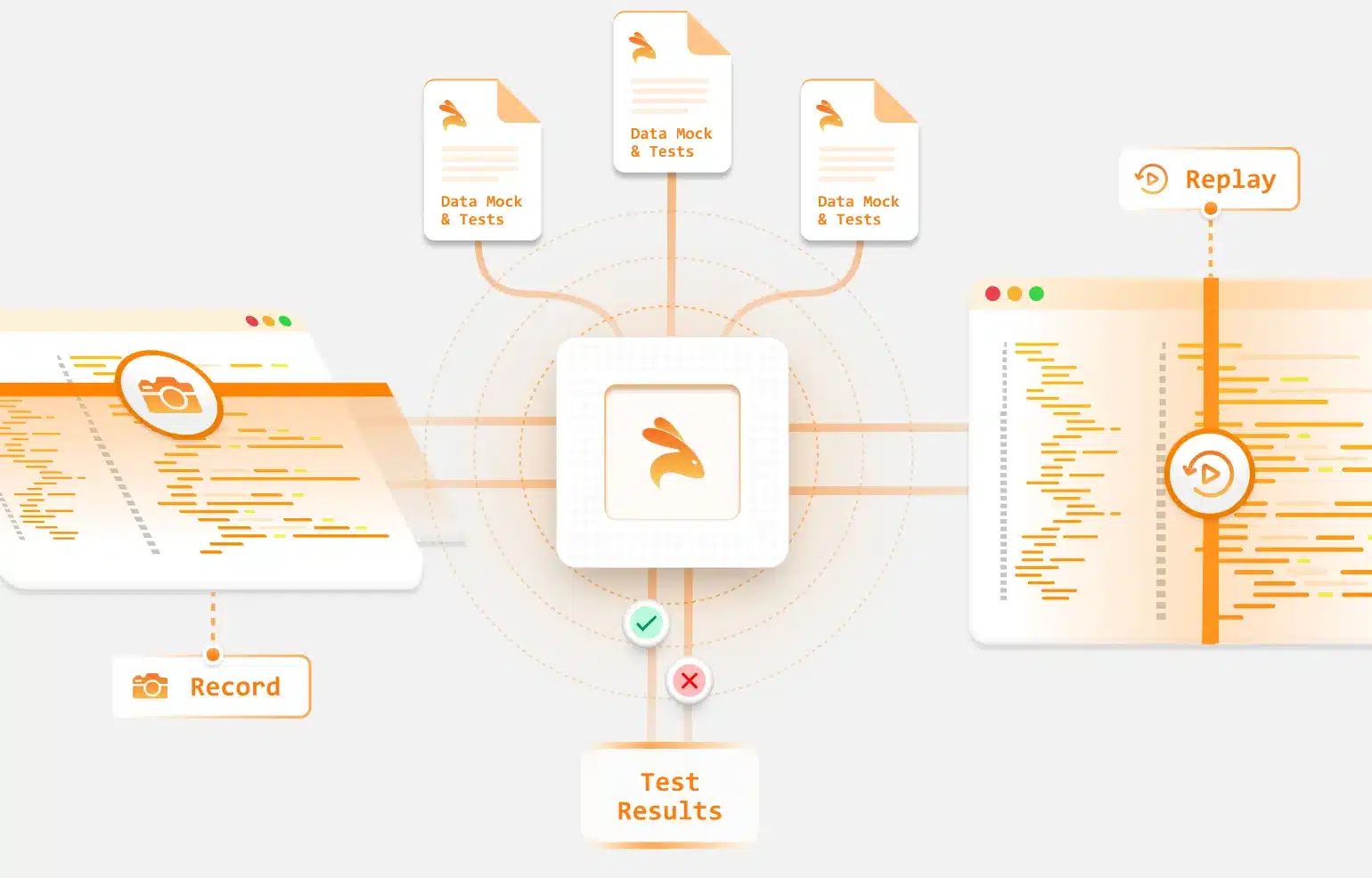
- Zero-code test generation: Keploy’s api test case generator records actual API interactions and turns them into executable tests, so tests reflect real-world usage patterns without manual scripting.
- Low-maintenance tests: When an API changes, tests can be re-recorded from new traffic instead of rewritten by hand, which cuts the maintenance burden that usually slows automation down.
- Realistic test data: By capturing and replaying real data flows, Keploy removes the need to build artificial test datasets and catches issues that only appear with specific data combinations. This makes it one of the more practical test data management tools for API-heavy teams.
- Automatic dependency mocks: Keploy records calls to databases and downstream services and replays them as mocks, so you get realistic test environments without hand-written mock configuration.
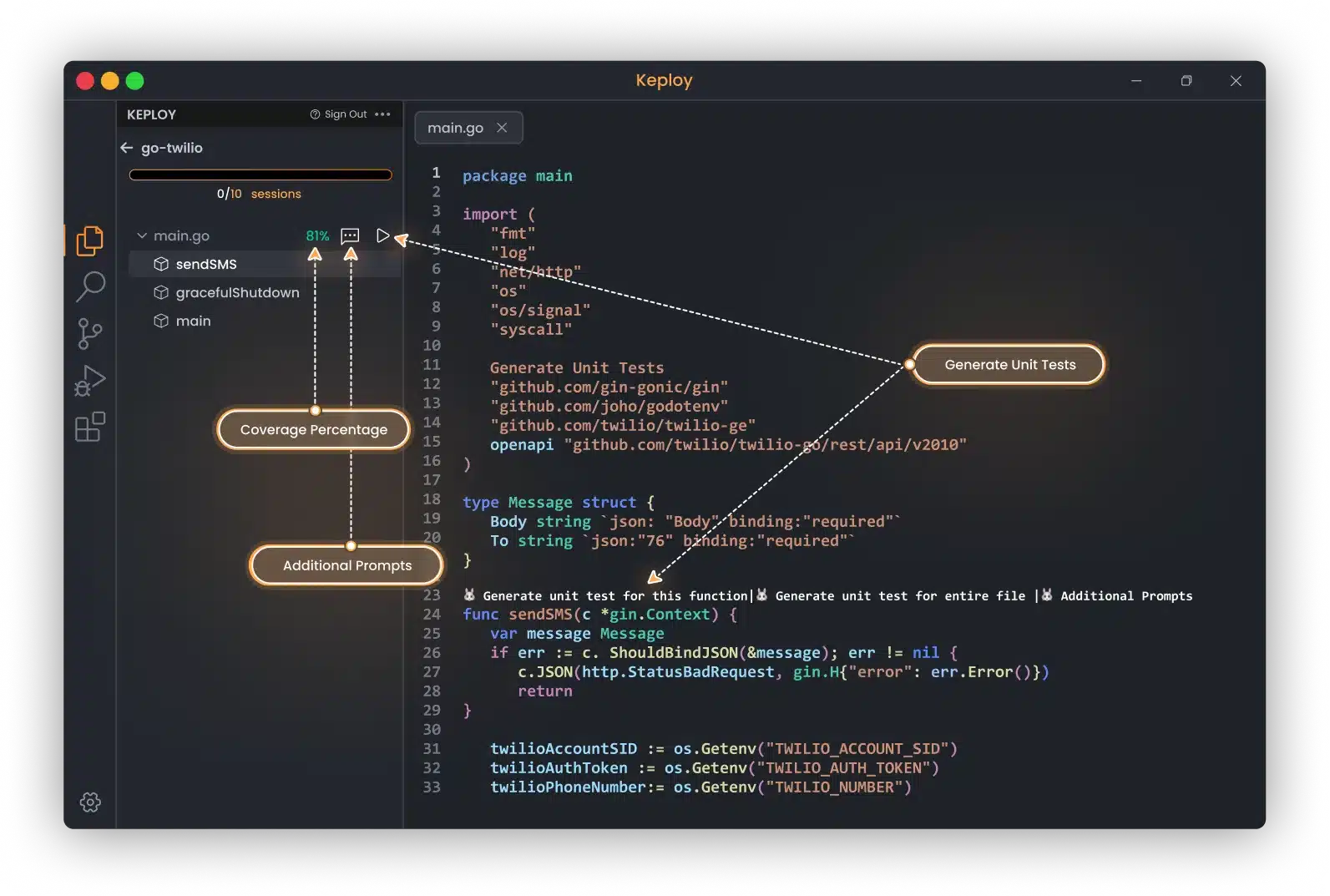
- Simple CI/CD integration: Keploy tests plug into existing CI/CD pipelines and run consistently from developer machines to CI servers.
- Clear test reports: When a test fails, Keploy shows the exact difference between the expected and actual response, which makes failures easier to diagnose.
- Coverage reporting: Keploy reports coverage for recorded tests, helping teams see which paths are still untested and focus on the most critical user journeys.
This approach is particularly valuable for microservices architectures and rapidly evolving APIs, where traditional automation struggles to keep pace with change.
DevOps approach and continuous testing
DevOps integrates development and operations teams, emphasizing continuous testing throughout the software delivery pipeline.
Key characteristics:
- Automated testing integrated into CI/CD pipelines
- Shift-left testing approach
- Test environment automation
- Continuous feedback and monitoring
Best practices:
- Implement test automation at multiple levels (unit, API, UI)
- Build the automation stack from open source automation tools first, choosing frameworks by testing layer before selectively adding commercial tools
- Use containerization for consistent test environments
- Adopt infrastructure as code for test environment provisioning
- Implement comprehensive monitoring and alerting
What are the types of software testing?
Functional testing methodology
Functional testing verifies that each function of the software operates according to specifications. Types include:
- Tests individual components in isolation
- Typically performed by developers
- Uses frameworks like JUnit, NUnit, or pytest
- Focuses on code correctness at the function or method level
How Keploy helps: Keploy offers AI-assisted unit test generation, and its recorded API traffic gives developers realistic request and response data to test components against, instead of hand-crafted mock data.
- Verifies interactions between integrated units
- Tests component interfaces and data flow
- May follow top-down, bottom-up, or sandwich approaches
- Identifies interface defects and component compatibility issues
How Keploy helps: Keploy records and replays API interactions between services and mocks their dependencies, so teams can test service integrations without maintaining complex test environments.
System testing
- Evaluates the complete, integrated system
- Verifies compliance with functional requirements
- Tests end-to-end workflows and scenarios
- Uncovers system-level defects
How Keploy helps: Keploy captures complete request flows in staging or production and converts them into executable tests that validate the full application stack with minimal maintenance.
Acceptance testing
- Validates the system meets business requirements
- Often performed by end users or clients
- May include alpha and beta testing phases
- Confirms software readiness for production deployment
How Keploy helps: Because Keploy’s tests come from real user behavior and are stored in readable YAML, stakeholders can review captured workflows as acceptance criteria based on real interactions rather than theoretical use cases.
Non-functional testing methodology
Non-functional testing evaluates aspects of software beyond functional correctness. Types include:
- Evaluates system behavior under various load conditions
- Measures response times, throughput, and resource utilization
- Identifies performance bottlenecks
- Types include load, stress, endurance, and spike testing
Security testing
- Identifies vulnerabilities in the application
- Tests for common security flaws (e.g., OWASP Top 10)
- Includes penetration testing and security code reviews
- Ensures protection of sensitive data
Usability testing
- Evaluates ease of use and user experience
- Focuses on UI/UX design effectiveness
- Often involves real users performing typical tasks
- Provides insights for improving user satisfaction
Compatibility testing
- Verifies software works across different environments
- Tests across browsers, devices, and operating systems
- Ensures consistent functionality and appearance
- Identifies environment-specific issues
Importance of software testing methodologies
Implementing appropriate software testing methodologies offers several critical benefits:
- Quality assurance: Methodical testing ensures software meets quality standards before release
- Cost efficiency: Early defect detection significantly reduces the cost of fixes
- Risk mitigation: Systematic testing identifies potential risks before they impact users
- Customer satisfaction: Well-tested software leads to better user experiences and fewer production issues
- Process improvement: Testing methodologies provide insights for continuous improvement
- Compliance: Structured testing helps meet regulatory and industry standards
- Competitive advantage: Higher quality software differentiates products in the marketplace
How Keploy fits modern testing methodologies
Keploy is an open-source API testing platform, and its traffic-based approach maps onto the methodologies above in different ways:
- Agile and DevOps: Tests are generated from actual usage, so coverage grows alongside the application within each sprint and runs in every pipeline.
- Microservices: Dependency mocks let teams test individual services in isolation while keeping confidence in how they integrate.
- TDD and XP: Keploy complements hand-written tests by adding tests based on real usage, covering edge cases that manually created tests might miss.
- BDD: Given-When-Then scenarios define the behavior teams intend to build, while Keploy protects existing behavior from regressions without extra scenarios to maintain.
Conclusion
Selecting the right testing methodology is essential for delivering high-quality software that meets business and user requirements. Each methodology offers distinct advantages suited to different project types, team structures, and organizational goals, and the most successful strategies often blend elements from several of them. A balanced approach that combines early testing, automation, and continuous feedback lets teams improve software quality while reducing time-to-market and development costs.
FAQs
What is the most widely used software testing methodology?
Agile testing methodologies have become the most widely adopted approach in modern software development due to their flexibility and focus on continuous improvement. Within the Agile framework, practices like CI/CD and DevOps further enhance the testing process.
How do I choose the right testing methodology for my project?
Consider factors like project size, complexity, requirements stability, team expertise, timeline constraints, and available resources. Stable, well-documented requirements suit Waterfall or V-Model, while changing requirements suit Agile, Iterative, or XP.
Can multiple testing methodologies be used within the same project?
Yes, many organizations implement hybrid approaches that combine elements from different methodologies. For example, using V-Model for critical components while following Agile practices for user-facing features.
How does AI impact software testing methodologies?
AI is transforming testing methodologies by enabling intelligent test generation, predictive analytics for test prioritization, visual testing automation, and anomaly detection. These capabilities are being integrated into existing methodologies to enhance efficiency and coverage.
What role does test automation play in modern testing methodologies?
Test automation is increasingly central to most testing methodologies, especially in Agile and DevOps environments. It enables continuous testing, faster feedback cycles, and more comprehensive test coverage while allowing testing teams to focus on complex, exploratory testing activities.
How do testing methodologies differ for cloud-native applications?
Cloud-native applications require testing methodologies that address distributed architectures, containerization, microservices, and dynamic scaling. Testing approaches must incorporate service virtualization, infrastructure as code testing, and chaos engineering principles.

Leave a Reply