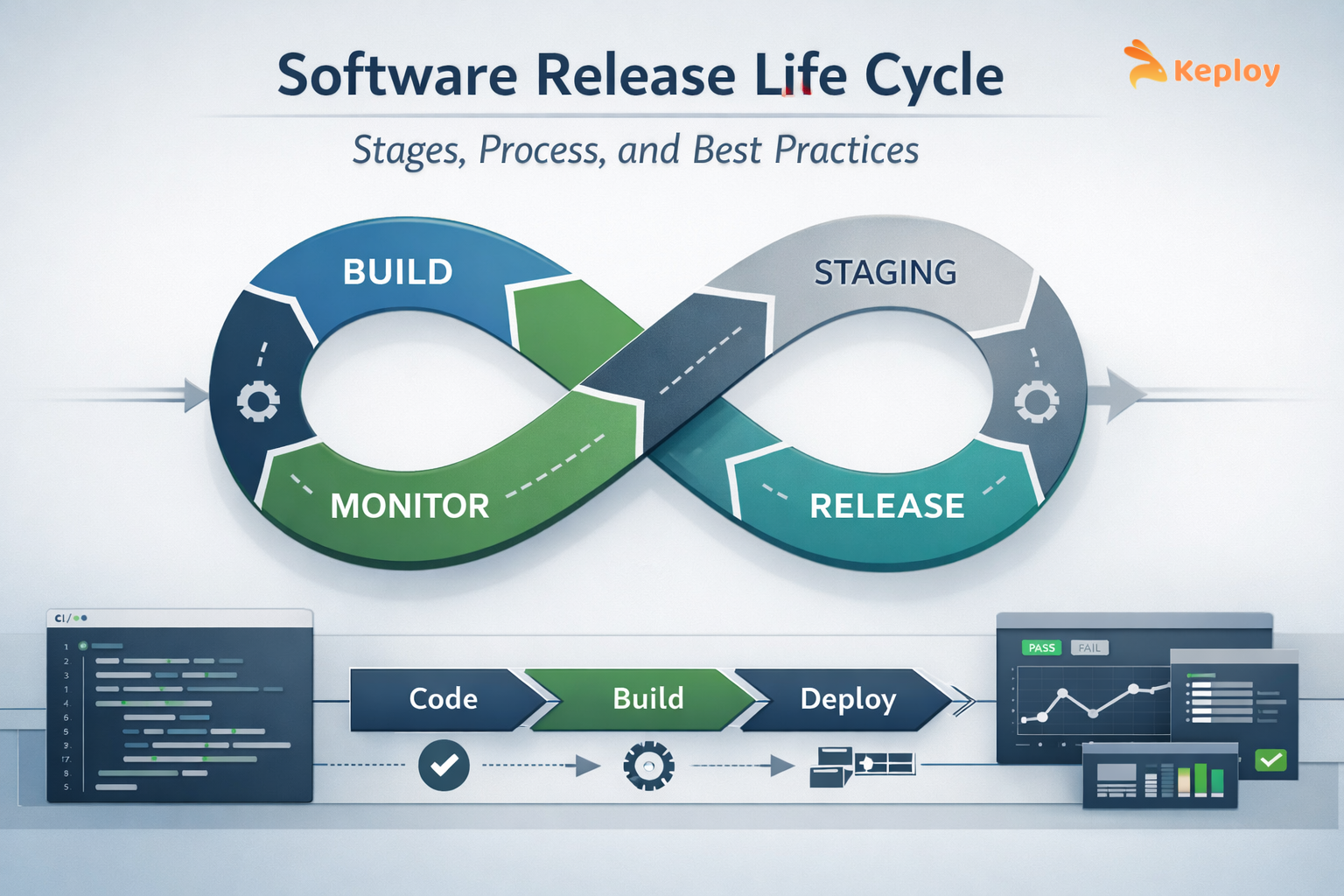
Software release life cycle is the sequence of stages software moves through from development to production: pre-alpha, alpha, beta, release candidate, and general availability. Unlike the SDLC, the SRLC focuses on how software is validated and delivered safely. One distinction modern teams rely on: deployment and release aren’t the same – code can sit in production behind a feature flag before users ever see it.
The software release life cycle (SRLC) is where most engineering failures begin. Not because of bad code, but because of a broken release process. In modern environments, applications run across APIs, microservices, and cloud infrastructure, where even small changes can ripple far. A well-defined release cycle – with clear stages, automated validation checkpoints, and rollback strategies is what gets code to users without surprises.
Traditional testing validates components in isolation. Real issues show up when systems interact under production conditions. That gap is what makes release management central to software quality.
What Is a Software Release Life Cycle?
The software release life cycle refers to the sequence of stages a software product goes through from development completion to production release and beyond. It focuses on how software is packaged, tested, and delivered to users.
It is closely related to the software development lifecycle, but with a more focused scope. While SDLC covers the entire process of building software, the release life cycle is specifically about how that software is prepared and delivered safely.
In simple terms, it answers a key question:
How do we move code to users without breaking the system?
In practice, teams don’t struggle with defining the release life cycle – they struggle with making it reliable under real-world conditions.
How the Software Release Process Works
In real systems, the software release process is a coordinated workflow rather than a single step. It involves development, testing, validation, and approval before anything reaches production.
A typical flow looks like this:
-
Code is developed and merged
-
Builds are generated and validated
-
Tests are executed across environments
-
Release candidates are created
-
Final approval is given before release
In real systems, these steps are not always sequential. Multiple stages run in parallel, and failures at any point can trigger retries, rollbacks, or pipeline restarts.
On paper, this process looks straightforward. In practice, this is where most failures originate. Misconfigured environments, incomplete test coverage, or unexpected dependency behavior can break the release pipeline.
This is why teams invest heavily in automation and validation. CI/CD pipelines help speed up the process, but they also require stronger checks to ensure reliability at every step.
Key Stages of the Software Release Life Cycle
The software release life cycle phases define how software evolves before it reaches users. Each stage exists to reduce risk, improve stability, and validate behavior under different conditions.
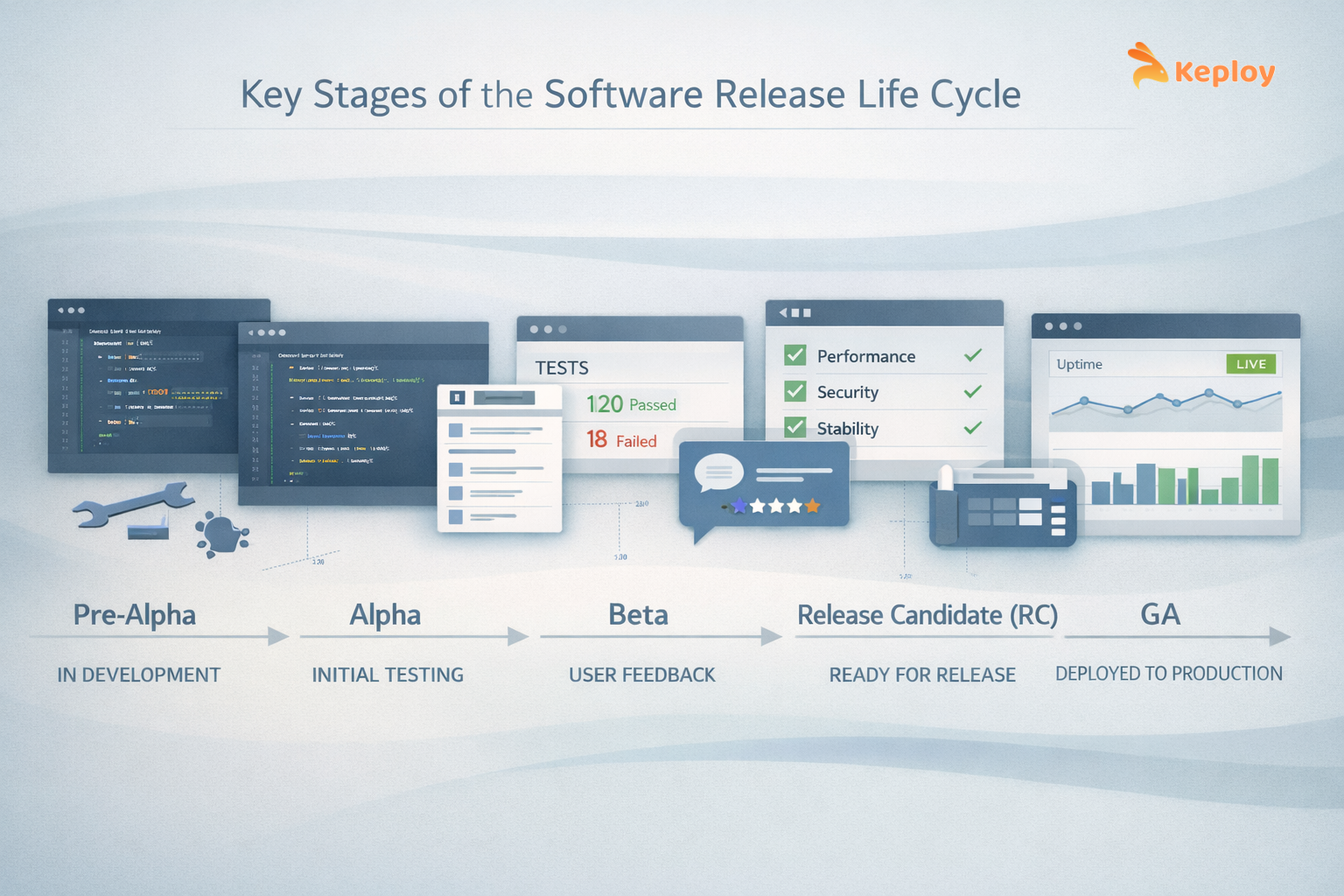
While modern systems may compress or automate these stages, the underlying intent of each stage still matters.
1. Pre-Alpha
Early development. Features are incomplete, testing is mostly internal, and the focus is on building core functionality. Teams iterate fast without worrying much about stability.
2. Alpha Release
During the alpha release stage, the product gets tested internally in a more structured way. The goal is catching major bugs, validating core workflows, and confirming the system behaves as expected in a controlled environment.
At this stage, the software is still not ready for external users, but it becomes stable enough for deeper testing.
3. Beta Release
In the beta testing stage, the software is released to a limited group of external users. This is where real-world usage begins to expose issues that internal testing might miss.
Teams focus on usability feedback, edge cases, and performance under real conditions. It’s the first real signal of how the system behaves outside a controlled setup.
4. Release Candidate (RC)
The product is feature-complete. The focus shifts from building to stabilizing — finding and fixing the last critical issues before production. If nothing serious turns up, the RC becomes the final release.
5. General Availability (GA)
The software reaches all users. From here, the work is reliability, performance, and monitoring. Teams keep watching system behavior and respond quickly to anything unexpected.
In modern CI/CD-driven systems, these stages often run in parallel or get compressed. Skipping their intent, though, tends to produce unstable releases.
Common Software Release Types
Not all releases serve the same purpose. In practice, teams choose different software release types based on the nature of the change, system criticality, and how urgently the update needs to go live.
Understanding these release types helps teams avoid unnecessary risk while maintaining delivery speed. There are four main types:
1. Major releases
These introduce significant changes, such as new features, architecture updates, or breaking changes. They usually require more extensive testing and coordination because they can impact multiple parts of the system.
2. Minor releases
These focus on incremental improvements, such as small features or enhancements. They are more frequent and carry lower risk compared to major releases, making them easier to roll out.
3. Patch releases
Patch releases are used to fix bugs, security vulnerabilities, or minor issues without introducing new functionality. They are typically lightweight and fast to deploy.
4. Hotfix releases
These are urgent fixes applied directly to production to resolve critical issues. Unlike other releases, hotfixes often bypass parts of the standard pipeline to restore system stability quickly.
In real-world systems, the challenge is not defining these release types but using them correctly. For example, treating a high-impact change as a minor release can introduce unexpected failures, while overusing major releases can slow down delivery.
This is why teams align release types with deployment frequency, system risk, and business impact rather than following a fixed pattern.
Benefits of a Structured Release Management Cycle
Without a structured software release cycle, teams often deal with unpredictable releases, last-minute failures, and difficult rollbacks. As systems grow, these issues don’t just slow teams down – they directly affect user experience and system reliability.
A well-defined release process brings clarity and control at every stage.
Some key benefits include:
1. Improved predictability
When releases follow a consistent process, teams know what to expect at each stage. Issues are identified during staging or validation phases instead of surfacing after deployment, which reduces unexpected failures in production.
Teams that want to measure whether these improvements are compounding over time track them using DORA metrics – specifically Change Failure Rate and Lead Time for Changes, which respond most directly to release process maturity.
2. Better quality control
Structured checkpoints ensure that only stable builds move forward. Automated tests, smoke checks, and validation steps act as filters, preventing unstable changes from reaching users.
3. Reduced risk
Early exposure to real-world conditions helps uncover edge cases that internal testing often misses. By the time software reaches production, most critical issues are already identified and addressed.
4. Faster recovery
When something breaks, a defined release structure makes recovery straightforward. Versioned releases and rollback strategies allow teams to quickly revert to a stable state without prolonged downtime.
In practice, these benefits go beyond process improvement. They directly influence how stable and reliable a system feels in production. As release frequency increases, having this structure becomes essential rather than optional.
Software Release vs Software Deployment
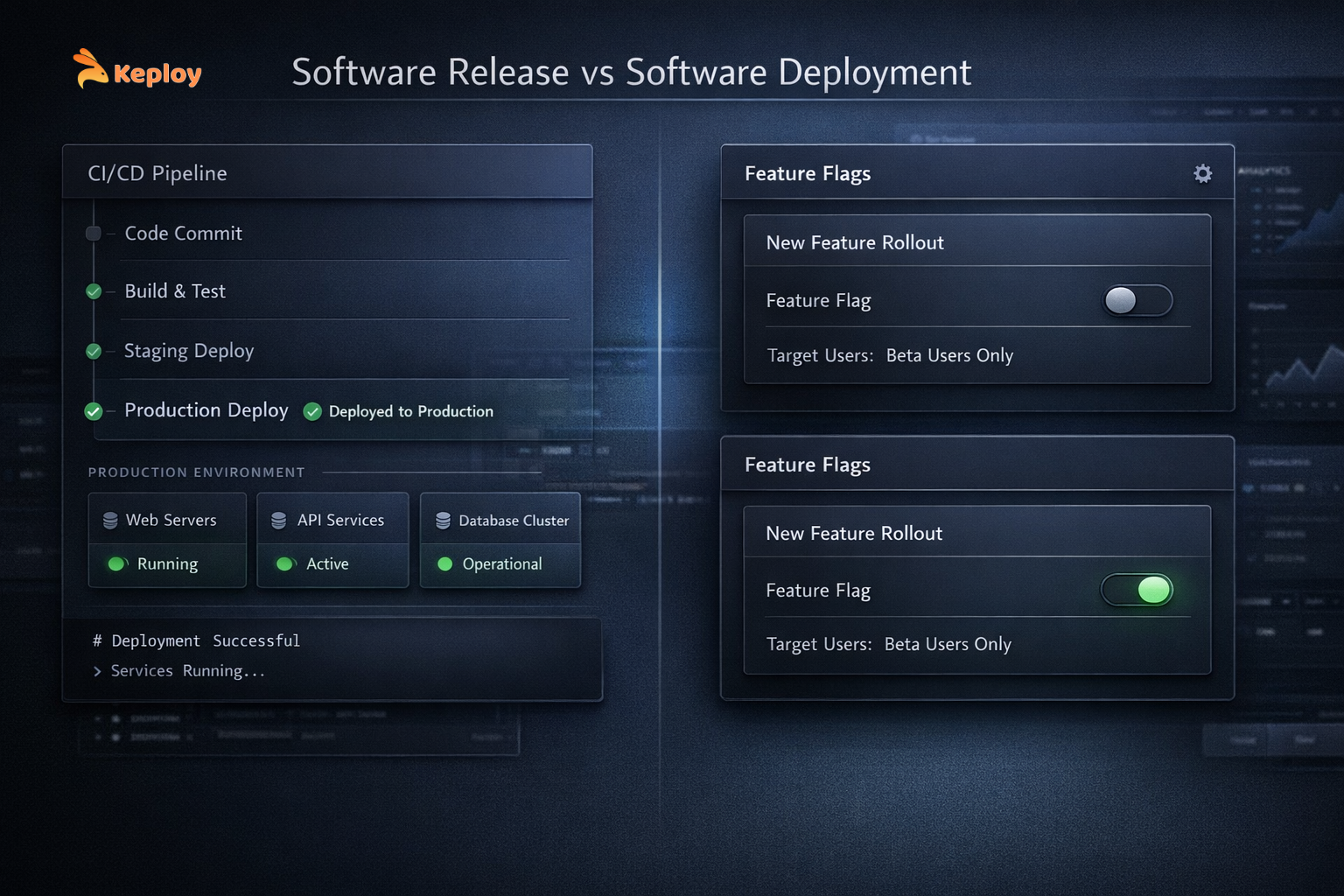
This is a common source of confusion in many teams. Here’s a clear breakdown:
| Aspect | Release | Deployment |
|---|---|---|
| Focus | Readiness and user access decision | Technical execution of moving code |
| Timing | When users can access the feature | When code is pushed to production servers |
| Example | Enabling a feature flag for all users | Deploying code to production with flag off |
| Key Distinction | Controls what users see | Controls where the code lives |
In simple terms: Release = readiness and decision. Deployment = execution.
Consider a real-world scenario: A team deploys new code to production that includes a new payment feature. The code is live on the servers, but the feature is hidden behind a feature flag.
At this point, deployment has already happened, but the release has not. Users cannot access the feature yet.
Later, once the team verifies stability and performance, they enable the feature flag. This is when the actual release happens – users can now use the feature.
This distinction becomes important in modern systems where teams deploy frequently, but control releases more carefully to reduce risk.
Software Release Life Cycle in Modern Systems
Traditional release models were linear and infrequent. Modern systems have completely changed this approach.
Today’s systems rely on:
-
CI/CD pipelines
-
microservices architectures
-
API-based communication
This makes the software release life cycle continuous rather than sequential. Companies that deploy changes frequently, sometimes multiple times a day, instead of large releases, they focus on smaller, incremental updates.
However, this speed introduces new risks. A small change in one service can break downstream systems if dependencies are not properly validated. This makes release validation more critical than ever. This shift makes release strategy a core engineering concern, not just an operational step.
Challenges in the SRLC
As systems grow, release management gets harder. What works for small applications tends to break in distributed, API-driven environments where multiple components evolve independently.
Some common challenges teams face include:
-
Coordination across teams: In microservices architectures, different teams own different services. A change in one service can impact others, making release coordination difficult. Without proper versioning and communication, this often leads to unexpected failures during or after release.
-
Testing bottlenecks: As systems scale, test suites become larger and slower. Delays in validation can block release pipelines, forcing teams to choose between speed and confidence. This is where incomplete testing often slips through.
-
Environment inconsistencies: Differences between staging and production environments are a frequent source of issues. A release that works perfectly in staging can fail in production due to configuration mismatches, data differences, or external dependencies.
-
Limited real-world validation: Most tests rely on predefined scenarios, which rarely capture how systems behave under real user traffic. As a result, edge cases and integration issues often surface only after release.
Real incidents show what’s at stake:
-
The 2017 AWS outage started with a single maintenance command that took down a large portion of the internet.
-
The 2021 Facebook outage came from a configuration change that broke internal service communication. Both show how small release or deployment issues cam cascade into large-scale failures.
Fixing this requires more than adding tests. Teams increasingly focus on the quality of validation, not just volume. That means clear versioning and dependency contracts between services, test pipelines tuned for both speed and coverage, production-like environments wherever possible, and validation against real or realistic traffic patterns.
In practice, this shift is supported by tools like Keploy, which record actual API calls and replay them as test cases. This allows teams to validate releases against real-world behavior, reducing the gap between testing and production without adding manual effort.
Best Practices for Effective Release Management
From what I’ve seen across teams, effective release management is less about adding more steps and more about making existing steps reliable under real-world conditions.
As systems scale, small gaps in the process can quickly turn into production issues. That’s why teams focus on practices that improve both speed and confidence. As your release management lifecycle scales, these practices become essential:
1. Automate the release pipeline
Manual steps in the release process often introduce inconsistencies and errors. Automating build, test, and deployment workflows ensures that every release follows the same validated path, reducing the chances of unexpected failures.
2. Test early and continuously
Instead of relying only on final-stage validation, teams integrate testing throughout the development cycle. This helps catch issues when they are easier to fix, rather than discovering them during release or after deployment.
3. Use smaller, frequent releases
Large releases increase risk because they bundle multiple changes together. Smaller releases make it easier to isolate issues, reduce rollback impact, and improve overall system stability.
4. Monitor releases in real time
Even after a release goes live, validation does not stop. Monitoring metrics, logs, and user behavior helps teams quickly detect anomalies and respond before they escalate into major incidents.
5. Maintain rollback strategies
No release process is perfect. Having a clear rollback plan ensures that teams can quickly revert to a stable version if something goes wrong, minimizing downtime and user impact.
In practice, these best practices are not independent steps. They work together to create a release system that is both fast and reliable, which is critical in modern, continuously evolving environments.
Software Release Cycle Diagram
A typical SRLC diagram represents the flow of software from development to production, including stages like development, testing, staging, release, and monitoring.
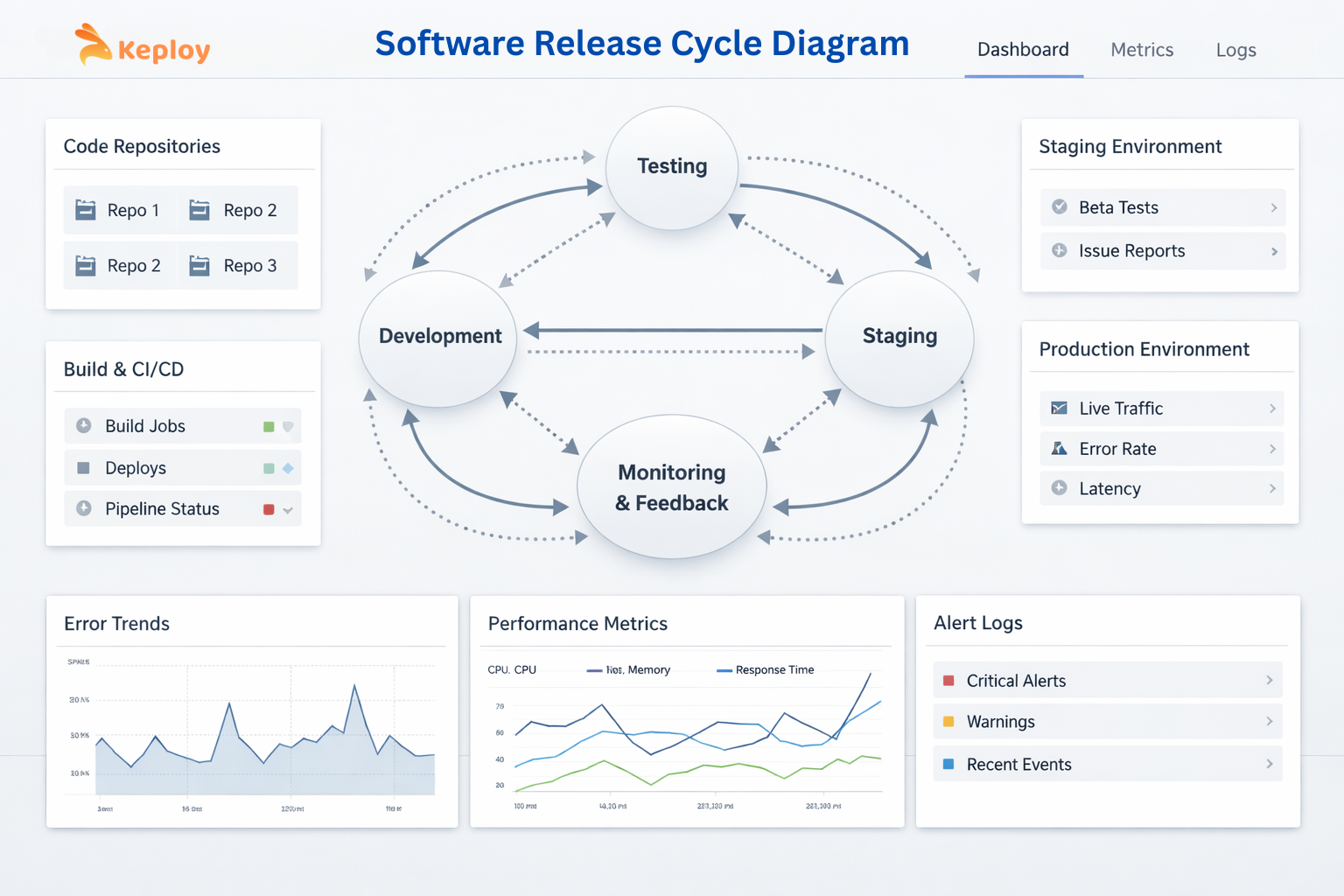
These diagrams are useful for understanding the overall process, especially for aligning teams on how releases move across environments.
However, in real systems, this flow is rarely linear.
For example, issues detected during monitoring often feed directly back into development or testing. A production incident might trigger immediate fixes, new test cases, and even changes in the release process itself. Similarly, feedback from staging or beta environments can push teams to revisit earlier stages before moving forward.
Because of this, the release cycle behaves more like a continuous loop than a straight pipeline.
Understanding this dynamic nature is important. Teams that build feedback loops into their process adapt faster and handle real-world complexity more effectively.
Conclusion
The software release life cycle determines how reliably software reaches users. As architectures get more distributed and release frequency increases, small gaps in that system compound into significant failures.
High-performing teams aren’t just fast at shipping – they know what they’re shipping and have validated it against real conditions. Tighter feedback loops, real-world test data, closing the distance between test environments and production: that’s what actually makes continuous delivery reliable, rather than just fast.
FAQs
1. What is the difference between software release life cycle and SDLC?
The SRLC focuses on delivering software. SDLC covers the entire development process from requirements through maintenance.
2. What are the main software release stages?
Pre-alpha, alpha, beta, release candidate, and general availability.
3. How do frequent releases impact software quality?
Done well, they reduce risk per change and improve speed. Without strong validation, they increase the chances of production failures.
4. Can software releases happen without deployment?
Yes. Feature flags let teams deploy code to production without exposing it to users until they’re ready.
5. What is the biggest challenge in the software release life cycle?
Real-world validation. Many issues only appear under actual user traffic and system interactions, which are hard to fully reproduce in test environments.

Leave a Reply